

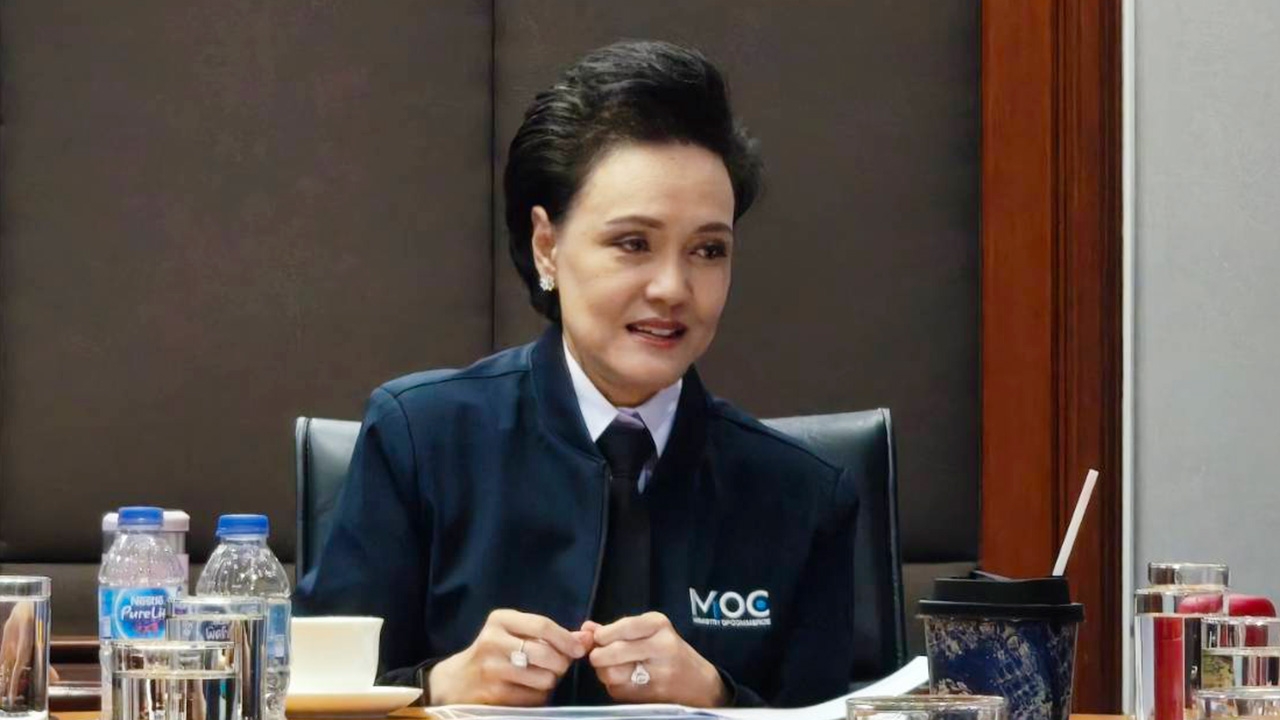
"Supachai" laid out four strategies to counter U.S. tariffs, accelerating the ART agreement deal, promoting forced labor legislation, and clarifying excess capacity issues. She emphasized that the Prime Minister has fully approved negotiations but insists on not crossing national interest red lines.
Ms. Supachai Suthumpun, Deputy Prime Minister and Minister of Commerce, revealed that the government is fully prepared to handle U.S. tariff measures on all fronts. The primary goal is to expedite the Agreement of Reciprocal Trade (ART) negotiations to achieve the best mutual benefits, since this agreement will determine whether Thailand receives the previously agreed 19% tariff rate or faces a rate close to 36%, as initially announced by the U.S.
Ms. Supachai stated that back in April 2025, the U.S. ranked countries by trade surplus, placing Thailand at 11th. Using the International Emergency Economic Powers Act (IEEPA), the U.S. imposed a 36% tariff on Thailand. This led the then-cabinet to negotiate, resulting in the agreed 19% tariff on 7 August, contingent on concluding ART talks and negotiating product lists under Annex III.
However, due to a change of government and a caretaker cabinet with only about four months in office, ART negotiations did not advance in detail with relevant ministries. Then, in February, the U.S. Supreme Court ruled that tariff measures under IEEPA used by the President were unlawful and ordered their termination. The U.S. switched to using Section 122, imposing a temporary 10% tariff on all countries, effective for only 150 days until 23 July 2026.
When Section 122 expired, the U.S. shifted to Section 301, which differs from IEEPA by requiring stakeholder consultations, including businesses and affected countries, before the USTR submits findings to the President and Congress. Thailand is under investigation mainly for forced labor issues and excess production capacity, while intellectual property matters are not being pursued further.

Ms. Supachai said that regarding forced labor, Thailand was investigated alongside 60 countries, with results announced on 24 July. Thailand faces a 12.5% tariff rate, placing it among 46 countries at this rate, whereas 14 countries, mostly with ART agreements, received a lower 10% rate. Thailand already has domestic laws addressing forced labor enforcement.
What remains lacking is a law banning imports produced with forced labor, currently under rapid development within the Ministry of Justice as comprehensive human rights due diligence (HRDD), with the Ministry of Labor as secretary. This legislation aims to enable businesses to verify that imported goods comply with proper labor practices without forced labor domestically or abroad. The draft law will be pushed forward for parliamentary consideration.
“The 12.5% tariff related to banning imports made with forced labor is not imposed immediately because it requires stakeholder consultations, including businesses. Thus, it does not mean the USTR can enforce it fully on its own. Their role is to gather opinions from investigated countries like Thailand and others, then present to the President and Congress, who will decide the final tariff percentage,” the Deputy Prime Minister explained.
Regarding excess production capacity, the U.S. has not officially announced results. Thailand presented factual clarifications to the USTR on 15 April 2026 and again from 13-15 May, supported by statistical data showing that Thai automotive and parts, rubber and rubber products, and machinery industries operate at 75-95% capacity, exceeding the 60% threshold questioned by the U.S.
However, after discussions with the USTR, they acknowledged Thailand's data as factual, though it is uncertain how the final decision will go. Further talks with the USTR are planned before any official announcement.
The Deputy Prime Minister said that during last week's trade negotiations with the U.S., the Thai delegation met with high-level policy officials to reaffirm Thailand's commitment to reducing the trade deficit per the original agreement, and presented data on Thai private sector investments in the U.S. valued at about $19.3 billion, plus plans for nearly 20 additional investments, demonstrating Thailand’s role in creating U.S. jobs and income.
“We are not like Malaysia and Indonesia because we and the U.S. have many potential strategic partnership areas. We stress that our domestic context and laws differ. We have red lines on some issues but are flexible on others. All negotiations are based on mutually agreed conditions, including matters of security and agricultural products,” the Deputy Prime Minister said.
Regarding imports from the U.S. under the original agreement, Ms. Supachai said Thailand seeks to reduce some targets to better reflect reality, such as lowering the 80 aircraft target appropriately. Agricultural imports, previously set at $2.6 billion annually, may need to be divided into phased targets since the year is halfway through. Negotiations on fisheries and seafood products continue.
Nonetheless, the government has outlined four key next steps: accelerating legislation banning imports related to forced labor; concluding ART negotiations for the greatest mutual benefit without disadvantaging Thailand; continuing to support Thai private sector investment in the U.S.; and increasing U.S. imports according to the original framework agreed last August under the Joint Statement, affirming full protection of farmers' and national interests throughout negotiations.
“All this has been reported to the Prime Minister, who agrees and grants authority to negotiate without crossing our red lines. Some countries might concede everything to finalize negotiations and then overturn them in parliament, but here the public is very strong politically and we cannot accept that,” the Deputy Prime Minister concluded.
Read more news " Government policy " Additional