

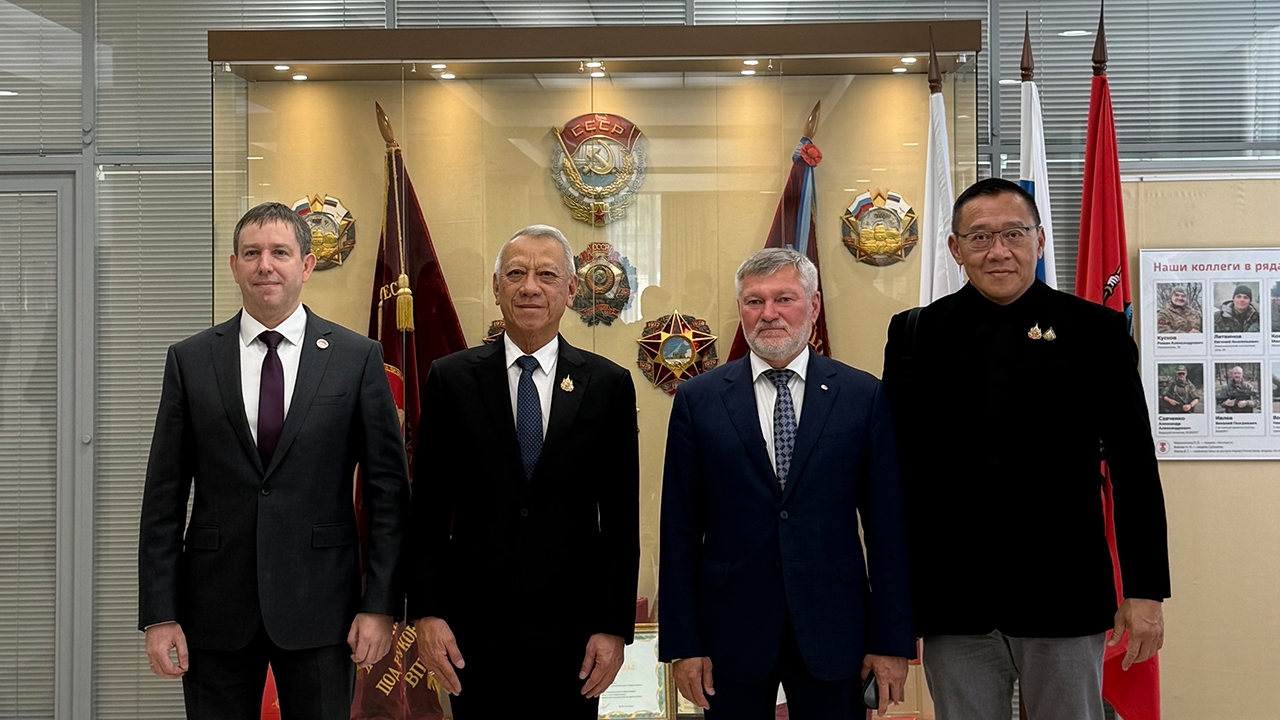
"Phiphat" leads the Ministry of Transport team to Russia to discuss with the VNIIZHT Institute to build upon the Thailand-Russia MOU, focusing on exchanging rail system technology, developing personnel and innovation, aiming to enhance safety and reduce foreign dependence.
Mr. Phiphat Ratchakitprakarn, Deputy Prime Minister and Minister of Transport, accompanied by Mr. Chayatham Promsorn, Permanent Secretary of the Ministry of Transport, Mr. Sorapong Paitoonpong, Director-General of the Department of Land Transport, Mr. Anan Phonimdaeng, Governor of the State Railway of Thailand, and other Ministry of Transport executives, met with Mr. Mikhail Mekhedov, Deputy Director of the All-Russian Scientific Research Institute of Railway Transport (VNIIZHT), and the institute's executives in Moscow, Russian Federation. They discussed exchanging knowledge, technology, and experience in rail systems and advancing cooperation under the Thailand-Russia transport MOU toward practical implementation.
Mr. Phiphat expressed gratitude to the VNIIZHT executives for their warm welcome and noted that this institute is one of Russia's renowned rail research centers, established in 1918. It has played a key role for over a century in researching and developing rail technologies nationwide, covering infrastructure development, signaling and traffic control systems, rolling stock technology, testing and certification, as well as digital technology and innovation to enhance rail system efficiency and safety.
Mr. Phiphat stated that the Thai government prioritizes rail system development as a core national infrastructure because it facilitates travel convenience and safety for citizens, reduces logistics costs, enhances freight transport capacity, and strengthens connectivity with neighboring countries and the region. Therefore, Thailand must develop infrastructure, technology, personnel, and the rail industry simultaneously.
He added that this discussion must lead to concrete joint work. Thailand seeks to learn technology, experience, and standards that Russia has long accumulated to select and adapt appropriately for the country's context. The main goal is not merely importing technology but building Thai personnel capacity to independently develop, maintain, and advance rail technology in the future. Before the meeting with VNIIZHT executives, he personally experienced Moscow's metro to study service systems from the passenger perspective, including using automatic ticket machines, Troika Card tap-in/out systems, passenger information, and interline connections and transfers.

The delegation also traveled on the Sokolnicheskaya metro line before transferring at Komsomolskaya station on the Circle Line, a major transit hub connecting with Moscow's main railway stations. They studied station space design, traffic flow management, and passenger operations in this large station. They then proceeded to Park Pobedy station, located about 84 meters underground, to study deep underground station management, including long escalator systems, ventilation, safety measures, and passenger management.
Mr. Phiphat noted that experiencing the system firsthand revealed that efficient public transport depends not only on trains or stations but also on designing the entire travel experience—from ticket purchasing, station access, line transfers, travel information to safety measures. Thailand plans to adapt these elements to ensure convenient, safe, and seamless travel for its people.
He further said that Thailand has the potential to build upon its position as a regional automotive production base, with strong engineering personnel, parts manufacturers, and supply chains, to develop the rail industry. The government and rail agencies should serve as key mechanisms to create knowledge and market demand before allowing the Thai private sector to play a greater role.
Regarding Thailand-Russia cooperation, the approach will start with personnel development, expert exchanges, joint research and development, technology and knowledge transfer, standards and testing systems development, maintenance, supply chain creation, and eventually rolling stock production or assembly in Thailand long-term to build a robust national rail industry.
Mr. Phiphat emphasized that the Ministry of Transport's ultimate goal is to select knowledge and technologies suitable for Thailand to raise rail system safety and efficiency while developing human resources, creating jobs, and enhancing Thai industry capabilities, so rail investments yield sustainable economic returns for the country and its people.
Mr. Chayatham Promsorn, Permanent Secretary of the Ministry of Transport, said this discussion advances the cooperation framework under the MOU between Thailand and Russia's transport ministries into practical actions. The Russian side is ready to share knowledge, experience, and lessons from their long railway development, especially in rolling stock management, maintenance, standards and safety oversight, as well as personnel development and research.
Mr. Chayatham noted that short-term cooperation can begin with personnel development and training. Russia has 19 universities and transport institutes, with the Russian University of Transport covering expertise from railway engineering, rolling stock, bridges, tunnels, signaling systems, digital technology, to Artificial Intelligence (AI) for transport. Thailand proposes cooperation including students, engineers, researchers, State Railway of Thailand staff, and the Rail Technology Research and Development Institute, starting with human resource development before progressing to joint research, knowledge exchange, and technology transfer suitable for Thailand.

He added a proposal for Expert-to-Expert Cooperation, allowing Thai agency experts to present real-world problems to Russian experts online across fields, enabling ongoing collaboration without waiting for ministerial meetings. One interesting technology is a system analyzing and forecasting external impacts on railway infrastructure by integrating weather, temperature, humidity, and hydrological data to assess risk areas or stations. This system can alert when parameters approach critical levels, identify risk zones, notify responsible parties, and link to operational procedures—from structure inspections and speed restrictions to possible train suspensions for safety.
Mr. Chayatham said this technology has potential for joint study with the State Railway of Thailand and Thai research agencies to tailor it to the national context, especially for coping with heavy rain and flooding risks. Linking weather data with infrastructure information would enable agencies to quickly recognize risks, provide timely warnings, and make safer operational decisions.
VNIIZHT also has strengths in research, setting technical specifications, product testing and certification, and developing rail standards, particularly in testing rolling stock and high-speed rail technologies, including a brake testing platform supporting speeds over 400 kilometers per hour. This knowledge is crucial for Thailand to study to develop national standards, testing, and certification of rail technologies in the future.
Mr. Chayatham stated that the Ministry of Transport will coordinate with relevant agencies, especially the State Railway of Thailand and the Rail Technology Research and Development Institute, to define clear cooperation frameworks in each area and push this discussion's results into actionable plans. This will lay a vital foundation to modernize, secure, and enhance the competitiveness of Thailand's rail system in the long term.
/ State Policy /