

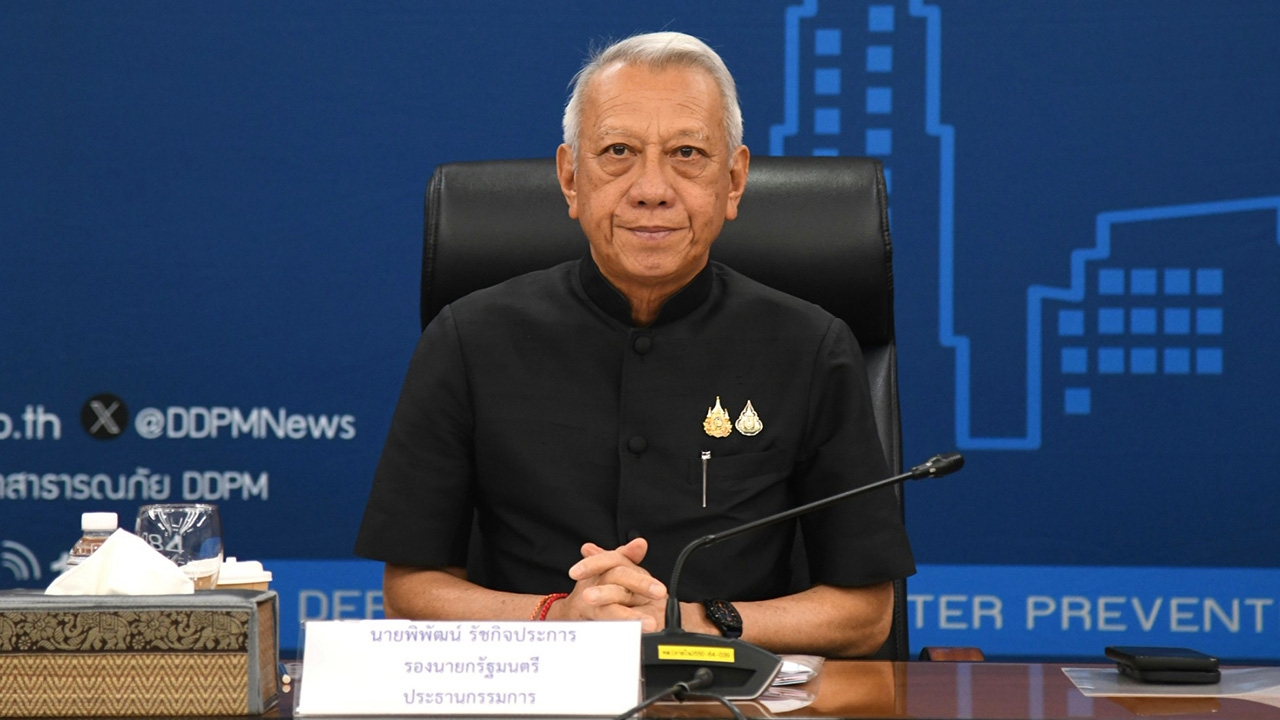
"Phiphat" held the first meeting of the Southern Flood and Drought Response Committee, ordering all agencies to integrate efforts in disaster preparedness. He highlighted the caregiver home model and stressed that helping vulnerable groups must be the top priority.
Mr. Phiphat Ratchakitprakarn, Deputy Prime Minister and Minister of Transport, in his role as chairman of the committee to prevent and solve flood and drought problems in the southern region, chaired the first meeting of the committee for 2026 at the Department of Disaster Prevention and Mitigation (DDPM). The meeting was attended by Mr. Warasit Liangprasit, Deputy Minister of Interior, along with representatives from related agencies and governors from southern provinces for consultation.

Mr. Phiphat said that Prime Minister Anutin Charnvirakul prioritizes disaster preparedness, both for seasonal hazards and climate variability impacts. Therefore, he ordered the establishment of five regional flood and drought prevention and resolution committees covering the North, Northeast, Central, East, and South regions. This aims to enhance unified disaster management, reduce overlap, and enable rapid and efficient response to situations.
The South has a unique climate because the Andaman coast and Gulf of Thailand coast have different rainy seasons, while the risks of floods and water shortages vary by area. Management must be based on 'location - timing - type of hazard,' with comprehensive preparation before, during, and after events, including relief, rehabilitation, and recovery, which are the main responsibilities assigned to the committee.

According to meeting data forecasting weather conditions, drought-prone areas in Prachuap Khiri Khan and Chumphon provinces must be closely monitored during August-September before rainfall increases in late October. Flood monitoring will be heightened from November to January, especially from Surat Thani province southward. From February 2027 onward, management of water reserves must be prepared to face the dry season.
Dividing management by these time periods aims to help each province prepare measures suited to their risk profile; it does not mean all southern areas will experience floods and drought simultaneously.
Regarding preparedness, the DDPM reported readiness of personnel, machinery, rescue equipment, as well as public warning systems via SMS and Cell Broadcast, and preparations for shelters for residents in vulnerable areas.

Additionally, data integration from water agencies, meteorology, and technology through a War Room enables real-time forecasting and situation assessment, linking information between central and local levels. This allows early warning and rapid deployment of assistance when risk signals arise.
The National Water Resources Office reported on water management strategies, emphasizing monitoring of heavy rains late in the year that could cause flash floods and runoff, alongside balancing water discharge and storage to prepare for the 2027 dry season.
Meanwhile, Songkhla and Yala provinces reported readiness measures including waterway improvements, shelters, evacuation points, and safe vehicle areas to handle situations and reduce impact on residents.
Mr. Phiphat instructed provincial disaster prevention and mitigation offices to be the main operational mechanism and ordered that vulnerable groups receive priority support, including life-saving measures, medicine, and emergency vehicles.
He also proposed that each area prepare 'caregiver homes' in vulnerable communities to form networks caring for patients, the elderly, and children, with dry food and drinking water reserves. One caregiver home would be responsible for about 5-10 neighboring households in case officials cannot access the area.
Additional directives were given for managing vulnerable areas as follows:
Safe vehicle parking locations. These must be surveyed and communicated to the public in advance, with a ban on parking on elevated areas or bridges that could obstruct rescue and ambulance routes.
Agricultural areas. Especially around Songkhla Lake (in Songkhla, Phatthalung, and Nakhon Si Thammarat), reserves of grass and dry straw should be prepared in case of prolonged flooding.
Fire risk monitoring. Warnings should be issued about fire risks at landfill sites and peat swamp forests during the dry season, such as Khuan Kreng Peat Swamp in Nakhon Si Thammarat and To Daeng Peat Swamp in Narathiwat.

The committee chairman emphasized that if any agency faces limitations or obstacles, they must report promptly so the committee can find ways to support and resolve issues quickly to minimize impact on the public.
Read more news " State policy Additional