

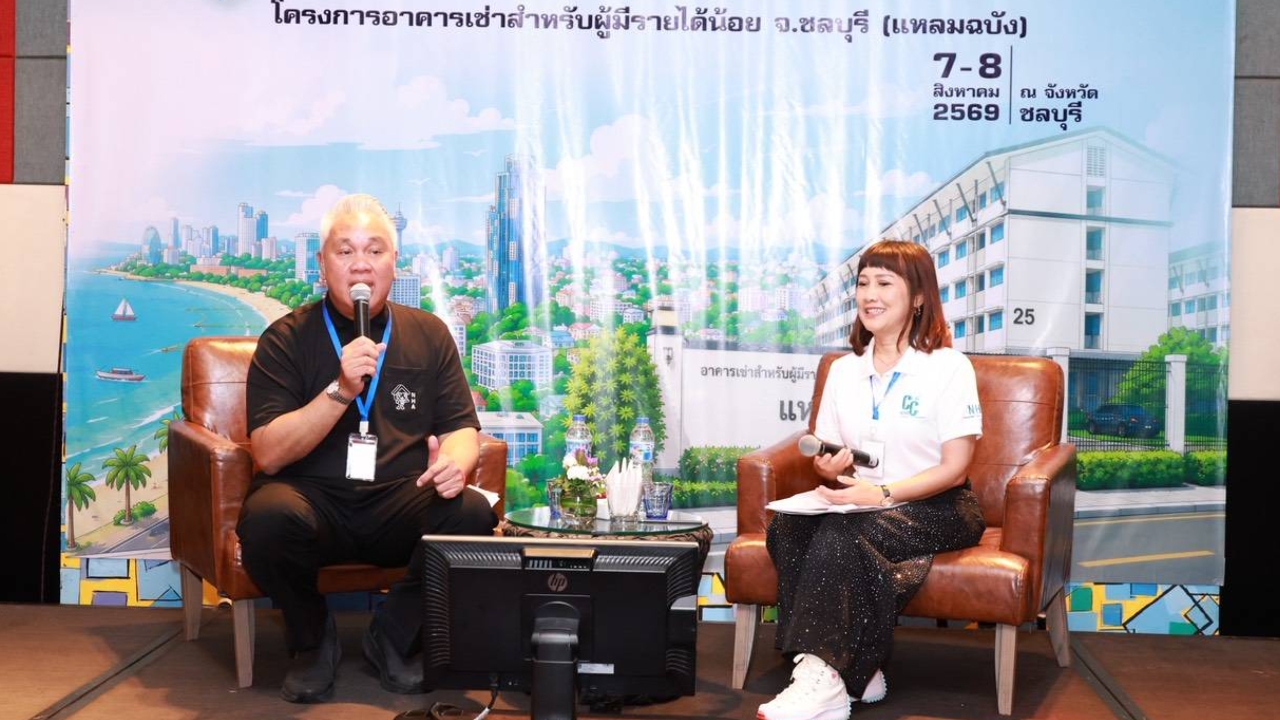
The National Housing Authority (NHA) is accelerating its "Housing for Thais" initiative, advancing the Senior Complex, urban renewal projects, utilizing Land Bank and Sunk Cost assets to increase organizational value, and promoting clean energy development.

The National Housing Authority is moving forward with its efforts.The "Housing for Thais" program.It is fast-tracking housing development and urban renewal projects in several areas—Thung Song Hong, Ram Inthra, and Huai Khwang—as well as the Senior Complex in Chonburi. At the same time, it leverages Sunk Cost and Land Bank lands to create added organizational value while promoting clean energy for sustainable development.


Mr. Tawepong Wichaidit, Governor of the National Housing Authority, revealed that during the past six months, the NHA has accelerated its mission in line with the Ministry of Social Development and Human Security’s (MSDHS) policy under the supervision of Minister Nikorn Somglang. The ministry emphasizes eight key policies under the theme "Building a Prosperous Society with Opportunities for All Thais," focusing on securing housing stability, improving environmental quality, and enhancing the efficiency of state assets to generate revenue for improving people’s quality of life. The NHA is pushing forward with the "Housing for Thais" project to provide citizens access to quality housing in suitable locations, based on Universal Design principles accommodating all age groups. The goal is to create affordable housing security, divided into five phases covering over 44,000 units, which will be submitted to the Cabinet for consideration in 2027.The period from 2027 to 2032.These include:


Additionally, the NHA is preparing to advance the Senior Complex housing development for the elderly in Bang Lamung District, Chonburi Province, piloting 1,696 units under the concept of a "Happy City" to support an aging society. The design follows Universal Design principles for all age groups, with designated active spaces promoting exercise and passive areas for relaxation and quality living. The project will use a Design & Build plus Invest model under a 30-year long-term lease of state land, with an option to extend for another 30 years to ensure continuous development and management. Collaboration with relevant agencies will support investment and provide elderly residents access to suitable retirement housing.

The NHA Governor also discussed urban development efforts, stating that the authority continues to push urban renewal projects to improve residents’ quality of life and develop modern, safe, and livable urban communities. Currently, the second phase of the Din Daeng urban renewal project (supporting original residents) is progressing as planned, including residential building plot A (Building A1), a 32-story structure with 635 units expected to complete by December 2026. Residential building plot D1 (Building D2) is a 35-story building with 612 units expected to finish in 2027. The residential building on plot C (Building C1) will be a 34-story structure with 816 units; it is currently in the contractor procurement phase, with development expected to begin in 2026. There are also plans to develop new resident areas in subsequent phases, totaling 13,746 units. The master plan for the Din Daeng urban renewal project is under revision and is expected to be submitted for Cabinet approval in 2027, before exploring public-private partnership investment options.

Meanwhile, the NHA is expediting the Thung Song Hong urban renewal project, which is the most ready for construction to quickly accommodate residents. The Ram Inthra and Huai Khwang urban renewal projects are under feasibility studies and detailed planning. The NHA will accelerate all steps to ensure timely progress, aiming to promote quality housing development alongside improving residents’ quality of life and sustainable urban growth.
The National Housing Authority is also in the process of selecting a new board of directors, with plans to propose them for Cabinet approval and hold the first meeting by August 2026, to continue driving policies and property management.

Mr. Tawepong discussed key asset management strategies, saying the NHA plans to maximize the use of vacant Land Bank and Sunk Cost lands through partnerships with private sector investors in potential areas, such as Phetchabun Province for solar farm electricity production and agricultural activities; Bang Phli Complex for commercial and residential projects; and Rom Klao and Pracha Nivet areas with commercial development potential to generate future revenue. There are several other prime locations ready to receive investment to enhance state asset utilization efficiency and maximize value.


Another dimension is the NHA’s continued focus on clean energy development. In collaboration with the Provincial Electricity Authority (PEA), they are implementing solar rooftop power generation systems and electric vehicle (EV) charging stations at the NHA headquarters, scheduled for completion by 2027. They are also selecting sites for 79 EV charging stations nationwide and plan to gradually replace government lease vehicles expiring in 2026 with electric vehicles to support the government’s policy to reduce fossil fuel use and promote development toward a low-carbon society.

"The National Housing Authority remains committed to advancing its mission by developing housing projects at all levels, ensuring citizens live in safe, modern environments appropriate for all ages. We will continue to manage state assets and land efficiently to generate revenue for ongoing social development, alongside driving clean energy and sustainable development policies. Our aim is for the NHA to be financially stable and a reliable housing resource for Thai people forever," the NHA Governor concluded.
Read more news " State Policy "