

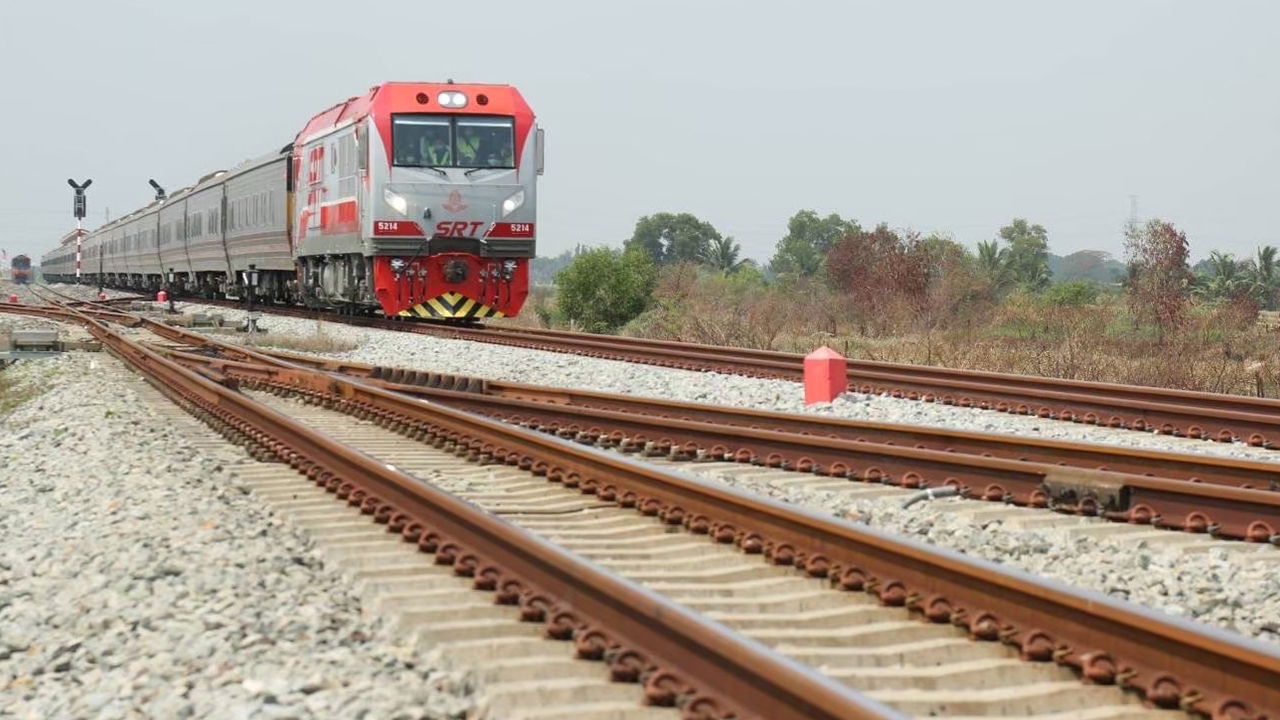
The State Railway of Thailand (SRT) board has approved the Southern double-track railway project in three sections with a budget of 120 billion baht, revising designs to address flooding issues. The proposal will be submitted to the Cabinet within 1-2 months, with bidding expected to start early 2027 and phased openings between 2031 and 2033.
Mr. Anan Pho Nin Daeng, Governor of the State Railway of Thailand (SRT). He revealed that the SRT board meeting, chaired by Mr. Piyapong Chiwattanakulpaisan, Director-General of the Department of Highways (DOH), approved the proposal for phase 2 of the Southern double-track railway project covering three sections: Chumphon-Surat Thani, Surat Thani-Hat Yai, and Hat Yai-Padang Besar. All three projects have completed Environmental Impact Assessments (EIAs) and received opinions from the Office of Natural Resources and Environmental Policy and Planning (ONEP). The board reviewed and updated the budget framework and scope before submitting for project approval.
The original budget framework for the three Southern double-track sections proposed by the SRT was about 104.47 billion baht. After reviewing construction costs and updating the scope, an additional 18.25 billion baht is needed, totaling 122.72 billion baht. This aligns with current costs and site conditions, especially improvements to address flooding in Hat Yai and related areas, including drainage system redesigns and flood prevention measures better suited to the terrain.
Mr. Anan said the SRT submitted the revised budget to the railway committee for consideration. After board approval, the SRT will present the matter to the Ministry of Transport this week to circulate among relevant agencies before submitting to the Cabinet for project approval. The SRT expects to present to the Cabinet within 1-2 months, or by 2026, and is trying to expedite inclusion in a mobile Cabinet meeting, provided document preparation and agency reviews proceed on schedule.
Mr. Anan said that regarding the Hat Yai-Songkhla section, an extension from Hat Yai to Songkhla, the SRT plans to postpone this due to insufficient site readiness, especially significant encroachment along the existing route. It will be considered in a later phase. Meanwhile, the three main routes—Chumphon-Surat Thani, Surat Thani-Hat Yai, and Hat Yai-Padang Besar—will proceed as planned to accelerate Southern double-track railway development.
The SRT's preliminary plan schedules construction for the Chumphon-Surat Thani section to start around July 2027, with an estimated construction period of 60 months, aiming for completion by June 2032. The Surat Thani-Hat Yai section is estimated to take 72 months; starting in July 2027, it is expected to complete by June 2033. The Hat Yai-Padang Besar section, being shorter, will take about 48 months; starting July 2027, it should complete by June 2031. Overall, the three sections will be completed in stages from 2031 to 2033.
However, before construction begins in July 2027, the SRT must carry out contractor procurement. Bidding and contractor selection are expected between January and June 2027 to enable construction to start as planned in July 2027. After Cabinet approval, details will be resubmitted to the SRT board, particularly regarding contract formats and quantities. Initially, bidding will be combined for the three projects: one contract for Chumphon-Surat Thani, two contracts for Surat Thani-Hat Yai, and one contract for Hat Yai-Padang Besar.
“The EIA reports for the three projects have not expired and do not require complete new assessments. The first two sections received EIA approval in 2023 and remain valid for five years, allowing continued progress. The Hat Yai-Padang Besar section’s EIA was approved in 2020 and expires in 2025. Therefore, the SRT is reviewing and updating data to reflect project progress and verify if any significant changes have occurred, rather than conducting a full new environmental impact study,” Mr. Anan said.
Mr. Anan said the SRT has discussed this with ONEP, conducted site visits, and explained procedures for handling EIAs that have reached five years, as there are no direct precedents. They have submitted updated documents to ONEP, focusing on reviewing and updating information. If no significant changes are found, it should not hinder project progress, and after Cabinet approval, bidding can proceed smoothly.
Mr. Anan acknowledged some issues with land expropriation and encroachment, but said main routes face fewer problems because the SRT has management plans for about 300 communities involved. The biggest issue is the Hat Yai-Songkhla section, which has been separated from the current plan to allow more time for land preparation. The Hat Yai-Songkhla extension will be considered in a later phase with a separate bidding plan. The SRT wants the main routes completed first.
The increased budget is due not only to current construction cost adjustments but also rising material and expense prices recently, plus redesigns to address flooding, especially in Hat Yai. The SRT must elevate and upgrade some structures to improve drainage efficiency and reduce future flood risks.
One key approach is redesigning structures at flood-prone points where the railway has previously been affected, considering bridge and embankment structures in some sections to raise the railway alignment suitably. Special attention is on the R.1 canal area and nearby Hat Yai locations that have suffered flood damage before. These design changes are part of the updated scope and budget review.
Mr. Anan said the budget adjustment does not imply a fundamental change to the project. The SRT has prepared detailed explanations of work quantity changes and reasons for the increased costs to accompany the approval request. If related agencies find no significant changes, the proposal can proceed through circulation and additional clarifications.
Regarding funding sources, the principle depends on Cabinet resolutions and the Ministry of Transport’s guidelines. Most double-track projects will likely use loan frameworks, as they are major public infrastructure investments, different from fully private investment models. Procuring train sets is a separate matter that the SRT will handle apart from construction, either by acquiring trains itself or allowing private operators to use infrastructure under relevant laws and regulations.
Read more news " State Policy " updates