

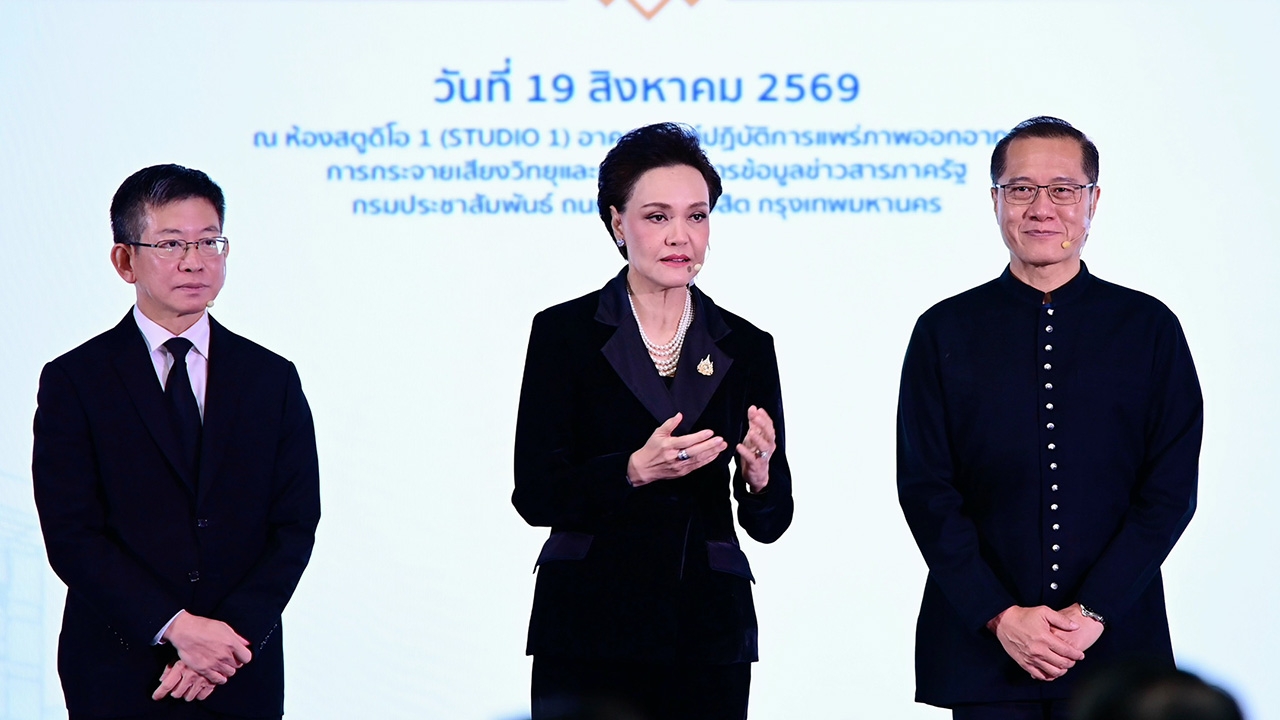
"Supachai" launches 4 task forces uniting government and private sectors to tackle Thailand’s economic challenges amid the 5D global shifts, pushing agriculture, SMEs, and the Visitor Economy towards global markets with an emphasis on concrete action and measurable results.
“Supachai” presents the big picture of Thailand’s economy adapting to global transitions, highlighting the 5D factors: geopolitics, risk diversification, digital technology and AI, environmental sustainability, and demographics. He stresses that Thailand must shift from “what we have” to “what the market demands,” driving progress through 4 task forces under a Cluster concept that fosters public-private collaboration aimed at both short- and long-term outcomes. Meanwhile, “Weerasak” promotes the Visitor Economy concept, shifting focus from tourist numbers to creating experiences and economic value. “Kobsak” pushes to advance nearly 100 proposals with a focus on practical implementation.
On 19 Aug 2026 GMT+7, Mrs. Supachai Suthammanphun, Deputy Prime Minister and Minister of Commerce, shared the vision and direction of the task force on trade, tourism, and community economy development. She noted that Thailand faces simultaneous multidimensional global changes, making traditional economic methods inadequate. She identified the 5D drivers as Geopolitics (Decoupling), Risk Diversification, Digital Technology and AI, Environmental Transition and Decarbonization, and Demographics—all directly impacting Thailand’s competitiveness.

Mrs. Supachai said these changes require Thailand to be flexible and constantly adaptable, especially in trade and marketing. The key question is no longer just “what do we have” or “what will we produce,” but “what does the market want, and how can we create added value?” She emphasized spreading markets, income, and economic opportunities across all levels.
For trade, production, services, and community economy under her responsibility, the Deputy Prime Minister has established 4 task forces to drive the economic engine comprehensively, namely:
Task Force on Agricultural Products and Food Security
Task Force on Community Economy and SMEs
Task Force on Creative Economy Development and Visitor Economy
Task Force on International Trade
“Our aim is not to create just another committee out of the existing 320, but to establish task forces that deliver real results measurable in both short and long terms,” said Mrs. Supachai.
Regarding the task force on agricultural products and food security, Mrs. Supachai said the entire agricultural system must be addressed—from upstream to midstream to downstream. Thailand has about 7.7 million agricultural households, nearly 30% of all households, but they contribute only about 8.8% to GDP, so productivity and value addition must be enhanced.
Upstream efforts focus on improving production, technology, and data; midstream aims to increase processing and storage to prevent farmers from rushing to sell during peak seasons; downstream targets expanding both domestic and international markets. Better processing and storage can reduce seasonal pressures and stabilize farmers’ incomes year-round.
The Deputy Prime Minister cited that agricultural exports in the first half of this year declined by about 3.2%, despite being valued over 800 billion baht, reflecting significant growth potential if the entire chain is upgraded and processed agricultural products increase.

For community economy and SMEs, the “SME Journey” concept will support entrepreneurs from startup through expansion to becoming industry leaders and regional players, focusing on skill upgrading, technology, access to capital, market channels, and connecting to large business supply chains.
Currently, Thailand has about 3.28 million SMEs, accounting for 99.5% of all enterprises and generating about 35% of GDP. The goal is not just for SMEs to survive but to create a system that facilitates easy startup, growth, and leadership development.
Additionally, regulatory and licensing obstacles will be removed, and SME ID and linked databases will be developed to enable government agencies to understand entrepreneurs’ status and tailor support measures precisely.
Regarding the creative economy and Visitor Economy, Mrs. Supachai emphasized shifting focus from mere tourist numbers to economic value and visitor experiences by analyzing visitor groups’ purposes and designing products, services, and experiences to better meet these needs.
Thailand’s creative economy is currently worth about 1.44 trillion baht, roughly 8% of GDP, while tourism and visitors generated about 1.58 trillion baht last year. There is an opportunity to connect creative economy, tourism, products, services, and investment to add value to Thailand’s economy.
The international trade task force will aim to reduce market and business concentration by expanding into new markets while maintaining existing ones, accelerating utilization of FTAs, reducing trade barriers, increasing local content, and linking SMEs into global supply chains.
Mrs. Supachai noted that although Thai exports grew about 17% in the first half of this year, a good performance amid global economic volatility, the internal structure needs scrutiny, particularly regarding market diversification, increasing processed agricultural products, and greater SME participation.
“On one hand, we must bring our products to the markets; on the other, we must bring markets to our products and services. The core focus is that farmers, communities, and Thai entrepreneurs must grow together,” Mrs. Supachai said.

Mr. Weerasak Kowsurat, Advisor to the Deputy Prime Minister and Chair of the Creative Economy and Visitor Economy task force, as well as the International Trade task force, said Thailand must shift from counting “tourists” to understanding why different visitor groups come, as many do not travel solely for tourism but also for health, work, education, sports, relaxation, or specific experiences.
Therefore, the “Visitor Economy” designs an economic system that meets each visitor group’s purposes, turning their experiences into spending, investment, repeat visits, and engagement with local economies.
Mr. Weerasak stated, “Tourism is not the goal but a tool,” and the number of visitors is not the ultimate objective. What matters is the experience Thailand provides and making visitors feel involved with communities, the economy, and the country.
Opportunities must also be spread from main cities to secondary cities, including “secondary cities within main cities,” creating new activities that encourage visitors to spend more time and money locally, with communities actively co-creating experiences rather than merely providing services.

. (The part is incomplete or a fragment.) Mr. Kobsak Putrakul, Advisor to the Deputy Prime Minister and Chair of the Agricultural Products and Food Security task force and the Community Economy and SMEs task force, said the task forces have met twice and gathered nearly 100 proposals. The focus is not on creating more plans but on implementing existing proposals.
“Thailand already has many plans, but the key is that we know the obstacles and solutions; what we need now is people to act and solve those issues,” Mr. Kobsak said.
For agriculture, efforts will focus on upgrading from upstream to downstream, including increasing yield per rai, reducing costs via technology, developing machinery suited to Thai agriculture, using drones and community machinery service centers, enhancing food safety, developing shared agricultural databases, promoting Young Smart Farmers, and increasing processed agricultural product value addition.
Simultaneously, proposals include creating new market channels for farmers by linking to industrial estates, developing e-commerce platforms, reducing logistics costs, and connecting to foreign markets to provide farmers with more selling options and reduce reliance on single channels.
For SMEs, emphasis will be on building the “SME Journey” from startup to global entrepreneur, with key measures such as reducing licensing steps, establishing SME ID and databases, developing community accountants, creating a “Big Brother” system where large businesses help small ones, linking SMEs to supply chains, upgrading products and packaging, applying AI and digital tools, and expanding online marketing channels.
Mr. Kobsak said proposals will be prioritized based on readiness; quick-win items will be implemented immediately, while longer-term initiatives like database development will proceed in phases to achieve both rapid gains within 6 months to 1 year and structural changes over 2 to 4 years.

Mrs. Supachai concluded that the work of all 4 task forces will not be isolated but integrated—from monitoring global trends and policy making to implementation and evaluation—with the key goal of making Thailand’s economy resilient, competitive, and generating income and opportunities that reach farmers, communities, and Thai entrepreneurs.
“We will not move in a single direction; we must go to the markets, attract markets to us, and the core center of all this work today is farmers, communities, and Thai entrepreneurs growing together,” Mrs. Supachai said.

Read more news " Government Policy " Additional