

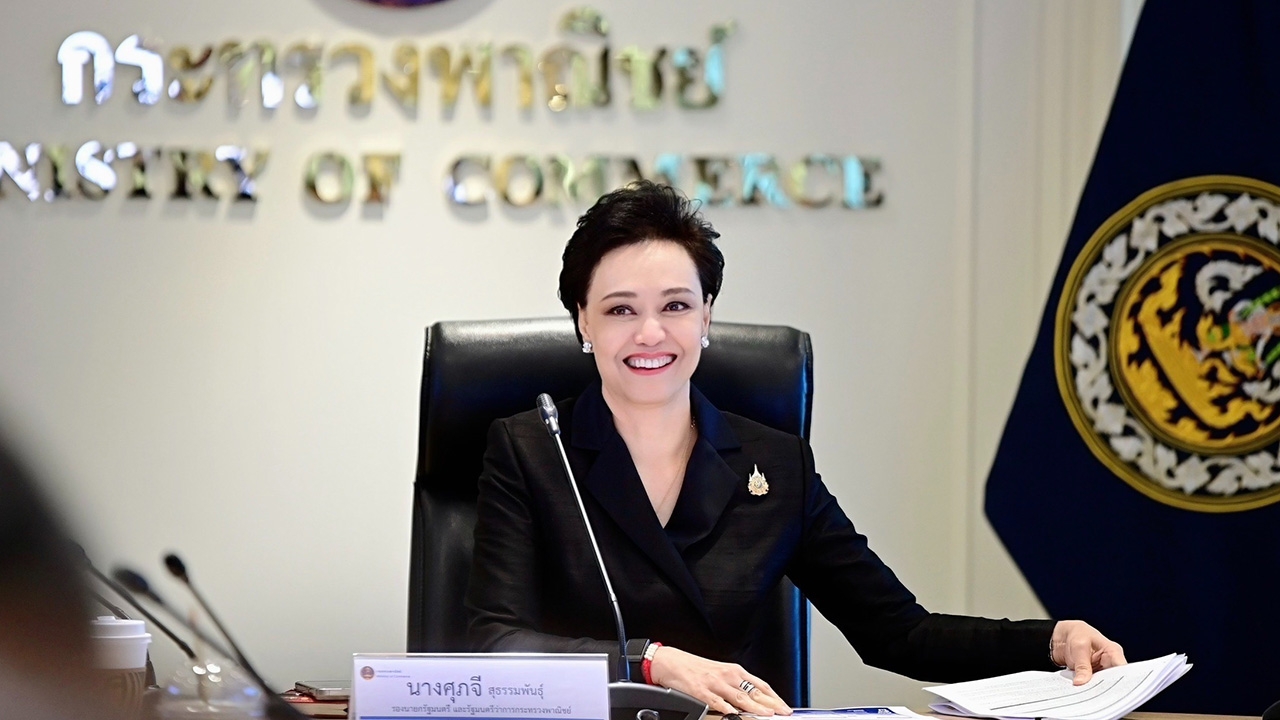
"Supachai" reported 90-day achievements Ministry of Commerce expressed satisfaction with reducing citizens' living costs by over 818 million baht, generating more than 140 billion baht, and advancing 7 urgent missions to boost exports and support SMEs amid crisis
Ms. Supachai Suthampan, Deputy Prime Minister and Minister of Commerce, reported on the Ministry of Commerce's 90-day achievements, saying that she has worked full-time every day and is satisfied with the results. She stated that all plans were 100% implemented, though not all problems are solved due to their long-term accumulation. The ministry will continue focusing on managing living costs, stabilizing agricultural product prices, strengthening SMEs, balancing trade, and accelerating Thailand's economic restructuring amid global economic volatility. Thailand faces "crisis upon crisis," including geopolitical fluctuations, energy costs, and a complex global trade system, requiring flexible work approaches addressing both short-term issues and laying long-term structural foundations.

The Prime Minister assigned four Deputy Prime Ministers to drive the economy in four areas: Mr. Aekniti Nitithanprapas responsible for investment and new investments, Ms. Supachai Suthampan in charge of trade and community economy, Mr. Yossanan Wongsawat focused on human capital development, and Mr. Pakorn Nilprapunt handling deregulation efforts to help Thailand escape the middle-income trap and become a high-income country within 12 years.
Regarding trade and community economy, Ms. Supachai established four specialized working groups to link policy to implementation: the Creative Economy and Visitor Economy Working Group chaired by Mr. Weerasak Kowsurat; the Agricultural Products, Food Security, and High-Value Agriculture Working Group chaired by Dr. Kobsak Pootrakool; the Community Economy and SME Working Group also chaired by Dr. Kobsak Pootrakool; and the International Trade Working Group chaired by Mr. Weerasak Kowsurat. These aim to generate income and distribute opportunities to farmers, communities, and Thai entrepreneurs, targeting Quick Big Wins within 6 months to 1 year and structural adjustments over 2 to 4 years.
The efforts over the past three months focused on immediate problem-solving alongside laying long-term foundations, with concrete results as follows:
through the project “Thai Help Thai” which has reduced citizens' living costs by over 818 million baht and generated economic value exceeding 2.9 billion baht since April 2026. This was achieved through price reductions, organizing Back to School events with the Ministry of Education in over 1,000 schools, linking over 800 district-level networks, and deploying "mobile markets" to distribute essential goods at affordable prices nationwide.
Simultaneously, the project promotes income generation by introducing SME products to online channels, supporting franchising including the "Half-Half Franchise" where the government subsidizes half the cost up to 10,000 baht, and connecting entrepreneurs to funding sources.
The Ministry shifted its approach from reactive problem-solving to "proactive and systemic solutions" from upstream to downstream by integrating efforts with the Ministry of Agriculture and Cooperatives, Ministry of Industry, Ministry of Higher Education, Science, Research and Innovation, and related agencies.
They advanced “community trading hubs” to strengthen farmers’ bargaining power, with 12 interested locations out of a target of 10. They also developed “premium rice” targeting 466 groups, currently about 200 groups participating, to enhance seed quality, production, processing, branding, and marketing.
Key agricultural product prices have generally improved recently: white rice rose from $334 to $467 per ton (19% increase), cassava increased by 79% to 3.65 baht/kg, palm oil by 45% to 8.70 baht/kg, and rubber by 30% to 36 baht/kg. Aromatic coconuts rose to approximately 10-11 baht each. The ministry closely monitors agricultural prices considering factors such as yield, imports, and factory purchases to ensure fairness and proper marketing channels for farmers. They are preparing measures especially for animal feed corn, which is about to enter the market this season. In 2026, the ministry will supervise pricing structures and link buyers to remote areas to ensure farmers receive appropriate prices when supply increases and prices tend to fall.
Additionally, they plan to develop a shared data system with the Ministries of Agriculture, Higher Education, and Digital Economy to forecast yields in advance and promote a provincial-level agricultural product calendar to enable timely responsive measures.

The Department of Business Development has enhanced the capabilities of over 50,000 entrepreneurs in skills, management, capital access, and market expansion. They have also intensified efforts against “nominee” practices by coordinating 23 agencies across 46 provinces, reducing high-risk groups by 75%.
The creative economy generated over 15.3 billion baht in economic value in 90 days, GI products created over 117 billion baht, and upskilling and reskilling efforts produced trade value exceeding 200 billion baht per year.
The Ministry is expanding markets and advancing FTAs with the European Union, Canada, South Korea, and other partners, including negotiating tax issues with the United States to preserve Thailand’s trade benefits.
During 90 days, trade promotion activities generated over 145 billion baht in value. THAIFEX alone created over 136 billion baht. The ministry also pushed online business matching, promoted soft power, and opened new markets.
For rice, the annual export target is 7 million tons, with efforts to expand markets in Africa, Saudi Arabia, Malaysia, and China. Cassava exports reached approximately 2.7 million tons in the first 7 months, with new markets and innovative agricultural products being promoted.
Regarding China, the ministry is working to balance trade by negotiating increased use of Thai raw materials and labor, promoting joint investment in new industries, pushing Thai SMEs into Chinese online markets through Thai Pavilion, and accelerating the Joint Trade Committee mechanism.
The Ministry is accelerating digital transformation, developing “MOC Plus” with AI to improve service efficiency. The Department of Business Development plans to enable 100% online corporate registration of all legal entity types starting October 1, 2026.
In intellectual property, there were 45,916 trademark applications in 2026, a 7.48% increase. The ministry is improving regulations and integrating trade measure data to provide faster, more efficient services.
Ms. Supachai stated that going forward, the focus will be on "better trade, growth, and fair protection," shifting from reactive problem-solving to proactive and structural solutions, with 7 key missions:
1. Accelerate trade negotiations, including FTAs and US tax matters under ART and Section 301.
2. Drive exports to achieve double-digit growth in 2026.
3. Maintain stability of agricultural product prices.
4. Strictly combat nominee practices.
5. Operate 4 working groups under the Economic Resilience Framework (ERF).
6. Fully stimulate the economy by continuing "Thai Help Thai" to reduce living costs and generate income through the end of the year.
7. Unlock operational procedures using technology and digital systems.
"What we accomplished in 90 days is not just short-term problem-solving but establishing systems to structurally resolve recurring issues so that citizens, farmers, and entrepreneurs can move forward steadily and ensure sustainable economic growth for Thailand," Ms. Supachai said.
Read more " Government Policy " updates