

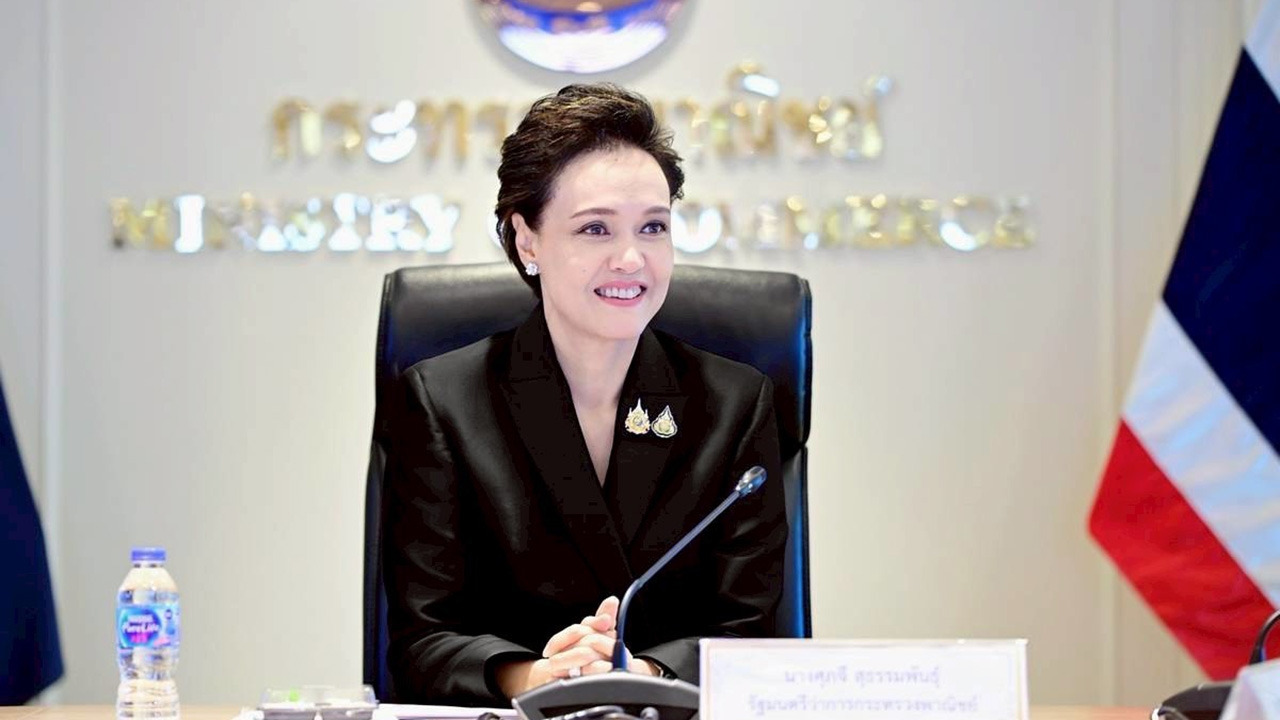
The Ministry of Commerce explained that Thailand ran a $35 billion trade deficit in the first seven months, noting that over 70% of imports were raw materials for production. It is advancing the Co-Creation strategy to restore economic balance in Thailand.
The Ministry of Commerce disclosed Thailand’s international trade structure for the first seven months of 2026 after a $35.35 billion trade deficit. It found that over 70% of imports were raw materials and capital goods related to manufacturing, while consumer goods accounted for only 9.2%. The ministry emphasized that solving the trade deficit requires looking beyond reducing import figures. The key challenge is how to increase domestic value addition from trade and investment while diversifying markets to reduce dependence on main markets. Efforts include adjusting trade relations with partners to better link investment and production with Thailand’s economy, providing opportunities for Thai businesses to join supply chains, and jointly developing new products and markets for the long term.
Ms. Supachai Suthempan, Deputy Prime Minister and Minister of Commerce She revealed that during the first seven months of 2026, Thailand's total trade deficit was $35.35 billion USD. Looking deeper into import structure, most import growth was linked to manufacturing. Capital goods and raw/semi-finished materials—such as machinery, electronic components, and chemicals—accounted for 72.9% of total imports. This trend aligns with global manufacturing growth (Global Manufacturing PMI), especially in technology, electronics, digital infrastructure, communication systems, and electrical systems, where Thailand is part of the international production chain.
Consumer goods made up 9.2% of total imports. When analyzing trade balance specifically for consumer products—excluding production-related goods, exports, military equipment, and energy—Thailand still had a $13.32 billion USD trade surplus. This indicates that the recent trade deficit was not mainly caused by consumer goods imports.
Ms. Supachai stated that moving forward, the focus is on enhancing production and investment to generate more sustainable value for Thailand’s economy through using domestic raw materials and components, employment, technology transfer, and expanding opportunities for Thai businesses, especially SMEs, to participate more in supply chains. She assigned the Ministry of Commerce to promote trade balance based on mutual benefit with partner countries. The goal is not simply to equalize import and export values numerically but to ensure trade and investment relationships bring more economic benefits back to Thailand. For countries with high investment in Thailand, the ministry will push for greater use of domestic raw materials, components, and labor while linking Thai businesses into supply chains. It will also build Thailand’s reputation as a trusted partner in terms of quality, standards, and supply chain security, and expand cooperation in potential sectors toward co-creating new value by combining the strengths of Thailand and its partners to develop products, industries, or business opportunities and jointly expand markets. The approach shifts from "Sell To" toward "Sell With."
Discussions with key partners have already piloted this approach, such as:
China Thailand proposed reviewing investment models to increase use of Thai raw materials and jointly develop new industries like processed foods and herbs to penetrate the Chinese and third-country markets, also integrating Thai SMEs into China’s e-commerce platforms.
United Arab Emirates (UAE) Although Thailand runs an energy import deficit, it is negotiating an FTA alongside developing new joint business ventures to extend long-term relations.
“The Ministry of Commerce’s goal is not merely to reduce the trade deficit figures but to use strategic relationships with partner countries to create new economic opportunities for Thailand. We must ensure that trade and investment enhance competitiveness, add domestic value, and open space for Thai businesses to play a bigger role in supply chains. At the same time, Thailand must build trust to be seen as a reliable partner, ready to move beyond simple transactions toward jointly creating products, businesses, and new markets. The ultimate goal is trade relations that grow not just in numbers but in mutual benefits, enabling sustainable growth for Thailand and its partners,” Ms. Supachai said.
Read more news " Government Policy " Additional