

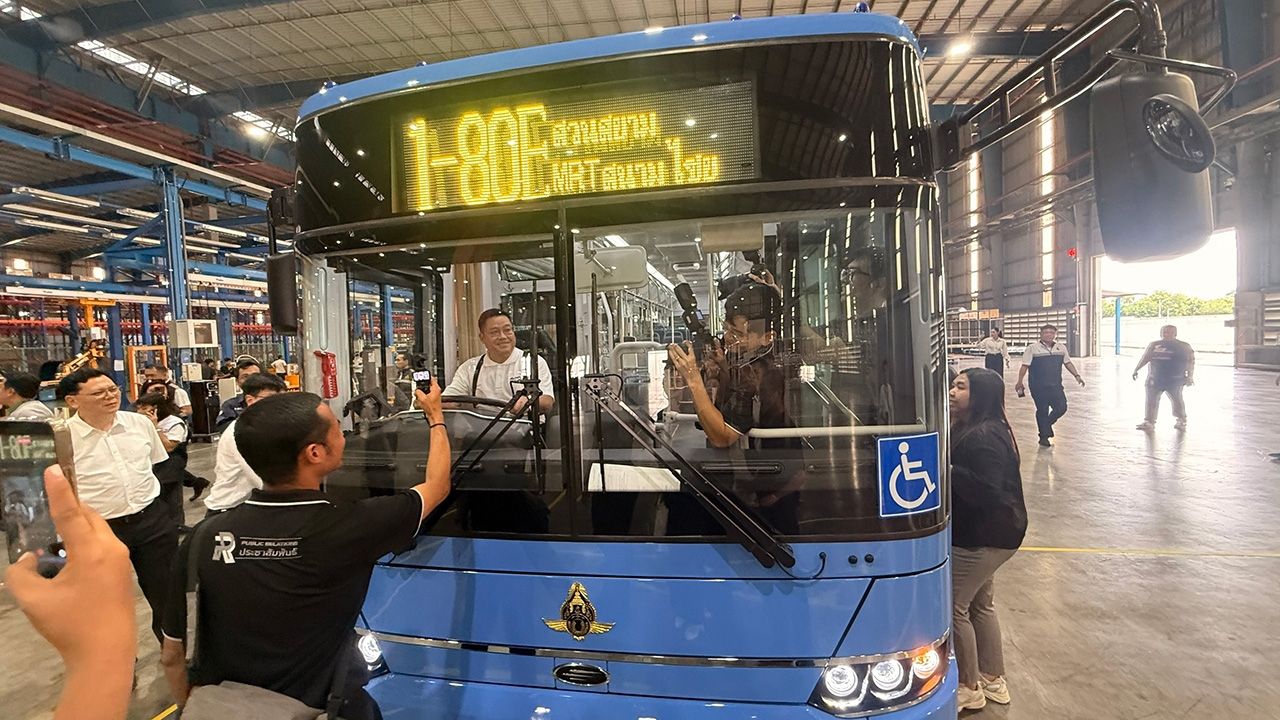
The Bangkok Mass Transit Authority (BMTA) has unveiled plans to upgrade transportation services by preparing to receive the first phase of 1,520 electric buses (EV), which will operate across 50 routes throughout the capital. The initiative aims to save on fuel and maintenance costs, cutting organizational expenses by over 4.1 billion baht annually.
Mr. Kittikan Jomduang, Director of the Bangkok Mass Transit Authority (BMTA), revealed progress on the first phase procurement of 1,520 electric buses (EV) to raise service standards and address the organization's accumulated debt burden. BMTA plans to receive the first batch of 500 buses by the end of March 2027, followed by a second batch of 500 buses by the end of April 2027, and a final batch of 520 buses by late May 2027.

Currently, key components for the first 40 buses have been delivered to the manufacturing plant of Energy Absolute Public Company Limited (EA), which has a maximum production capacity of 15 buses per day. BMTA plans a minimum production of 12 buses daily. Two demo buses have been assembled to test safety systems, road conditions, and to train drivers. On 24 September 2026, coinciding with BMTA’s 50th anniversary, one inspected prototype bus will be showcased and made available for staff test drives.

This replacement will bring electric buses to run one-for-one in place of the old ordinary cream-and-red buses, converting all to clean energy air-conditioned vehicles in line with government policy. The first phase will cover nearly 50 routes out of 107 currently undergoing reform.

Routes will focus heavily on the city loop area, such as Route 191 (Ratchadaphisek-Ramkhamhaeng) and central business districts (CBD) including Silom, Bang Rak, Khlong Toei, and Rama IV, as well as routes connecting suburban areas. These serve an average of 550,000 to 650,000 passengers on weekdays and 300,000 to 400,000 on holidays. Fares will range from 15 to 25 baht, following the Land Transport Department’s air-conditioned bus fare guidelines. The government is considering ways to ease passenger costs through integrated fare systems and state welfare cards.

In addition to the first phase, Mr. Kittikan stated that BMTA has planned procurement of a second phase of 800 electric buses, budgeted at over 8 billion baht. This proposal is currently under consideration by the House of Representatives for inclusion in the annual expenditure budget as a seven-year binding budget (2027–2033). The second phase is expected to proceed faster by applying the model and conditions from the first phase, with buses projected to begin service by 2028.

Historically, BMTA has faced long-standing debt and accumulated losses, partly due to high maintenance contracting costs for old buses exceeding 2 billion baht annually and diesel fuel expenses of 1.8 billion baht per year. Switching to leased electric buses built with lightweight, strong Monocoque structures suited for urban traffic will transfer maintenance responsibilities to the lessor. Additionally, switching to electricity, which costs about 60% less than diesel, will reduce energy expenses to approximately 800 million baht per year.


Combined with adopting operational management technologies that reduce personnel costs by another 900 million baht, BMTA projects total operational savings of up to 4.1 billion baht annually. This will sustainably improve the organization's finances while enhancing safety by installing CCTV cameras and GPS tracking on every bus.
/read news " government policy " more