

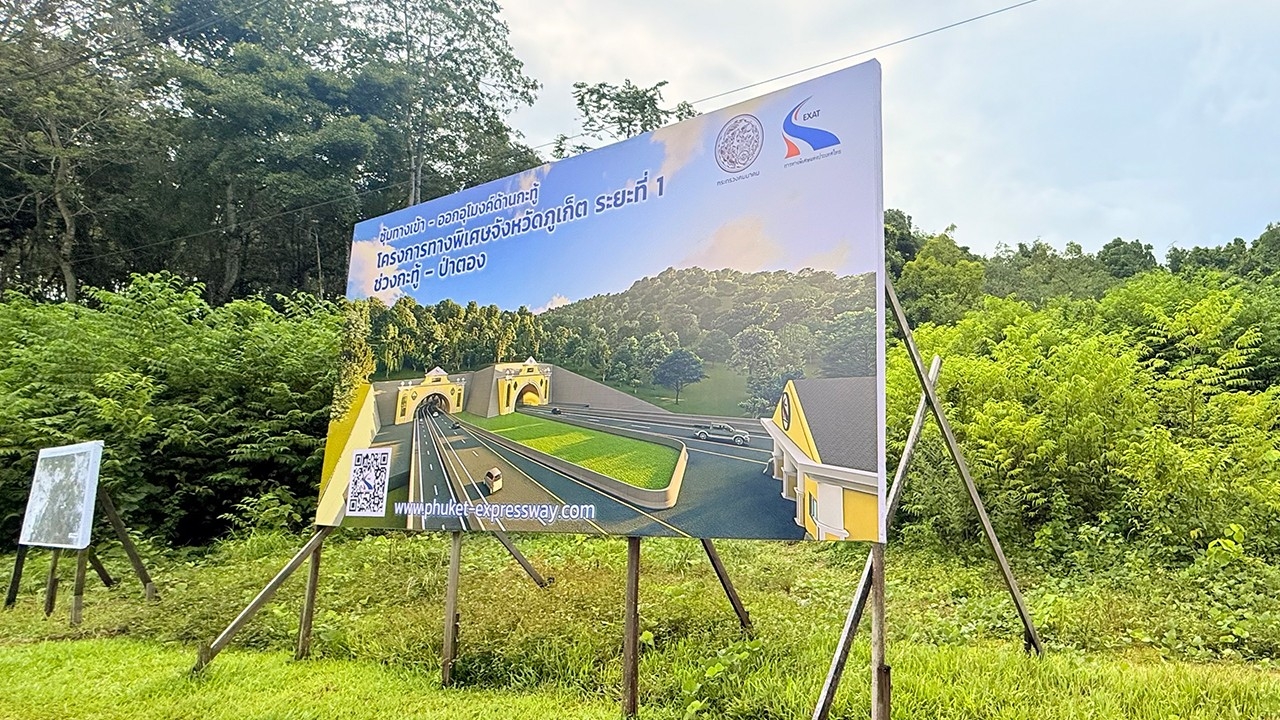
The Expressway Authority of Thailand (EXAT) is pushing ahead with Phase 1 of the Phuket Expressway, connecting Kathu to Patong, featuring the largest mountain tunnel in Thailand to cut travel time to 5 minutes. The project is set for Cabinet approval by the end of this year and expected to open in 2031 alongside Phase 2.
Mr. Surachet Laopoolsuk, Governor of the Expressway Authority of Thailand (EXAT). He revealed progress on the development of the Phuket expressway project, a key infrastructure initiative aimed at addressing traffic issues, improving travel efficiency, and supporting Phuket's expansion. EXAT plans to develop the project in two phases:
The goal is to connect economic zones, tourist attractions, and major road networks of the province into a unified system.

Phase 1, Kathu to Patong, is a crucial project to resolve travel problems between Kathu and Patong areas, which face geographical constraints, especially the mountain range. EXAT designed both an elevated highway and a mountain tunnel totaling 3.98 kilometers, with a total investment of about 16.757 billion baht. This includes approximately 5.792 billion baht for land acquisition and 10.965 billion baht for construction and supervision. EXAT will invest in civil works, while the private sector will co-invest in operations and maintenance (O&M).
Mr. Surachet added that EXAT has already submitted the project to the Ministry of Transport, with design adjustments notably reducing the tunnel width from 17 meters to 14 meters. They are currently consulting relevant agencies and expect to propose the project for Cabinet approval around December 2026. If approved, the bidding process will begin, with contractors selected by April 2027. Land acquisition aims to be completed by January 2027. Construction is scheduled to start in October 2027, taking four years, with completion in September 2031 and opening planned for October 2031.
The project starts near the intersection of Phra Metta Road or PK.4055 at kilometer 0+350 on the Patong side, then elevates over Phisitkarnnee Road for approximately 0.90 km before entering the Nakkerd Mountain tunnel, which is 1.85 km long. The tunnel is designed with an internal width of 14 meters, making it the largest tunnel in Thailand. It accommodates four lanes per direction—two for cars and two for motorcycles—to align with Phuket's travel patterns. Exiting the tunnel, the route connects to the Kathu side via an elevated highway near Phra Baramee Road or Highway 4029 for about 1.23 km.

This construction allows travel between Kathu and Patong to bypass the limitations of the current route. The project includes grade-separated interchanges at Patong and Kathu to connect with surrounding road networks. Once completed, it will provide alternative travel options, reduce reliance on the physically and capacity-constrained existing roads, improve access to tourist and economic areas, and enhance safety and efficiency in Phuket's transportation system. Travel time between Kathu and Patong, which currently takes about 30 minutes, will be reduced to just 5 minutes via the tunnel.
Regarding toll rates, EXAT has followed government policy to reduce the public's living costs by revising the toll structure from the originally considered rates as follows:
It is anticipated that when Phase 1 opens, the average daily traffic volume will be about 50,000 to 60,000 vehicles, including motorcycles, with increases expected after Phase 2 is completed.
Mr. Surachet also stated that Phase 2 of the Phuket Expressway, covering Muang Mai to Koh Kaew to Kathu, is a continuation of Phase 1, extending connectivity to the central and eastern areas of Phuket. The project spans 30.62 km, including 24.45 km of main line and 6.17 km of spur line. The investment budget is under review, preliminarily estimated at approximately 67.462 billion baht, with about 29.548 billion baht for land acquisition and 37.914 billion baht for construction and supervision.

Regarding Phase 2 progress, EXAT is currently designing project details and expects to submit for Cabinet approval by 2027. Construction is targeted to start in October 2028, with a three-year timeline, aiming to open alongside Phase 1 in October 2031. EXAT is also in the process of obtaining forest land use permits from the Royal Forest Department.
Mr. Surachet further explained that the main route of Phase 2 begins near the intersection with Highway 4026, heading south through Muang Mai before connecting to the Phase 1 expressway network at Highway 4029. The spur line starts at the Ma Nik 2 interchange, serving as a system interchange connecting the main line and spur line, heading east and ending at the Bang Khu interchange to link with Highway 4024. This allows the network to distribute traffic to more areas of Phuket.
The structural design of Phase 2 over 30.62 km integrates three types of structures according to the terrain:
Another highlight of Phase 2 is the toll collection system, which will use a closed MTC/ETC system charging tolls based on actual travel distance. The project also plans to develop service areas to enhance user convenience, including a service area at km 3+900 on the outbound side toward the airport and a rest stop at km 16+400 on the spur line, covering about 13 rai to support rest and travel services, promoting tourism.
Read more news " Government Policy "