

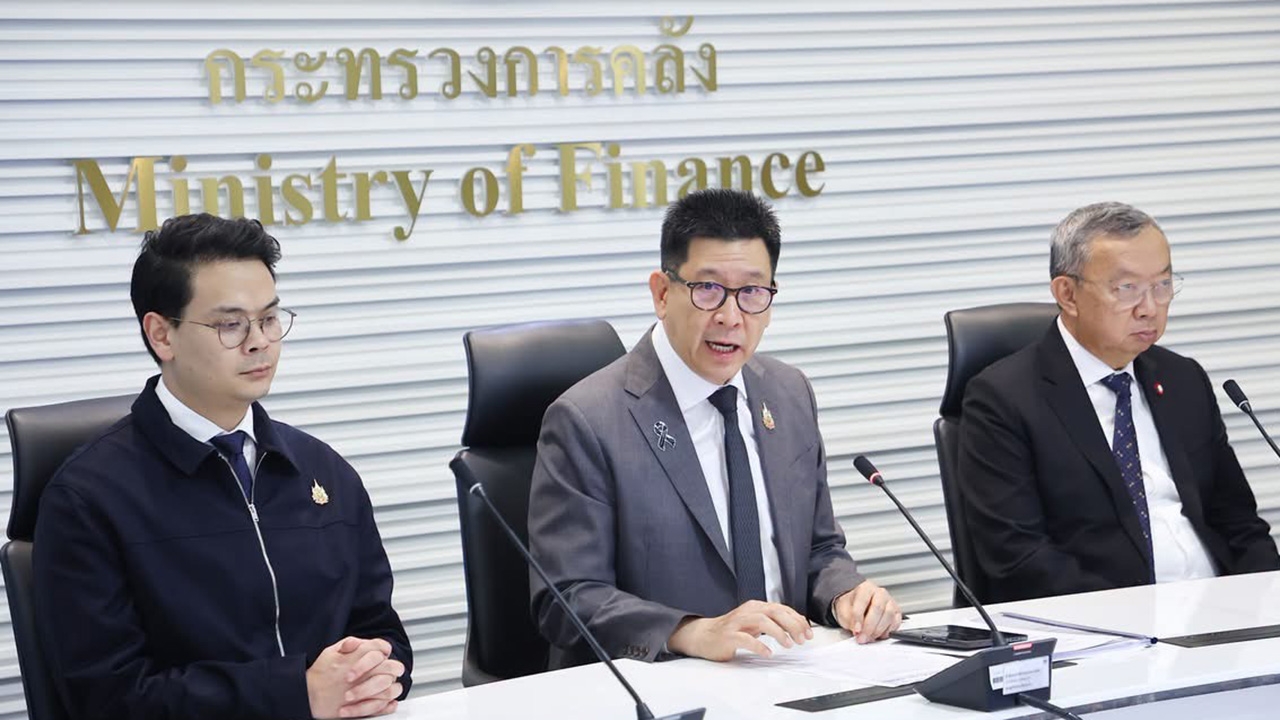
The Ministry of Finance, in cooperation with the Ministry of Digital Economy and Society, is preparing to establish four national central systems to intercept suspicious transactions, highlighting the features "single report - rapid freeze" with the goal of cutting off mule account and call center gang operations to provide timely assistance to victims.
Dr. Akniti Nitithanprapas, Deputy Prime Minister and Minister of Finance, as chairman of the Subcommittee on Linking Financial Data to Enhance the Monitoring of Suspicious Financial Transactions, held a joint press conference with Mr. Chaichanok Chidchob, Minister of Digital Economy and Society. They revealed that suspicious financial transactions are increasing rapidly and evolving from primarily bank account flows to being dispersed through multiple accounts, withdrawn as cash, converted into digital assets, gold, or foreign currencies, and moved abroad within hours. Meanwhile, data from different agencies are not integrated, and coordination relies heavily on manual processes, causing delays that allow funds to move faster than agencies can coordinate. By the time all data are collected for legal procedures, it is often too late to recover the money.
At the second meeting of 2026 on 14 September 2026, the subcommittee jointly considered approaches to upgrade operations for preventing and suppressing suspicious financial transactions, focusing on two main areas:

The first part involves enhancing the standards for Know Your Customer (KYC), Customer Due Diligence (CDD), and Enhanced Due Diligence (EDD) processes, which provide critical initial data for monitoring suspicious financial transactions by agencies such as the Anti-Money Laundering Office, the Bank of Thailand, and the Securities and Exchange Commission. These agencies will consider ways to elevate Thailand's KYC, CDD, and EDD standards to align with international financial centers.
The second part is the development of the National Anti-Fraud Master Plan, which will establish four national central systems to link data, report incidents, block money trails, and seamlessly transmit commands. This is a collaborative effort involving multiple agencies, including the Ministry of Finance, Ministry of Digital Economy and Society, Royal Thai Police, Bank of Thailand, SEC, Anti-Money Laundering Office, and the Thai Bankers' Association. The four systems are:
1) Data Sharing with Consent System: This serves as a channel to connect and verify various data such as identity, accounts, transactions, phone numbers, platform accounts, and incident reports. Data is linked under legal authority or consent to establish a personal risk level with the key principle of “one identity, one risk level.” This enables financial institutions, telecom providers, digital platforms, and law enforcement to view the same risk data and perform real-time API checks to approve, review, or reject transactions.

2) Anonymous Financial Data Bureau: This system collects transaction data without personal identifiers and stores it securely for analysis of crime patterns and network structures. It also develops and tests risk models tailored to each agency’s needs. This allows for “data analysis to stay ahead” of new fraud schemes and to establish appropriate prevention measures.
3) National Case Management System, overseen by the Ministry of Digital Economy and Society, operates under the principle “single report, single channel.” It consolidates reports from all sources—citizens, the AOC 1441 hotline, financial institutions, police—into one entry point. The system automatically forwards cases to responsible officials or agencies using a single reference number throughout the process, eliminating repeated reporting by the public and enabling faster freezing of funds before they are converted into other asset types that are harder to trace.
4) Financial Investigation and Account Action System: This system rapidly traces money flows while funds are in motion by linking the national case management system with fund freezing systems. Upon receiving a report, it can check remaining balances available for freeze at each financial institution or service provider and issue freeze orders under legal authority. All commands are logged with evidence and audit trails, including processes for returning funds to victims or lifting freezes based on case outcomes. Its goal is to “track promptly, freeze quickly.”
These four systems work together: System 1 ensures all sectors see the same risk signals before incidents occur; System 2 enables understanding of rapidly evolving fraud patterns; System 3 allows cases reported by the public to proceed immediately without inter-agency delays; and System 4 stops money before it is withdrawn or converted into other assets.
The benefits to the public and the country occur at multiple levels. For direct victims, a single report leads to faster money tracing and freezing, increasing chances of recovery. For the general public, a unified risk signal across sectors helps intercept risky transactions early, reducing new victims. Nationally, Thailand will develop standardized data infrastructure with strong personal data protection, reducing risks from suspicious transactions. In the future, this infrastructure can also support other uses, such as enhancing financial inclusion.
The subcommittee has tasked the Permanent Secretary of the Ministry of Finance and related agencies to urgently discuss and design the four systems, including detailed data structures, system workflows, connection methods, responsible agencies, and data standards. They are instructed to complete this within 30 days and present it to the subcommittee for further consideration.
/news "},{ Government Policy " Additional