

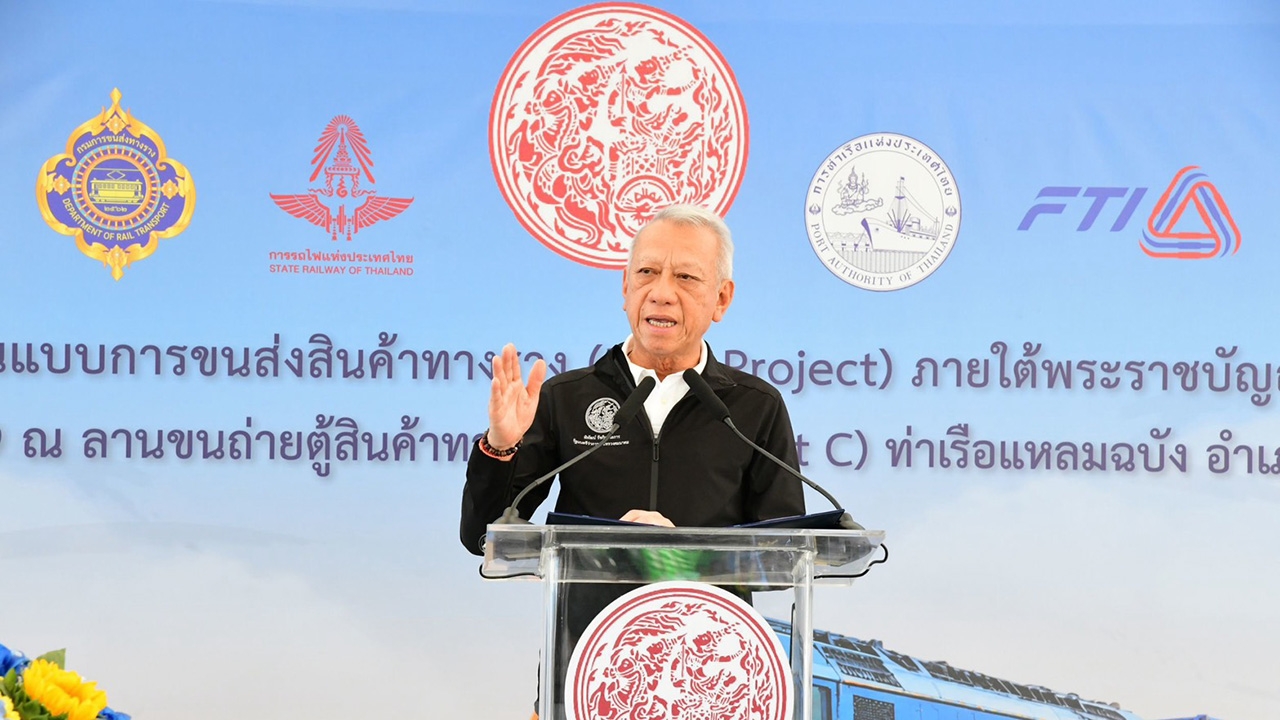
The Ministry of Transport has launched a pilot rail freight transport project along the Laem Chabang-Nong Khai route, aiming to reduce logistics costs, promote rail as a primary transport mode, and establish Thailand as a regional transportation hub.
18 Sep 2026 GMT+7 Deputy Prime Minister and Minister of Transport Pipat Ratchakitprakarn presided over the inauguration ceremony for the pilot rail freight service project under the Rail Transport Act B.E. 2568 (2025) at Port C container transfer area, Laem Chabang Port, Si Racha District, Chonburi Province. The event was attended by the Deputy Secretary-General to the Prime Minister for Political Affairs, the Minister of Transport’s advisors, the Chairman of the Port Authority of Thailand, senior Ministry of Transport officials, agency heads, executives from the Federation of Thai Industries, the Thai Chamber of Commerce, and the Thai Chamber of Commerce Federation.

Mr. Pipat said today marks another significant step in developing Thailand’s transport and logistics system. The Ministry of Transport, through the Office of Transport and Traffic Policy and Planning, the Department of Rail Transport, the State Railway of Thailand, the Federation of Thai Industries, the Thai Chamber of Commerce, and the private sector, jointly launched this pilot project, demonstrating a shared commitment to unlocking new growth potential by shifting freight transport from road to rail, thereby concretely supporting production, trade, and exports.

This pilot operation represents a genuine collaboration model, utilizing locomotives from TPI Polene Public Company Limited combined with freight cars from the State Railway of Thailand to transport rubber from Sritrang Logistics Company Limited along the strategic Laem Chabang - Nong Khai - Laem Chabang route. The goal is to connect cross-border trade networks to southern China through Laos. The process tests the entire transport chain to collect real cost data (including Access Charge, Locomotive Charge, fuel costs, and handling fees). This data will be analyzed to reduce regulatory barriers and compared with road transport costs in terms of price, time, and reliability.

Mr. Pipat added that the Ministry’s key objective is to make rail freight a competitive, standardized, safe, and seamless transport option aligned with the government’s green logistics strategy. The long-term goal is to transition to electric locomotives, transforming rail into the country’s main transport route while road transport serves as a feeder system to distribute goods locally.

Beyond the pilot, the Ministry is accelerating network expansion to support growth. The double-track rail project in the northeast is expected to be completed by 2027, while the southern route from Chumphon to Sungai Kolok is scheduled for completion by 2030. There are also long-term plans to develop logistics connections to Malaysia and Singapore, and studies on an Andaman Sea route linking to the Indian Ocean. These initiatives leverage Thailand’s geopolitical advantage at the heart of Asia with low natural disaster risk, aiming to establish Thailand as a comprehensive transportation hub.

Mr. Pipat concluded that advancing rail transport depends on close cooperation with the private sector. The government’s role is to create clear and fair regulations, while the private sector brings expertise and technology to enhance service quality. Lessons from this pilot project will mark the beginning of significant changes that reduce logistics costs and strengthen the country’s economic stability in the long term.
Read more news " State Policy " Additional