

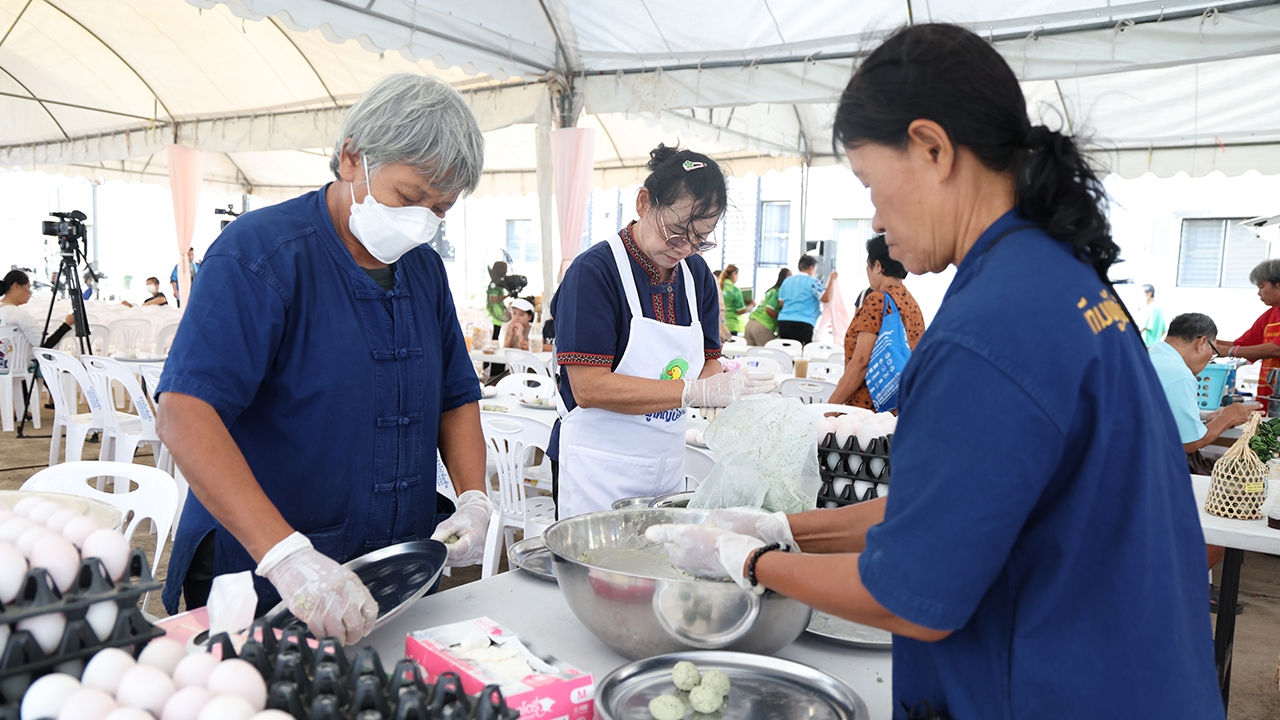
The National Housing Authority is pushing forward 125 career skill development projects nationwide, alongside enhancing 35 sustainable communities, promoting the concept "Skills, Tools, Occupation, Income" to strengthen grassroots economies.

Recently, Mr. Tawephong Wichaidit, Governor of the National Housing Authority, revealed that the agency is advancing the policy of Mr. Nikorn Somklang, Minister of Social Development and Human Security, to develop citizens’ career potential. They emphasize that housing security must go hand-in-hand with household economic stability by using skill development as a key mechanism to create opportunities for residents to leverage knowledge for employment, generate income, reduce expenses, and become self-reliant. Training covers online marketing via TikTok and Facebook, bakery, food processing, health herbs, handicrafts, tailoring, and technical trades, which can be developed into main or supplementary occupations.

In 2026, the National Housing Authority concretized this approach through 125 career development projects for residents nationwide under an economic stimulus budget, completed by 6 September 2026. Simultaneously, they extended development from individual to community economic strengthening through the Smart Sustainable Community project in 35 communities, also completed. The goal is to help each community identify its potential and connect people, occupations, products, and markets to stimulate economic activities and circulation locally.

Mr. Tawephong added that another key mechanism is integrating cooperation with the Vocational Education Commission, Department of Skill Development, and Department of Employment to link skill training with job opportunities and provide necessary tools for starting work or income generation. This cooperation has yielded tangible results in many areas, such as street food skill development for residents in Din Daeng and Huai Khwang housing communities, sewing product training in Samut Prakan province, and electrical and multipurpose repair skills in Nakhon Si Thammarat province. Besides skill enhancement, toolkits have been provided in five batches: two in Samut Prakan, one in Nakhon Si Thammarat, and two in Din Daeng and Huai Khwang, enabling trainees to effectively apply their knowledge.

Evaluation after the second training round showed clear results: over 70% of trainees tend to increase income and reduce expenses by applying the skills and knowledge in their occupations or daily life. This demonstrates that career skill development can produce economic outcomes at the household level and concretely improve quality of life. The National Housing Authority’s key objective is that career development does not end with training but progresses from "skills" to "tools, occupation, and income," while building economic networks within communities to enable residents to create opportunities and become more self-reliant.
"Having secure housing is a fundamental quality of life, but enabling people to earn income, care for their families, and be self-reliant ensures that security is sustainable. Career skill development is not merely training but creating opportunities for people to use their potential to build careers and income. When community members are strong, the local economy strengthens, leading to communities capable of self-driven growth," said Mr. Tawephong.

Mr. Tawephong concluded that the National Housing Authority will continuously monitor and evaluate the project outcomes, using the results to develop career promotion models tailored to each area’s needs. The aim is for residential communities to be more than just "places to live" but "spaces of opportunity" where residents can build careers, generate income, and sustainably improve their and their families’ quality of life. This aligns with the agency’s mission to "Build homes, build happiness for sustainable quality of life."
. . . Government policy . . .