

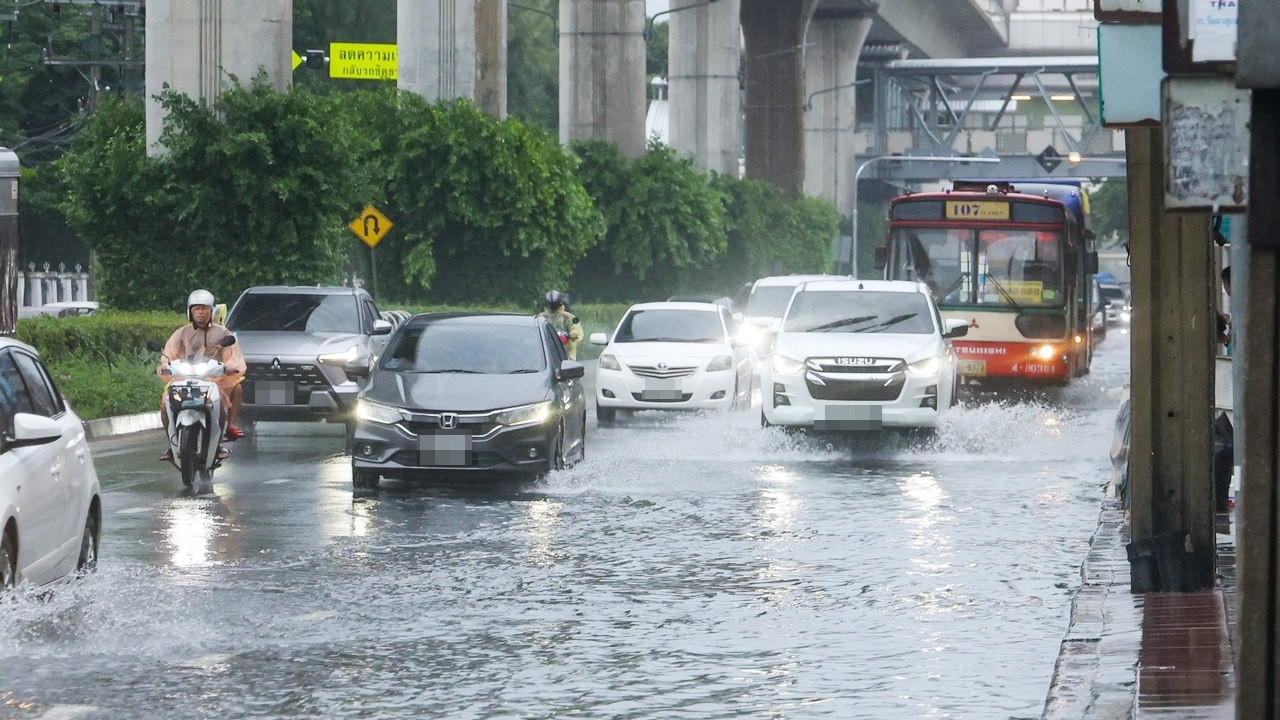
“Phiphat” has ordered the Ministry of Transport to fully mobilize flood response efforts, maintain 24-hour surveillance, ensure safe travel across roads, rails, and waterways, expedite route warnings, and promptly assist the public.
Mr. Phiphat Ratchakitprakarn, Deputy Prime Minister and Minister of Transport, has directed all agencies under the Ministry of Transport to elevate flood monitoring and response efforts around the clock following heavy rains and flooding in many areas. He emphasized that local agencies and officials must closely monitor the situation, ensure safety and continuity of travel via roads, railways, and waterways, and prepare personnel, machinery, vehicles, and equipment to assist the public immediately. He underscored the principle: “People must be safe – routes must remain connected – information must reach the public as quickly as possible.”
According to a report from the Department of Highways (DOH) on 25 Sep 2026, floods have affected highways in 14 provinces covering 26 routes and 54 locations, divided as follows:
In Bangkok, 29 flood monitoring points on highways have been designated. Morning inspections found some spots with water accumulation around 5–20 centimeters, but travel remains normal.

Mr. Phiphat said the current situation requires simultaneous "monitoring, prevention, mitigation, and assistance." He ordered all agencies under the Ministry to continuously gather and report field data, coordinate with provincial authorities, water management agencies, and disaster prevention and mitigation units to assess flood trends and vulnerable areas in advance. This data is used to deploy personnel and machinery appropriately without waiting for routes to be cut off or the public to suffer before responding.
The Department of Highways (DOH) and Department of Rural Roads (DRR) have instructed local units, especially in flood-affected and high-risk areas, to station personnel for 24-hour surveillance. They monitor water levels on road surfaces, low points, underpasses, bridgeheads, bridges, mountain routes, and landslide risk spots. They have prepared pumps, trucks, machinery, warning signs, lighting, and safety equipment ready for use. If water levels or road conditions pose danger, traffic will be restricted or closed immediately with detours designated and timely public notifications. Resources and machinery are mobilized to maintain key routes and community connectivity for maximum usability.
The State Railway of Thailand (SRT) monitors railway routes 24 hours daily, focusing on embankments, bridges, drainage, slopes, and erosion-prone areas. Inspection frequency has increased in heavy rain zones. If water levels or track conditions threaten safety, immediate safety measures are implemented. SRT promptly communicates any service changes and necessary information to passengers.
The Marine Department has instructed regional offices to closely monitor water levels, current speeds, channel conditions, waterway obstructions, and pier safety. They coordinate with water management agencies to track water trends and drainage. If conditions pose navigation risks, warnings are issued promptly to operators, vessel controllers, and the public, along with appropriate safety measures.
Mr. Phiphat further emphasized that all Ministry agencies in affected areas must coordinate closely. If the public suffers from flooding, available personnel, vehicles, machinery, and equipment should be deployed for appropriate assistance. They must also coordinate with provinces, local administrative organizations, police, rescue units, and relevant agencies to ensure aid reaches people quickly, especially by keeping access routes open to communities, hospitals, and critical areas.
Simultaneously, all agencies are to continuously communicate travel information to the public, including affected routes, water levels, caution points, impassable areas, road closures, detours, and public transport service changes, enabling safe travel planning and reducing risk from flood zones.
Mr. Phiphat urged the public to check conditions before traveling, especially in heavy rain and flood areas, and strictly follow official advice. Drivers should not force passage through flooded areas where water depth or current strength is unknown. If routes are officially closed, use designated detours.
The Ministry of Transport has instructed all agencies to promptly warn and inform the public about traffic conditions, detours, and caution areas continuously, urging people to check routes before traveling and avoid driving through deep or unknown floodwaters.
The public can check travel conditions or report incidents via the following channels:
Read more news " Government Policy " here.