

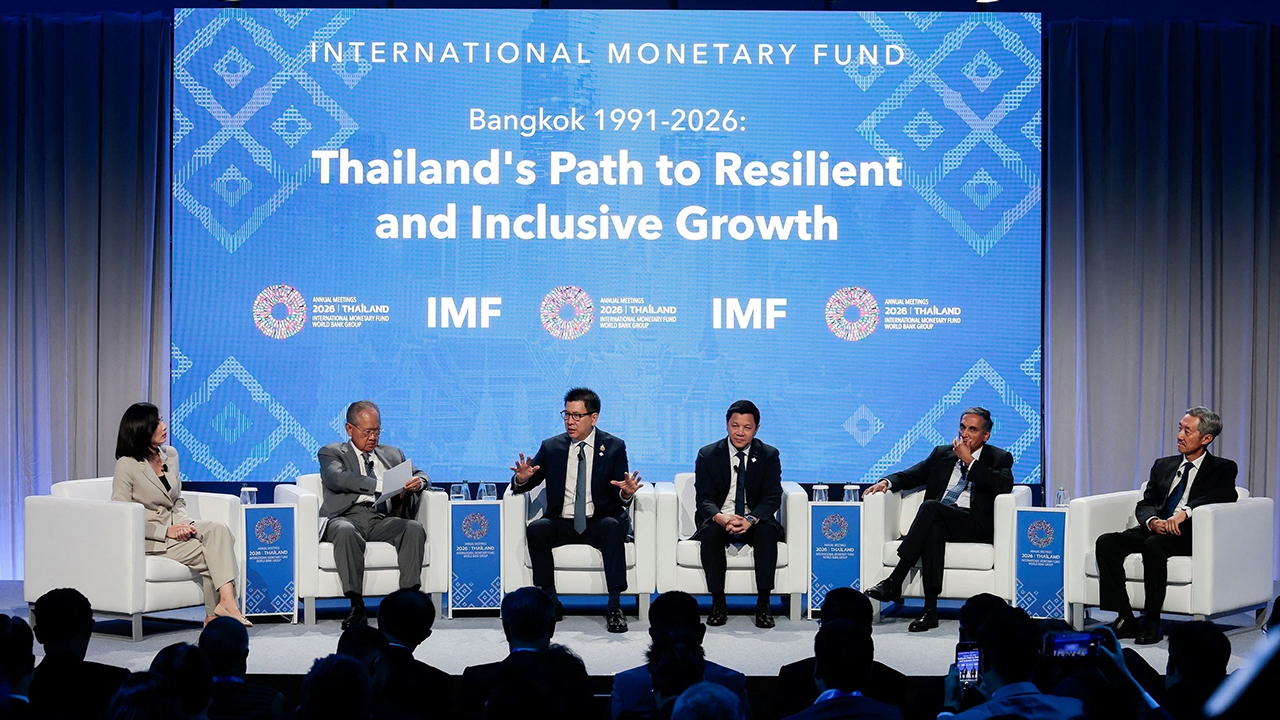
An IMF-World Bank panel points out that Thailand's economy is stuck around 2% growth, urging the government to stop supporting Zombie SMEs. The Finance Minister warns of the need to quickly upskill Thai workers to capture new waves of FDI investment before missing key opportunities amid a continuous GDP decline. >tags: [Thai economy, GDP growth, Zombie SMEs, FDI, Finance Ministry]
A reporter reported that at 3:00 p.m. on 13 Oct 1996, during the 2026 IMF-World Bank Annual Meetings at Queen Sirikit National Convention Center, a special seminar titled “Thailand Special Seminar: Bangkok 1991-2026: Thailand’s Path to Resilient, Inclusive Growth” was held, reviewing Thailand’s economic journey over 35 years and setting the stage for the country's next growth phase, with participation from key figures. >tags: [IMF, World Bank, Thailand, economic seminar, 2026] Mr. Akniti Nitithanprapas, Deputy Prime Minister and Finance Minister, >tags: [Akniti Nitithanprapas, Deputy Prime Minister, Finance Minister] joined the panel discussion with >tags: [] Mr. Kenji Okamura, Deputy Managing Director of the International Monetary Fund (IMF), >tags: [Kenji Okamura, IMF, Deputy Managing Director] , >tags: [] Mr. Krisna Srinivasan, Director for Asia and the Pacific at the World Bank; Mr. Vichai Ratanakorn, Governor of the Bank of Thailand; Mr. Narongchai Akraseranee, Chairman of the Strategic Policy Institute Foundation; and Professor Suttipan Jirathiwat of Chulalongkorn University. >tags: [World Bank, Bank of Thailand, economic experts, Thailand] Together, they reviewed Thailand’s economic path from hosting the first IMF-World Bank meeting in 1991 through to 2026. >tags: [Thailand economy, IMF-World Bank meetings, economic review]

Key points from the seminar included >tags: [economic seminar, key points] Mr. Narongchai Akraseranee >tags: [Narongchai Akraseranee, economic expert] highlighted that Thailand’s industrial sector has persistently operated at 60% capacity utilization, indicating many factories, machinery, and businesses are inefficient. He said it is time for the government to face reality and allow >tags: [industrial capacity, inefficiency, government policy] “Zombie SMEs,” >tags: [Zombie SMEs] or uncompetitive businesses, to be systematically phased out to free up space and resources for “Firms of the Future.” >tags: [business restructuring, resource allocation, future firms]
This aligns with >tags: [] Mr. Vichai Ratanakorn, Governor of the Bank of Thailand, >tags: [Vichai Ratanakorn, Bank of Thailand] who noted that the financial system and government can no longer support every SME. SME loan balances have declined for 16 consecutive quarters, with the latest quarter showing a 4.4% drop, contrasting with a 6% growth in large business loans. Data also shows that even the top 30% most efficient SMEs access only 21% of loans. This indicates the problem is structural rather than liquidity-based, leading the Bank of Thailand to shift support toward only SMEs with real competitive potential. >tags: [SME loans, Bank of Thailand, structural issues, SME financing]

Meanwhile, >tags: [] Mr. Akniti Nitithanprapas >tags: [Akniti Nitithanprapas, Finance Minister] outlined the strategy for driving the new economic wave (Next Takeoff), comparing the new wave of foreign direct investment (FDI) to a high-speed train arriving at the station with limited seats and doors open, while many Thai people wait on the platform. The major challenge is to open the doors wider for Thai people and SMEs to board this train through the SkillBridge program, connecting foreign investment with regional universities in Lamphun, Nakhon Ratchasima, and Songkhla, to upskill workers for future industries. This is accompanied by legal reforms such as unlocking work permits for foreign experts to attract highly skilled personnel worldwide to contribute to national development. >tags: [Next Takeoff strategy, FDI, SkillBridge, workforce upskilling, legal reform]

Regarding the macroeconomic picture, the panel reflected on contradictions over the 35 years from 1991 to 2026. Mr. Akniti noted Thailand now has top-tier financial and fiscal stability, with foreign reserves nearly triple short-term external debt, and 10-year government bond yields at only 2.4%, below the US rate of 5%, earning a stable credit rating. Meanwhile, Mr. Vichai described the real economy’s growth rate declining stepwise after each crisis: from over 7% before the 1997 Asian Financial Crisis to an average of 5.3% after, then slowing to 3.5% following the 2008 Global Financial Crisis, and down to 2.4% post-COVID-19, with this year’s forecast at only 2.1–2.3%. >tags: [macroeconomics, financial stability, GDP growth, economic crises]
This slowdown results from structural traps such as an aging population, high household debt, and low productivity. All parties agreed that financial stability alone cannot drive growth. Thailand must coordinate disciplined monetary and fiscal policies alongside serious structural reforms and institutional capacity building, to avoid permanent economic stagnation. >tags: [economic slowdown, structural challenges, policy coordination, reforms]
Read more news " >tags: [] State Policy >tags: [state policy] " here >tags: []