

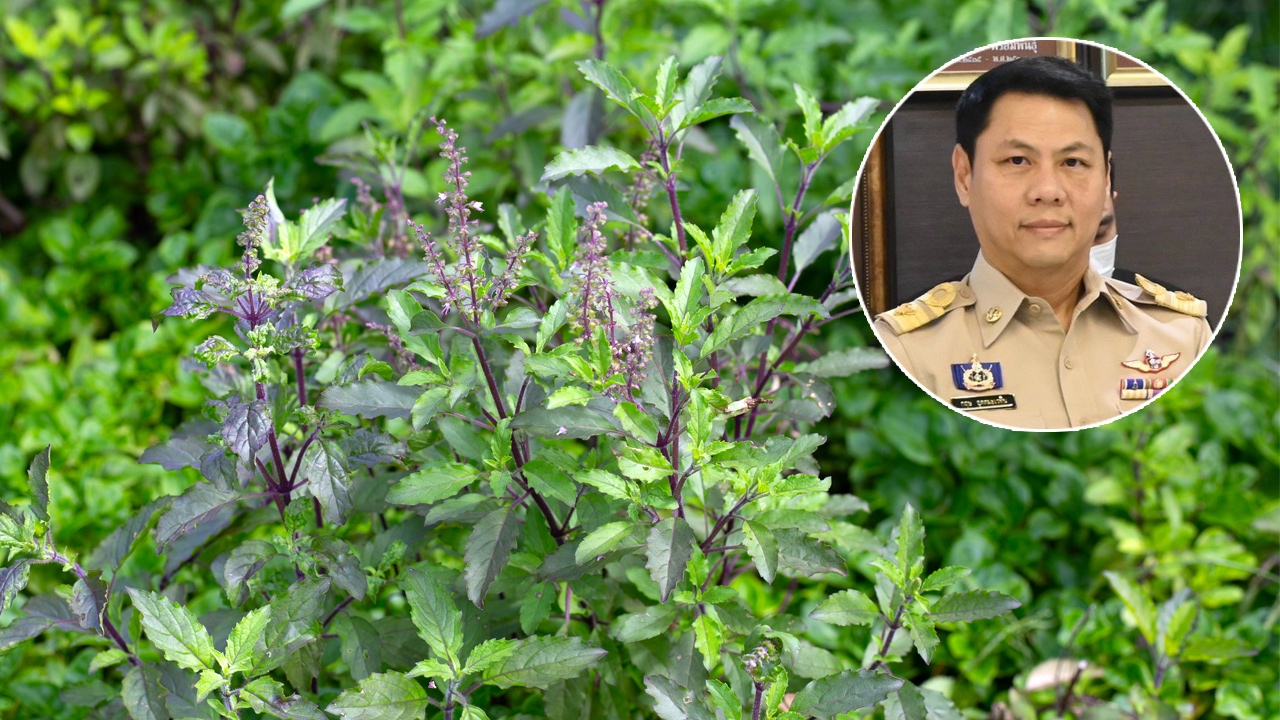
The Ministry of Agriculture and Cooperatives has addressed concerns among farmers and the general public regarding the registration of a new holy basil variety, assuring that it does not affect the traditional local holy basil strains widely used today.
Mr. Krits Uttamawetin, Deputy Permanent Secretary of the Ministry of Agriculture and Cooperatives, speaking as the ministry's spokesperson, explained that the registration of the Kaewjuree 01–04 holy basil variety protects only this newly registered variety.
This registration does not relate to traditional or common holy basil varieties found in the market, nor does it transfer ownership rights of the original varieties to the registrant.
Regarding public concerns about usage rights, the ministry spokesperson stated that the general public and farmers can continue to grow holy basil for consumption, harvest leaves for sale, sell plants as produce for consumption, or use them in food preparation without any legal violations.
However, it is stipulated that seeds or plants used must be traditional varieties, not those developed by any organization and registered under the Plant Variety Protection Act of 1999. If one wishes to propagate the protected variety (such as Kaewjuree) to produce seeds, seedlings, or cuttings for sale, prior permission from the rights holder is required.

The Department of Agriculture confirmed it is currently soliciting public feedback to update the Plant Variety Protection Act of 1999, which has been in effect for over 20 years. The process welcomes suggestions from all sectors, including farmers, plant breeders, and the general public, to develop laws that better fit the current agricultural context in Thailand.
For those with further questions about registration, cultivation, or selling of plant varieties, accurate information can be obtained from the Plant Variety Protection Research Group, Plant Variety Protection Division, Department of Agriculture, by phone at 02-940-7214 or via email.pvpo@doa.go.th
Read more news " State Policy " here