

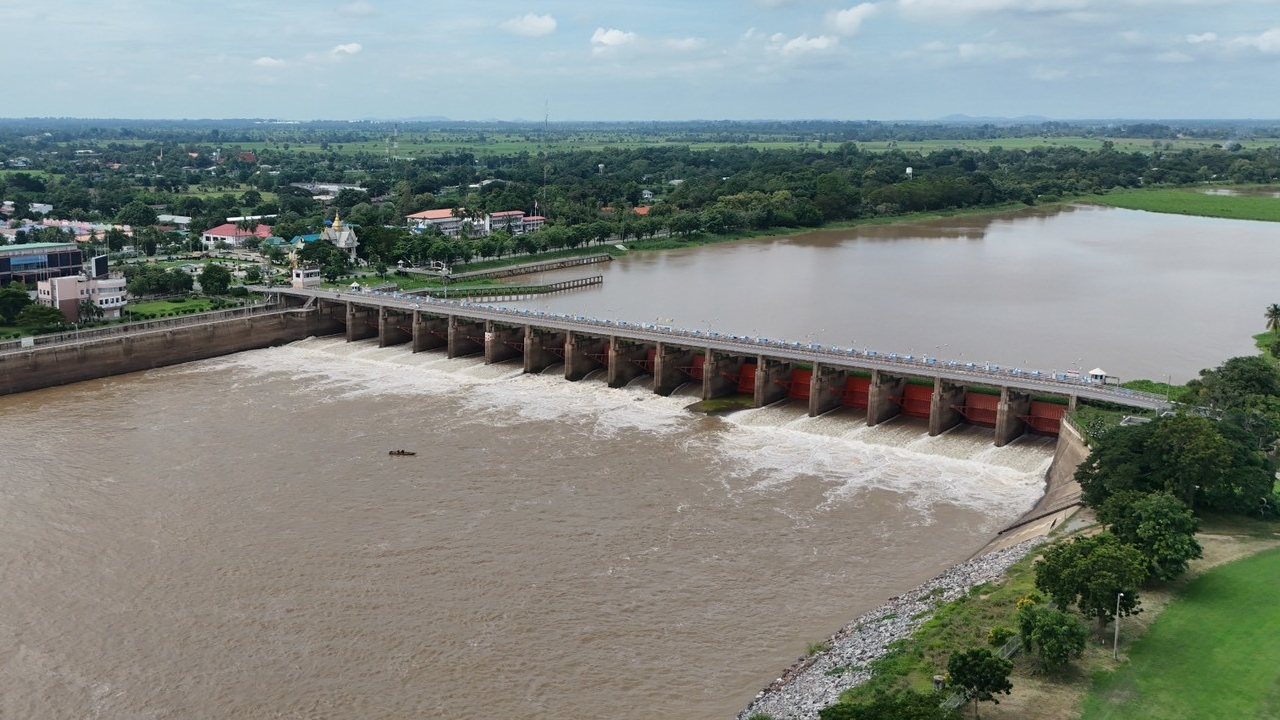
The Irrigation Department announced that upstream rainfall has decreased, leading to a gradual reduction in discharge from the Chao Phraya Dam to 900 cubic meters per second. It is accelerating drainage of flooded agricultural areas and plans to reduce discharge further to 700 cubic meters per second in early November, while closely monitoring accumulated rainfall in the southern region.
A reporter from the Irrigation Department reported that rainfall in the upper region has begun to decline, easing flood situations in several areas. Consequently, continuous drainage of waterlogged lowlands has been expedited following orders from Mr. Suriya Juangroongruangkit, Minister of Agriculture and Cooperatives, to alleviate public hardship and expedite recovery of affected areas so residents can return to normal life quickly. This is being done alongside water storage efforts to meet future demand, while closely preparing for rain conditions in the South.

As of 28 October 2026, large and medium reservoirs nationwide contain approximately 64,191 million cubic meters of water, representing 84% of total capacity. They still have capacity to hold over 12,490 million cubic meters of additional water.
The four main reservoirs in the Chao Phraya basin are:
Together, these hold 18,960 million cubic meters of water, or 77% of total capacity, and can still accommodate about 5,823 million cubic meters more. Overall, water volumes remain at levels that can be efficiently managed.
In the Chao Phraya basin, due to the continuing decrease of upstream water volume, the Chao Phraya Dam in Chainat Province has progressively reduced water discharge to 900 cubic meters per second. It is simultaneously pumping water from agricultural and low-lying areas to return land to farmers quickly so they can prepare fields for off-season rice cultivation.
The plan to reduce discharge will consider upstream water volume, main river water levels, and the drainage capacity of downstream areas to minimize impact on residents. It is expected that discharge through the Chao Phraya Dam can be lowered to 700 cubic meters per second by early November.

The Meteorological Department states that the South should continue to be monitored for accumulated rainfall, which may cause flash floods, runoff, and flooding, especially in foothill areas, water flow routes, and lowlands. Meanwhile, the upper part of Thailand may still experience localized thunderstorms.
The Irrigation Department has instructed local units to closely monitor weather conditions, check readiness of irrigation structures and drainage systems, and prepare pumps, water pushers, machinery, and personnel for immediate deployment. It has also emphasized ongoing water situation warnings to the public.
If the public needs assistance or information about water conditions, they can contact nearby irrigation projects or call the Irrigation Department hotline at 1460, available 24 hours a day.
Read more news " Government Policies " here