

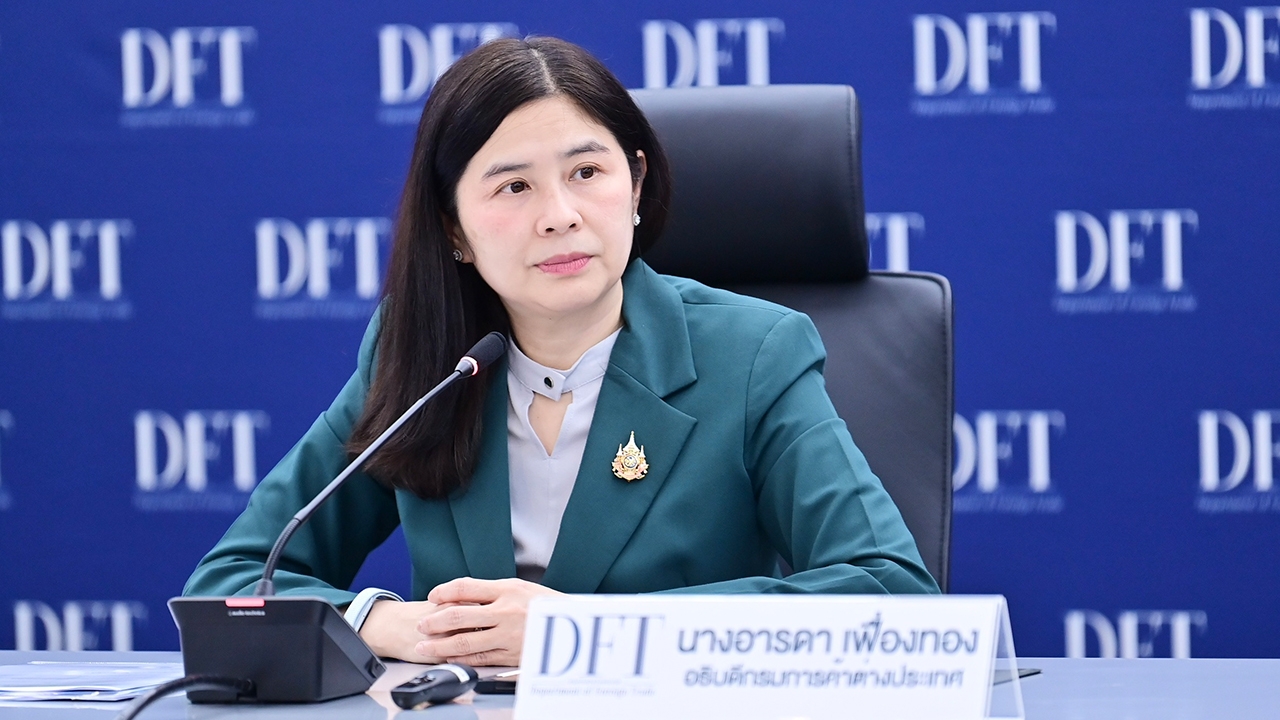
The Director-General of the Department of Foreign Trade admitted that rice and cassava exports this year missed their targets, with rice exports expected at only 6.5 million tons—the lowest in five years. He cited negative factors from the global economy and war, and took full responsibility himself.
Ms. Arada Fuengthong, Director-General of the Department of Foreign Trade. She revealed the situation of Thailand's rice and cassava exports this year, stating that rice exports are forecasted at only 6.5 million tons, below the 7 million ton target and the lowest in five years since 2022 when exports reached 7.69 million tons. In the first nine months (Jan–Sep) this year, exports were only 4.99 million tons—a 19.26% decrease from the same period last year—with a value of 2.962 billion USD, down 16.84%. To reach 7 million tons by the end of 2026, exports would need to hit 800,000–900,000 tons per month from September to December, which is unlikely since export licenses up to September 2026 total just over 5 million tons.
Throughout this year, global demand for rice dropped significantly, causing exports from the world's five largest rice exporters—Thailand, Vietnam, Pakistan, and the U.S.—to fall by 4%, except India which increased exports by 2% due to much lower prices. For example, India's 5% white rice is priced at 388 USD per ton, compared to Thailand's 480 USD and Vietnam's 420 USD per ton.
Moreover, Thai rice prices are much higher than competitors: Thailand's 5% white rice is 21.3% more expensive than India's, 12.2% higher than Pakistan's, and 11.6% above Vietnam's. In the context of a global economic slowdown, buyers are tightening budgets and opting for cheaper rice. Additionally, conflict in the Middle East has made the Iraq market—once importing over 1 million tons annually—unavailable due to unsafe shipping through the Strait of Hormuz. Key buyers like Indonesia have also suspended rice imports. The stronger Thai baht and rising shipping costs have further affected exports.
Regarding government-to-government (G2G) rice sales to China, the latest deal negotiated was with COFCO, a state-owned enterprise, for 60,000 tons over five shipments. However, Thai rice prices remain high and shipping costs have increased, so no agreement has been finalized. The latest G2G rice contract with China is for 1.22 million tons, with 760,000 tons delivered. The department will continue negotiations in the remaining two months to agree on pricing and delivery.
Ms. Arada. She continued on cassava exports, reporting that in nine months, exports totaled 3.24 million tons—a 55.12% decrease—with a value of 1.6978 billion USD, down 28.47%. This is due to severe domestic production shortages; in 2025/2026, production is only 24 million tons, down from the usual over 30 million tons. Imports from neighboring countries have also dropped to 1.46 million tons, with no imports from Cambodia at all. Despite this, prices remain high: pelletized cassava increased 10.56% from last year, raw cassava starch rose 30.74%, and processed starch went up 8.53%. The annual export target is 6.1 to 7 million tons, but may not be met.
"I must apologize for not meeting the targets for both rice and cassava. This year’s situation has been difficult due to war, shipping costs, and reduced purchasing power in various countries, which lowered import demand. Natural disasters also reduced production. Please do not blame the government or politics. As Director-General, I take responsibility personally because it is my direct duty." Ms. Arada said this while raising her hands in a traditional Thai apology gesture.
Read more news " Government policy " updates