

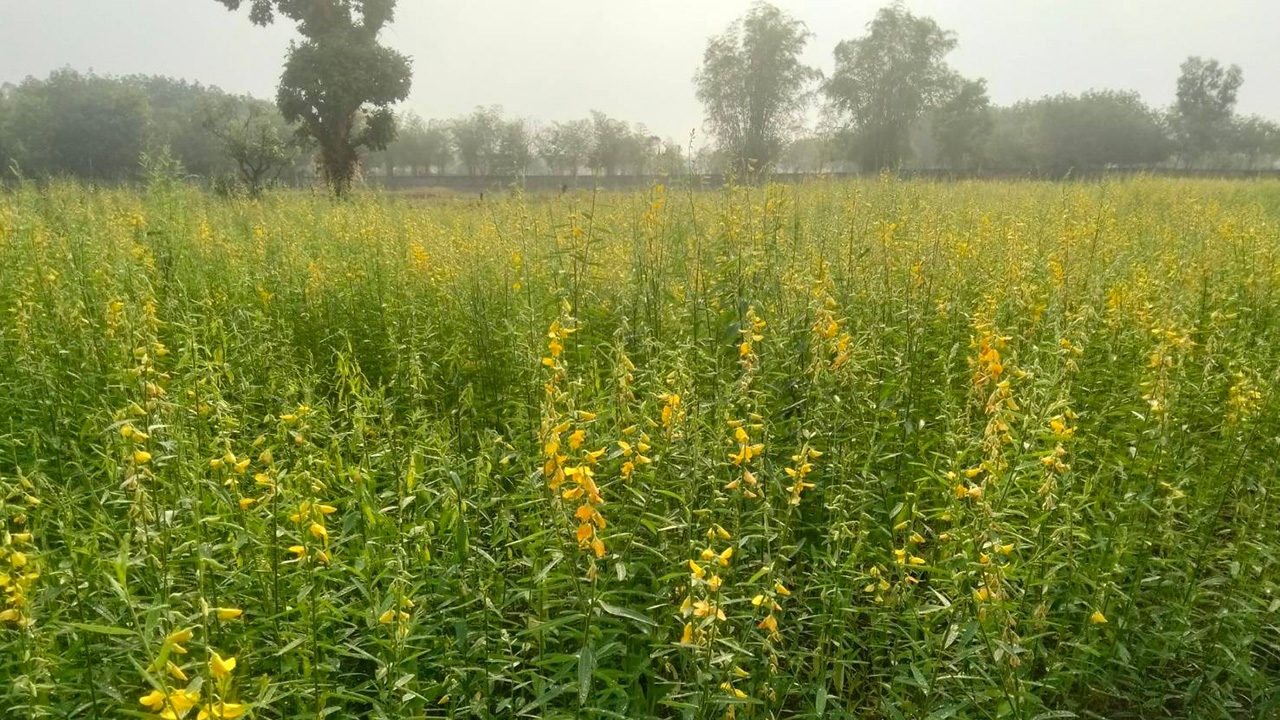
The Department of Land Development is encouraging farmers in northeastern Thailand to plant sunn hemp after rice harvesting, promoting it as a premium green manure that increases organic matter, improves soil texture, reduces chemical fertilizer costs, and raises rice yields higher.
Mr. Suchon Kaewkosaba, Deputy Director-General and spokesperson of the Department of Land Development, said that currently the department is promoting the use of green manure plants by campaigning for farmers to plant sunn hemp after harvesting rice. This is to improve and nourish the soil in rice fields. In the Northeast, many areas have coarse or sandy soils with low organic matter and fertility. Additionally, much agricultural land is outside irrigation zones and relies mainly on rainwater. Planting sunn hemp and plowing it under as green manure increases soil organic matter, enhances soil structure, improves moisture and nutrient retention, and leads to long-term soil fertility.

Plowing sunn hemp into the soil is like placing an organic fertilizer factory directly into the rice field, since sunn hemp is a leguminous plant that can fix high amounts of nitrogen. Data from the Department of Land Development indicates sunn hemp can produce about 1.5–5 tons of fresh biomass per rai and supply approximately 8.7–28.9 kilograms of nitrogen per rai, depending on soil fertility. When plowed under, it helps make soil loose, retain moisture well, and supports rice growth in the next season.

Mr. Komsan Khotsitha, a volunteer soil scientist from Sum Sao Subdistrict, Phen District, Udon Thani Province, a model farmer, uses sunn hemp to improve soil and integrates a rotation system of “rice–sunn hemp–drought-tolerant crops–rainfed rice” to maximize and sustain land use. After harvesting rainfed rice, he prepares the field and sows sunn hemp seeds at 5 kilograms per rai, then plows it under during flowering, the optimal stage for green manure use, allowing biomass to decompose and return nutrients to the soil. About two weeks after plowing under, he plants drought-tolerant crops like cucumber and yardlong bean to generate income during the dry season. After harvesting these crops, he prepares the land for the next rainfed rice season. This continuous rotation requires no chemical fertilizers. Mr. Komsan believes the “post-rice period” is not a time to leave land idle but an opportunity to restore soil and generate income, a method that can be shared and expanded among nearby farmers to improve agricultural efficiency and sustainability.


Ms. Saengchan Promsangsai, another model farmer, has farmed rice all her life on 26 rai. She initially used only chemical fertilizer, specifically 12 sacks of a 16-8-8 formula. She first tried green manure in 2018 by testing two plots: one with chemical fertilizer and one with sunn hemp. Both yielded the same rice harvest. The following year, she reduced chemical fertilizer to 3 sacks but maintained the same yield. Since then, she stopped using chemical fertilizer entirely. The soil improved from hard and compacted to soft, loose, and alive, resulting in an average rice yield of 350 kilograms per rai. She now considers sunn hemp indispensable, saying its presence gives farmers peace of mind.

Studies by the Department of Land Development found that using sunn hemp as green manure raised the yield of KDML105 rice from 351 to 494 kilograms per rai, about a 41% increase compared to unfertilized plots. Using sunn hemp together with half the recommended chemical fertilizer rate produced an average yield of 710 kilograms per rai, close to the 699 kilograms per rai yield with full fertilizer application. This demonstrates sunn hemp's potential to partially replace chemical fertilizer nutrients. However, actual yields may vary depending on soil type, rice variety, water availability, and field management.
Furthermore, using green manure plants like sunn hemp and plowing them into the soil not only restores organic matter and nutrients but also allows farmers to make profitable use of post-rice land by growing drought-tolerant crops for supplemental income before the next rice season. “Rest the rice field, but not the soil: plant sunn hemp to boost soil power before earning income from drought-tolerant crops.”
Read the news " Government policy " for more information.