

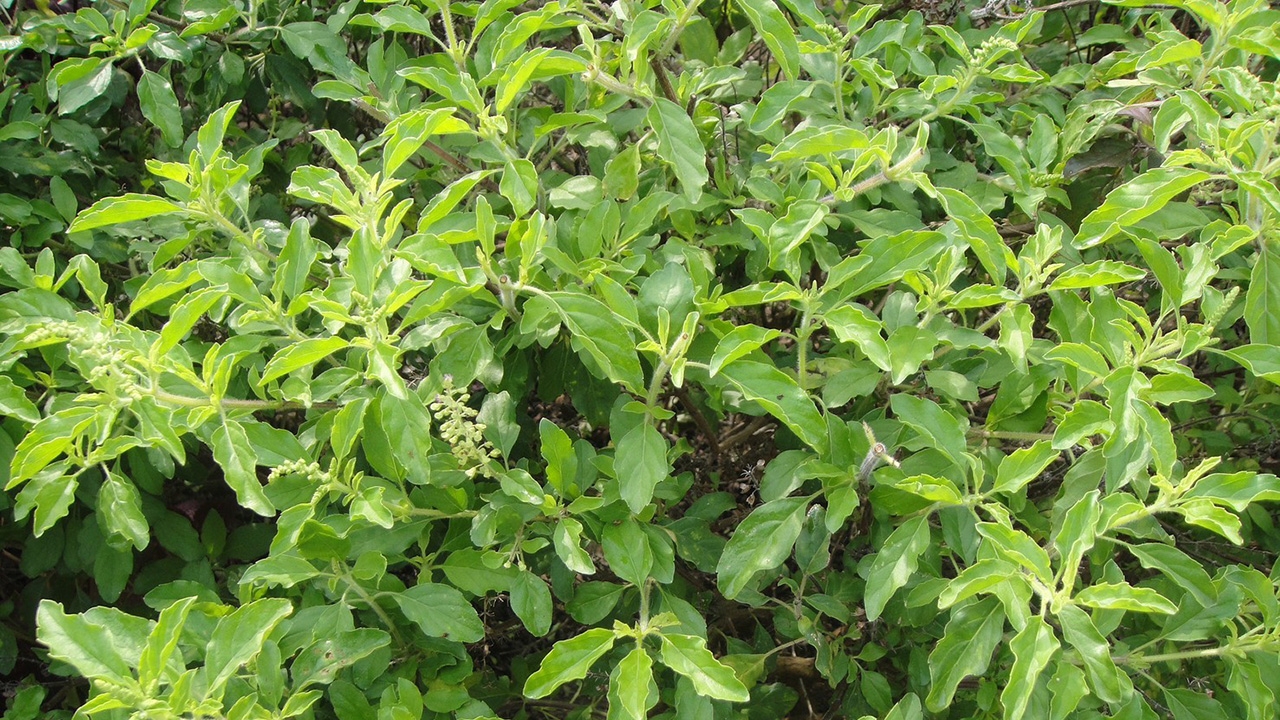
The Department of Agriculture clarified the case of registering protection for new plant varieties "Four Holy Basil Varieties" by CP RAM Company, confirming that every step followed the law and emphasizing it does not affect farmers and the public who grow indigenous holy basil varieties.
The Department of Agriculture confirmed that the registration of protection for the four holy basil varieties complied with the Plant Variety Protection Act B.E. 2542 (1999) at every stage, including examination, application review, licensing, and benefit-sharing agreements, emphasizing the law allows all parties equal opportunity to register new plant varieties and affirming this registration does not affect the rights to use indigenous or common holy basil varieties by farmers and the public.

Ms. Sasina Pantan, Deputy Director-General of the Department of Agriculture, serving as the department's spokesperson, revealed that the Minister of Agriculture and Cooperatives ordered the Department of Agriculture to verify whether the registration of protection for four holy basil varieties—Kaewjuree 01, 02, 03, and 04—was conducted legally under the Plant Variety Protection Act B.E. 2542.
The Department of Agriculture promptly and thoroughly investigated the facts and related documents as instructed by the Minister and found that the registration of protection for all four varieties was properly carried out according to the law.
The Department followed the ministerial regulations specifying criteria and procedures for registration applications, examination, public announcement, and official certificates under the 2003 regulation. It reviewed application documents, breeder history, origin and breeding history, key variety characteristics, and benefit-sharing agreements, finding all documents complete and compliant with the criteria.
Additionally, it verified the new plant varieties’ qualifications according to DUS standards—an essential criterion to determine if the plant variety qualifies as new under the law.
This evaluation considers three main criteria:
The varieties were planted and compared with the parent variety CPR1 and the closely related green large-leaf variety 059 over two planting seasons.
The examination found that all four holy basil varieties distinctly differ from the comparison varieties in leaf shape, size, and thickness, and show uniformity and stability of characteristics as required.

For the public announcement step, the Department publicly announced the applications for 90 days to allow stakeholders to object as per legal rights. Kaewjuree 01 was announced from 14 Nov 2023 to 12 Feb 2024, and Kaewjuree 02–04 from 28 Dec 2023 to 27 Mar 2024. No objections were filed during these periods, so the Department issued official plant variety protection certificates for all four varieties.
The Department’s spokesperson added that registering protection for new plant varieties is not exclusive to any private company but a legal right open to everyone, including individuals, universities, or private entities, who develop new varieties meeting all criteria.
Important facts about protection rights.
Common holy basil varieties remain unaffected. Protection applies only to the four registered varieties; farmers can still grow and use indigenous holy basil varieties normally.
Use of registered varieties. Registered protected varieties can be freely planted for personal consumption, leaf harvesting and sale, or for cooking and selling food.
Restrictions. It is prohibited to use protected varieties for "commercial propagation" such as producing seeds, seedlings, or cuttings for sale without permission from the rights holder.

“The investigation confirms that the Department of Agriculture’s actions and CP RAM’s registration application comply fully with the Plant Variety Protection Act B.E. 2542 and related laws. Furthermore, since the registration more than two and a half years ago, no farmers, consumers, or retailers have lodged complaints with the Ministry of Agriculture and Cooperatives about any negative impact. Plant variety protection is a legal mechanism to promote research and development of plant varieties, ensuring equal access to rights while safeguarding farmers’ and the public’s rights to use indigenous and general plant varieties,” said the Department’s spokesperson.
However, the Department of Agriculture has established a "Complaint Center" at its convenient government service center. Anyone affected can contact or file complaints at the Plant Variety Protection Division, Department of Agriculture, at telephone numbers 089 744 5013 or 091 718 4750.
Read news " State policy " Additional