

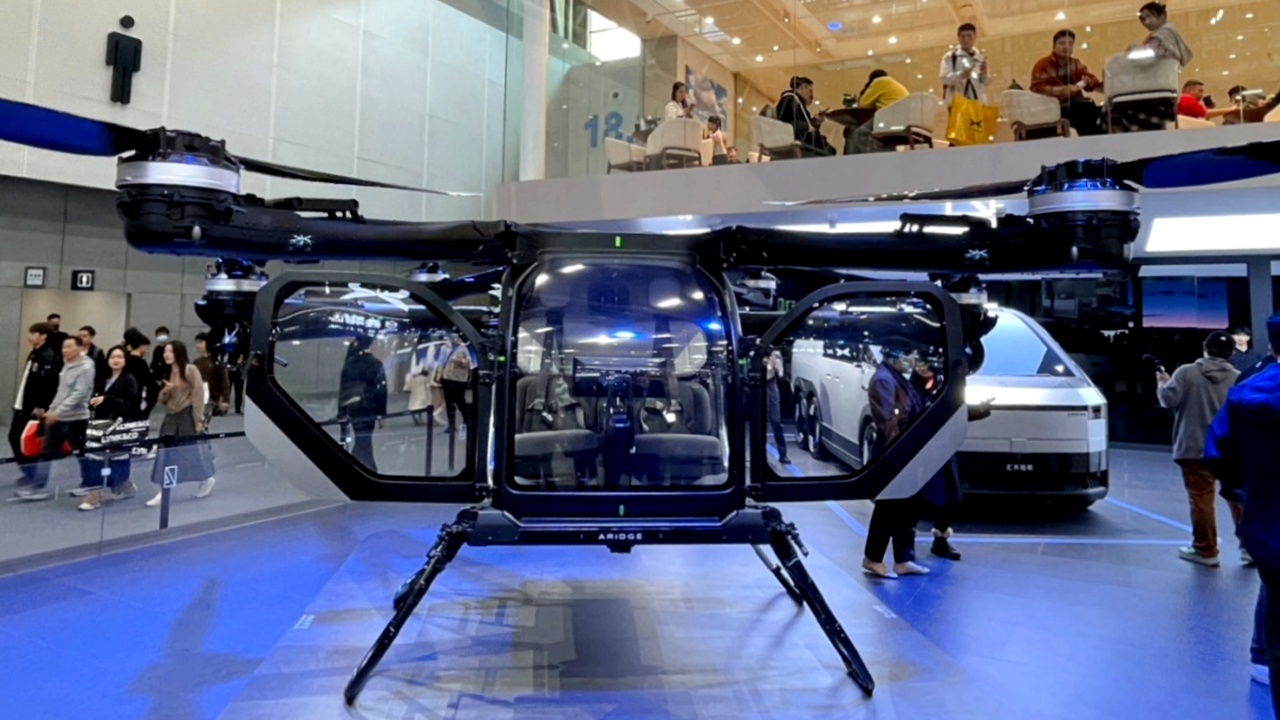
OR led media representatives to study innovations in energy and transportation in China, highlighting a remarkable model of fish farming that creates community jobs beneath solar panel farms, and flying cars planned for commercial production in 2026.
On 25 Nov, reporters learned that PTT Oil and Retail Business Public Company Limited (OR), operating in energy and retail, took a media delegation to study energy, technology, and innovation in China, one of the world's fastest leaders in energy and innovation.
The visit began in Guangzhou at Baiyun Power Group, a leading private company specializing in electrical equipment solutions that has supported China’s high-voltage power grid for over 30 years. They are experts in developing technologies that ensure electrical system stability and safety. A notable innovation is V2G (Vehicle-to-Grid), which allows electric vehicles (EVs) to charge their batteries and simultaneously feed energy back to the power grid. V2G helps balance electricity demand by drawing power from parked, charging EVs during peak usage times. However, V2G is not yet fully compatible with all EVs; currently, only vehicles with two-way charging capability and suitable charging systems can use it.

Additionally, the company produces a new generation of glass insulators made with technology that prevents electrical conduction, reducing energy loss on transmission lines and the risk of short circuits on power poles. These insulators have a longer lifespan and require less maintenance. They also manufacture fire-resistant components for transformers and cable connections, featuring specialized thermal insulation layers that lower the risk of heat accumulation.

Next, the delegation attended Auto Tech Expo 2025, an annual automotive technology event gathering Chinese and international companies ranging from startups to giants like BYD, Xpeng, and Geely. The Chinese government regards this expo as a showcase of China’s automotive and mobility technology.
A key highlight was the Xpeng Flying Car (AeroHT), a Land Aircraft Carrier model consisting of two main parts: 1. Ground Module — a large carrier-like vehicle seating 4-5 passengers; and 2. Air Module — an eVTOL (electric vertical takeoff and landing aircraft) that can detach from the ground module and fly at low altitudes. After flight, the air module docks back onto the ground module, with foldable propellers to fit the vehicle.
The ground module uses an Extended-Range Electric Vehicle (EREV) powertrain, combining a battery with a system to extend driving range. Xpeng announced plans to begin commercial production of the AeroHT flying car in 2026.
The Auto Tech Expo also showcased intelligent driving systems, the latest Lidar sensor technology, semi-autonomous driving systems ready for road use in China, and AI trained on Chinese road structures and driving behaviors. New EV batteries were displayed, featuring faster charging and longer use, such as low-cost sodium-ion batteries and ultra-fast charging batteries for large EVs.

Finally, in Shantou, the group visited Huaneng Shantou Power Plant (Huaheng Power International), a core company of China Huaneng Group Co., Ltd. (CHNG), one of China’s five major state power generation groups. It is among the largest and most diverse clean energy producers in China and the world, ranking second globally, with 49% of its output from clean sources like wind, solar, and small modular nuclear reactors (SMRs).

A major highlight at Huaneng Shantou was the largest floating solar farm in Guangdong Province, a large-scale solar panel system installed on a water surface. This solar farm operates alongside an aquaculture system, lowering water temperatures to improve power generation efficiency and reduce evaporation. Locals can farm fish and shrimp under the panels, creating additional income. This reflects the Green Plus Model (Green + X), such as Green + Fishing, Green + Agriculture, and Green + Tourism, meaning clean energy projects must provide extra benefits beyond electricity production.
