

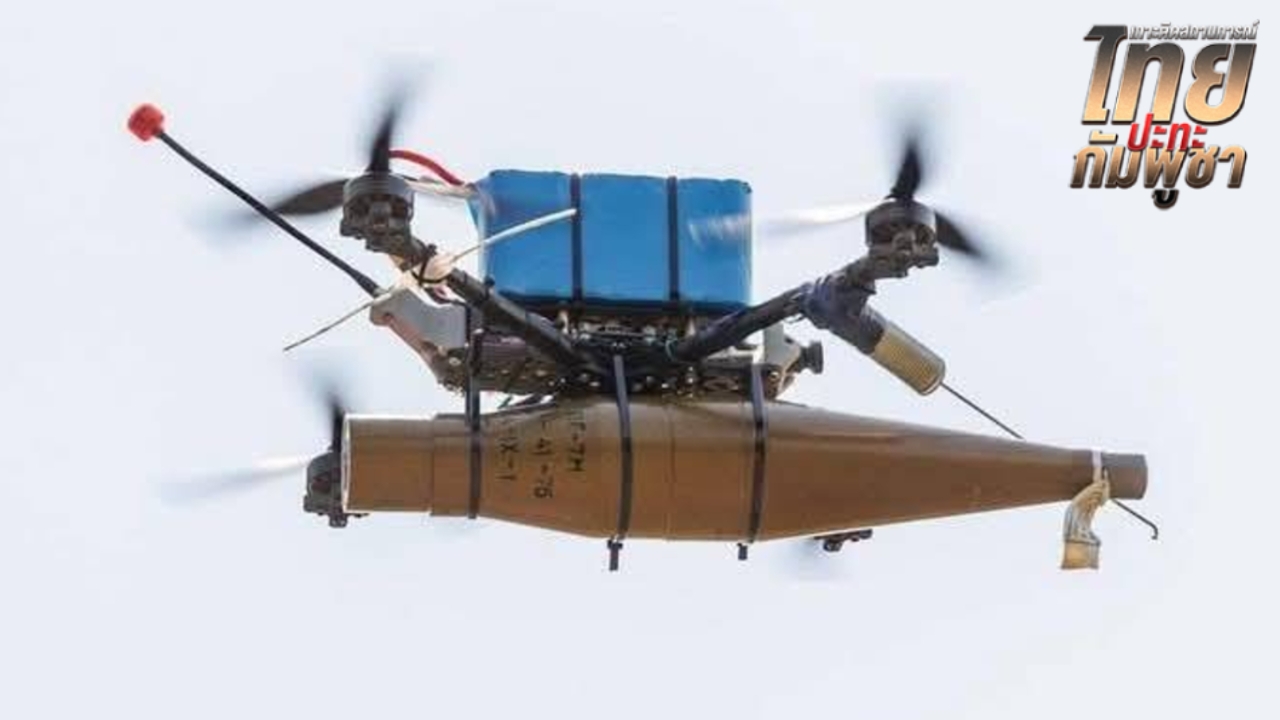
Revealed: why Cambodian drones have aggressively attacked for five consecutive days, using hills 745 and 677 as high ground and fiber optic systems to prevent interference from Thai jammers. Drone debris points to foreign control behind attacks on Thailand, employing tactics identical to those in the Ukraine–Russia battlefield.
On 12 Dec 2025 GMT+7, a report from the 2nd Army Region disclosed that during the past five days of fighting along the Thailand–Cambodia border, Cambodian forces have repeatedly used drones as weapons to attack Thai positions. Upon investigation, it was found that the drone operators were not Cambodian, leading to data analysis that confirmed the drones used by Cambodia against Thailand resemble those deployed in the Ukraine–Russia war.
Modern warfare developments have transformed drones into game-changing weapons, especially “FPV kamikaze drones,” as seen in the Ukraine–Russia conflict. These serve as key prototypes adapted by several countries, including Cambodia, in recent border clashes with Thailand.

Analysis of the drone wreckage seized in Thai territory, considering structural design, equipment, and strategic terrain, reveals tactical links and explains how Cambodia could effectively deploy drones despite lacking a clear prior training history.
FPV drones used in the Ukraine–Russia war exemplify low-cost weapons with high destructive power. Their main components include 1. carbon fiber frames, 2. four motors, and 3. FPV cameras connected to real-time control goggles, enabling operators to precisely crash drones into targets. They also mount small warheads or modified artillery, machine gun, or RPG projectiles, all at low cost but with significant tactical impact.

Mass production in field factories allows Ukrainian and Russian forces to deploy drones in sustained front-line swarm attacks, a phenomenon studied and emulated worldwide.
The 2nd Army Region report further stated that comparing drone wreckage captured by Thai forces at Chong Bok and Chong An Ma shows clear similarities to FPV drones from the Ukraine–Russia war: 5-inch frames, LiPo batteries with XT60 connectors, carbon fiber construction, warheads attached with straps and cable ties, and internal parts indicating kamikaze drones rather than surveillance drones. Signal detection shows drone activity originating from Cambodia during clashes, confirming these attacks were systematically controlled by operators knowledgeable in FPV systems.
The report added that directly transferring complete drone systems from Eastern Europe to Southeast Asia is unlikely due to transport and international weapons control constraints. More probable is the transfer of knowledge, techniques, personnel, and assembly prototypes to Cambodia, a common pattern in 21st-century proxy wars. FPV drone assembly skills and pilot training can be rapidly passed on, with experts entering countries under civilian statuses—such as drone racers, technicians, or private consultants—carrying portable control equipment discreetly. Supporting this theory, voice commands in English like “finished” were found, a language uncommon for Cambodian soldiers but typical among FPV pilots in the Ukraine–Russia conflict.

Regarding attack accuracy, target site selection, and flight behavior, all indicate that drone operators are experienced and not Cambodian forces using drones for the first time. Such skill requires advanced training and likely external support or veterans from actual battlefields.
Another key feature of the Cambodian drones is their fiber optic control system, which cannot be jammed by Thai jamming equipment. Using wired controls provides stable command in mountainous terrain but demands high operational skill, indicating systematic preparation and training beyond the basic capabilities of Cambodia’s past military personnel.
“Selecting attack sites such as Chong Bok and Chong An Ma reflects clear strategic terrain assessment. Cambodia’s high points like hills 745 and 677 offer wide views over Thai areas, serving as safe, advantageous drone launch bases. Drones flying from higher to lower terrain are easier to control, and the landscape of valleys, waterways, and dense forests helps conceal fiber optic cables, complicating Thai detection. This choice of terrain shows Cambodia’s deep understanding of geography and modern drone warfare.
The impact on Thai forces is multifaceted: geographic disadvantages, jammers ineffective against wired drones, and psychological stress from attacks with unseen origins necessitate a complete revision of defensive tactics, including improved detection systems, interception capabilities, and optimized troop deployments.
Overall assessment concludes Cambodia does not surpass Thailand in military technology but gains advantage through “appropriate attack site selection combined with techniques and likely personnel from the Ukraine–Russia war.” This has made Cambodian drones more effective than expected and provides an important lesson for Thailand to develop its forces in the emerging domain of drone warfare.
