

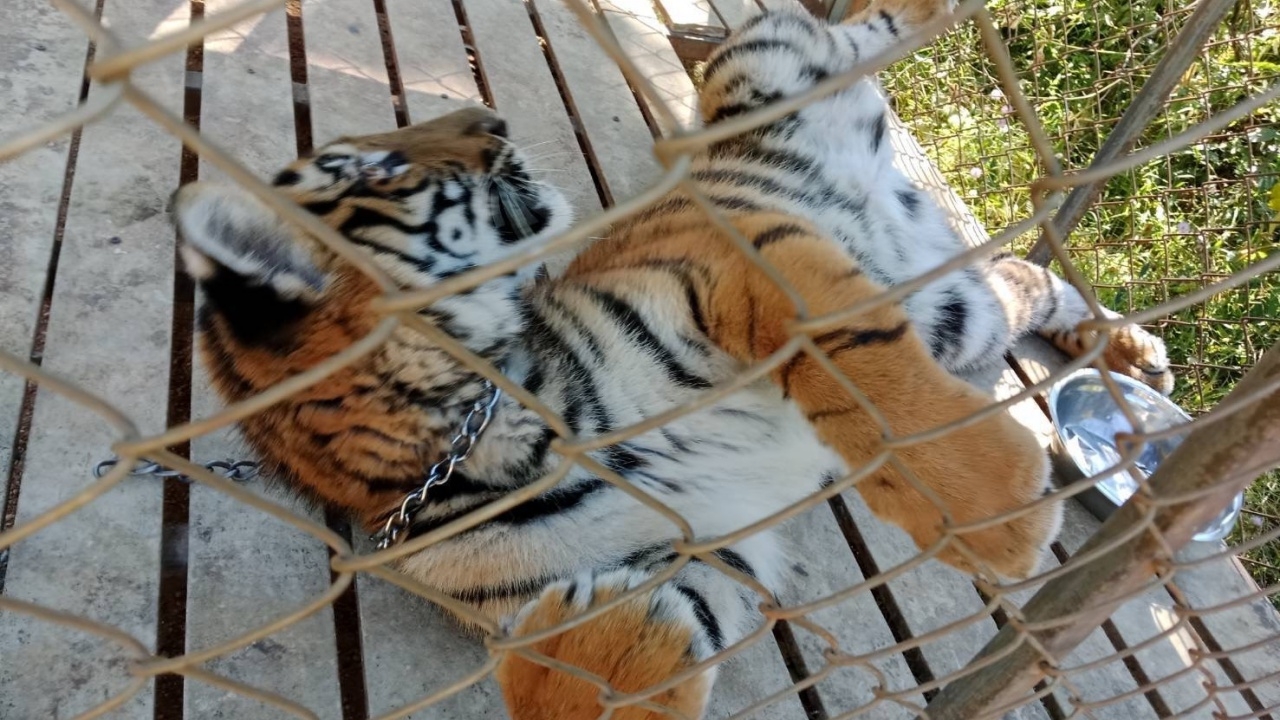
KNU soldiers raided a scammer base and found a female tiger cub held captive, sending it back to Thailand. The Minister of Natural Resources and Environment ordered expanded DNA testing to investigate connections to international wildlife trafficking networks and directed full legal prosecution before transferring the cub to Wildlife Rescue Center 3 for care.
On 18 December 2025, it was reported that Mr. Atthapol Charoenchansa, Director-General of the Department of National Parks, Wildlife and Plant Conservation, revealed he received a report from Mr. Rachan Buatri, Director of the Protected Areas Regional Office 3 (Ban Pong), regarding the reception of a female tiger cub found within a scammer gang's base on the Myanmar border.
Mr. Suchart Chomklin, Deputy Prime Minister and Minister of Natural Resources and Environment, expressed deep concern for the tiger cub's welfare, instructing the Department of National Parks to provide full care. He also ordered increased border enforcement to prevent illegal wildlife trafficking potentially linked to other illicit businesses in cross-border areas. Veterinarians were tasked with collecting blood samples for detailed genetic (DNA) testing to identify the cub's subspecies and determine if it is connected to major international wildlife trafficking networks.

The incident occurred at about 01:35 on 18 December 2025, when KNU soldiers seized the tiger cub during an operation against scammer groups in Myanmar. They delivered the cub at the Lat Ya checkpoint of the Surasi Task Force (6000 Rai), Sangkhla Buri District, Kanchanaburi Province, intending to hand it over to a foundation. Relevant agencies coordinated to conduct inspections.
Initial inspections found no legal documents for possession, import, or export. Officials confiscated the cub under the Wild Animal Reservation and Protection Act B.E. 2562 (2019) for unauthorized possession and import of protected wildlife; the Animal Epidemic Act B.E. 2558 (2015) for importing animals without health inspection; and the Customs Act B.E. 2560 (2017) for bringing goods into the kingdom without customs clearance. The head of the Sangkhla Buri wildlife checkpoint filed a formal complaint with Sangkhla Buri Police Station.
Mr. Rachan Buatri, Director of Protected Areas Regional Office 3, said the arrest team is gathering all evidence, including photographs, witness statements, and incident details, to file charges and prosecute all involved parties thoroughly—whether they smuggled the cub from Myanmar or the foundation personnel coordinating the handover.

The offenses include the Wild Animal Reservation and Protection Act B.E. 2562, Sections 17 (possession of protected wildlife without permission) and 23 (import of protected wildlife without authorization); the Animal Epidemic Act B.E. 2558, Section 31 (importing animals without a permit); and the Customs Act B.E. 2560, Section 242 (importing goods without customs procedures).
As this is a sensitive case involving a charity organization, officials are compiling thorough evidence to present to Sangkhla Buri Police for issuing summonses to offenders for legal proceedings.
After the cub was received under a police report at Sangkhla Buri Police Station, Kanchanaburi Province, report number 5 at 21:00 on 17 December 2025, it was transferred to Wildlife Rescue Center 3 for further detailed examination. The cub is a female, approximately 4 months old, weighing 29 kilograms.
External health checks showed the tiger cub is healthy, active, alert to its environment, and has a normal appetite. Hair samples were collected from its body for subspecies identification at the Department of National Parks, Wildlife and Plant Conservation's Forensic Science Center. Testing will take 30-45 days. In 3-5 days, once the cub’s stress level decreases, veterinarians will collect blood samples for laboratory disease testing.
