

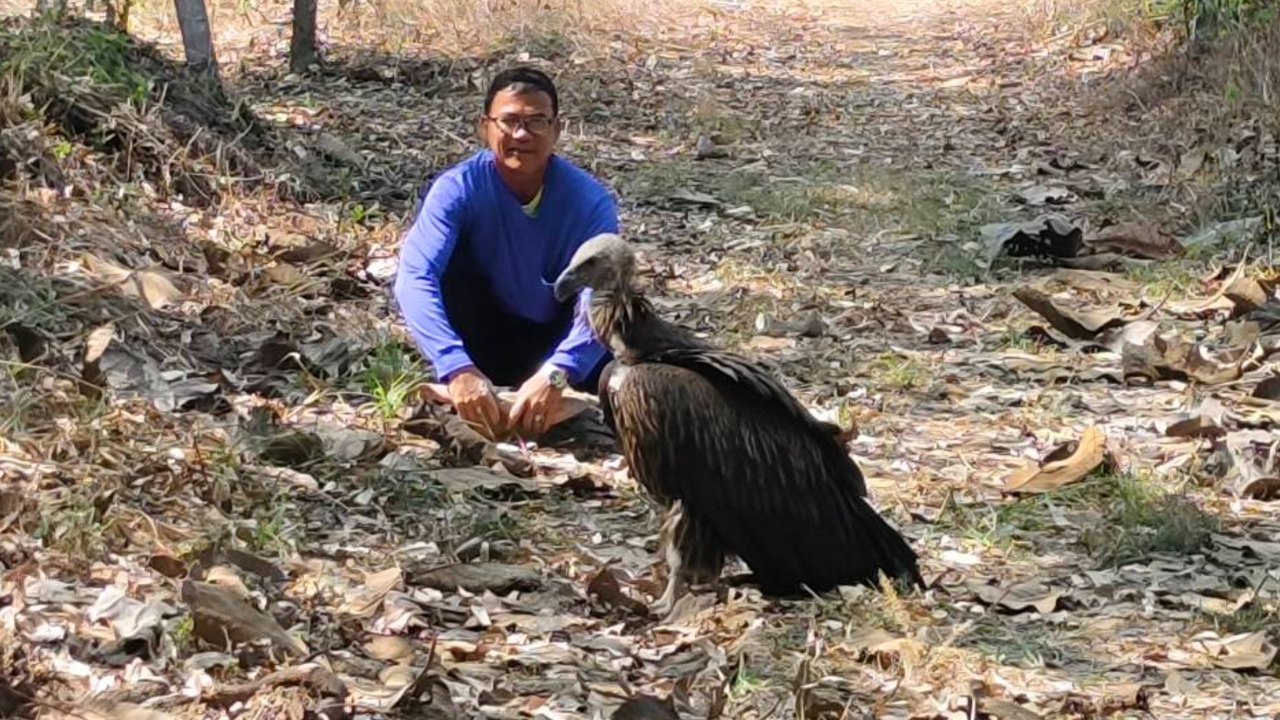
A juvenile Himalayan Griffon Vulture was found unable to continue migrating and exhausted, marking the third such incident this year. Authorities warn against feeding the bird and advise reporting to the Department of National Parks officials.
On 19 Jan 2026 GMT+7, villagers reported spotting a single brown Himalayan Griffon Vulture unable to continue migrating, perching on a teak tree before falling to the ground in front of a house in Village No. 14, Chiang Thong Subdistrict, Wang Chao District, Tak Province.
Mr. Boonlue Fanfuea, 58, the homeowner who found the bird, said he saw a very large bird spreading its wide wings, the likes of which he had never seen in his 58 years. The bird flapped loudly and was chased by crows before descending to perch quietly on the teak tree behind the house. Curious, he approached and realized it was a vulture.

Shortly after, the vulture fell from the teak tree and lay motionless on the ground for a while before slowly standing up. Mr. Boonlue kept dogs away to protect the bird and contacted Mr. Nopparat Manat, a well-known local volunteer councilor of Wang Chao Municipality, who came to assist and coordinated with relevant authorities and experts.
It was identified as a brown Himalayan Griffon Vulture, a protected wild species in Thailand classified as near-threatened. This rare species has a global population of about 66,000. The juvenile vulture likely migrated from western China or the Tibetan Plateau, flying through Thailand toward islands in Indonesia. This may have been its first migration, causing exhaustion and the fall.

Later, councilor Mr. Nopparat Manat coordinated with relevant agencies and assigned Mr. Kamoltep Unmuang, disaster prevention officer of Wang Chao Municipality, to lead a team with equipment to safely capture the vulture and transfer it to the wildlife conservation forestry officials at Protected Area Administration Office 14 in Pa Ma Muang Subdistrict, Mueang District, Tak Province for rehabilitation.
Currently, this is the third reported case of a fallen brown Himalayan Griffon Vulture this year, with at least two prior cases. Case 1 (Lopburi Province): A juvenile vulture was found lost in Huai Hin Subdistrict, Chai Badan District, in late December 2025. Park officials monitored and fed it until it recovered and flew back to the wild on 26 Dec 2025.
Case 2 (Satun Province): In early January 2026, a juvenile brown Himalayan Griffon Vulture was found fallen in Satun Province. Officials quickly transferred it to the Raptor Rehabilitation Unit at Kasetsart University (Kamphaeng Saen) for treatment and recovery.
According to data, each winter from November to March, 10-30 Himalayan Griffon Vultures (and occasionally Himalayan Black Vultures) fly into or through Thailand. They follow cold winds into ASEAN countries such as Myanmar, Thailand, Cambodia, and down to Singapore. Some become exhausted and fall in Malaysia and Sumatra, Indonesia.

These vultures drift southward with cold winds along the Tenasserim Hills (some fly northeast and are found in eastern Thailand). Without carrion—now scarce due to the lack of natural livestock carcasses—and as cold winds weaken, the vultures lose energy, struggle to fly due to their 6-12 kg weight, and fall. In southern Thailand, cold winds weaken due to monsoon humidity, causing more frequent vulture falls.
As a rare, near-threatened protected species under the Wildlife Preservation and Protection Act B.E. 2562 (2019), anyone finding a fallen vulture should call hotline 1362. Officials will rescue injured, lost, or exhausted vultures and take them to nearby breeding stations for care. Those needing medical treatment or surgery are sent to the raptor rehabilitation unit in Kamphaeng Saen, Nakhon Pathom Province, for health recovery and flight training before release during the northbound migration in April along the western and northern migration routes, such as Mae Wong and Pha Hom Pok National Parks.

Conservation and satellite tracking over five years (2021-2025) by the Raptor Research and Conservation Medicine Unit, Faculty of Veterinary Medicine, Kasetsart University, followed six vultures. They traveled long distances back to their origins in Sichuan, Gansu, Yunnan provinces, and Tibet Autonomous Region, China. Some vultures alternate their summer habitats between Mongolia and China.
If a fallen vulture is found unable to lift its head or resist, give warm saline water (1,000 ml clean water + 9 g table salt) 50-100 ml every 3-6 hours. Do not feed solid food initially. After 1-2 days, when the vulture can lift its head, small pieces of fresh pork or chicken (not necessarily spoiled) may be offered.
Do not force-feed meat or other substances, especially oils, as vultures may choke and die. When the vulture regains strength and can lift its head, move it to a veterinarian or wildlife breeding center under the Department of National Parks and call hotline 1362. Officials will collect and treat the bird free of charge.