

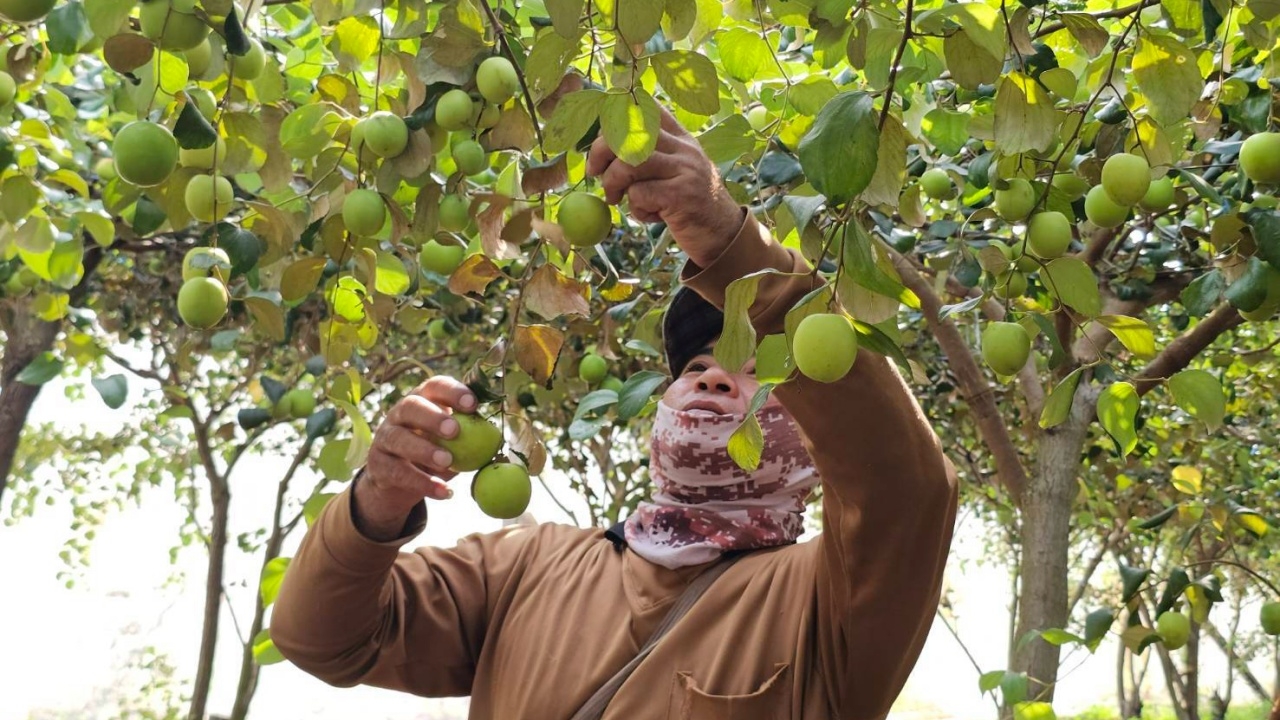
From studying new economic crops to replace rice farming, "Sugar Cane Jujube and Indian Red" have become main income-generating plants, a specialty from orchards in Laplae District, Uttaradit Province, producing once a year.
On 21 January 2026, Mr. Prateep Techai, a middle-aged farmer and owner of PTF Farm in Laplae District, Uttaradit Province, welcomed tourists and interested farmers to visit his sugar cane and Indian red jujube orchard spanning over 14 rai. The farm includes both net-covered and open-field jujube cultivation. After researching alternatives to rice farming due to the poor rice prices, the focus was on crops that require little water, are drought-resistant, and emphasize safe fruit production, which consumers now value highly. This led to converting 2 rai of paddy fields to net-covered jujube orchards, starting with wild jujube seedlings known for disease resistance, drought tolerance, and longevity. Branches of sugar cane and Indian red jujubes were grafted onto one tree, creating two varieties per tree. When flowering, the Indian red jujube aids natural pollination of the sugar cane jujube by wind—a specialized agricultural technique. The resulting fruit is large, apple-green in shape, with thin, crisp skin, averaging 10 fruits per kilogram, tasting sweet, juicy, and crispy.

"Starting net-covered jujube planting in 2019, many thought I was 'crazy.' I focused on new agricultural methods. The benefits of nets include protection from insects, controlling heat and sunlight, and water savings by irrigating only twice a week. I diligently maintain the orchard, keeping it clear and managing pests. Jujubes begin full production one year after planting, typically from January to March. This year marks the seventh year. Not only do I harvest and sell net-covered jujubes, but I have expanded to open-field cultivation covering another 12 rai, using fruit bagging to protect from insects instead of nets. This has become the largest sugar cane and Indian red jujube orchard in northern Thailand," said Mr. Prateep.
Mr. Prateep stated that over 1,500 jujube trees on more than 14 rai of dry land have become his family's economic crop. This year’s production is about 4 tons, with daily orders averaging no less than 100 kilograms. The minimum price is 150 baht per kilogram, reflecting the care invested. Importantly, jujube trees can live over 50 years and will continue producing fruit with proper care.

For interested farmers, he has opened the orchard for agrotourism, allowing visitors to tour, inquire, learn, and purchase fresh produce daily from 10:00 to 17:00. Besides harvesting and selling fruit, seedlings are also available for sale, along with planting advice. He hopes this place becomes a learning center for those interested, sharing knowledge freely to support the jujube as an alternative fruit crop, especially as prices for other fruits decline.
