

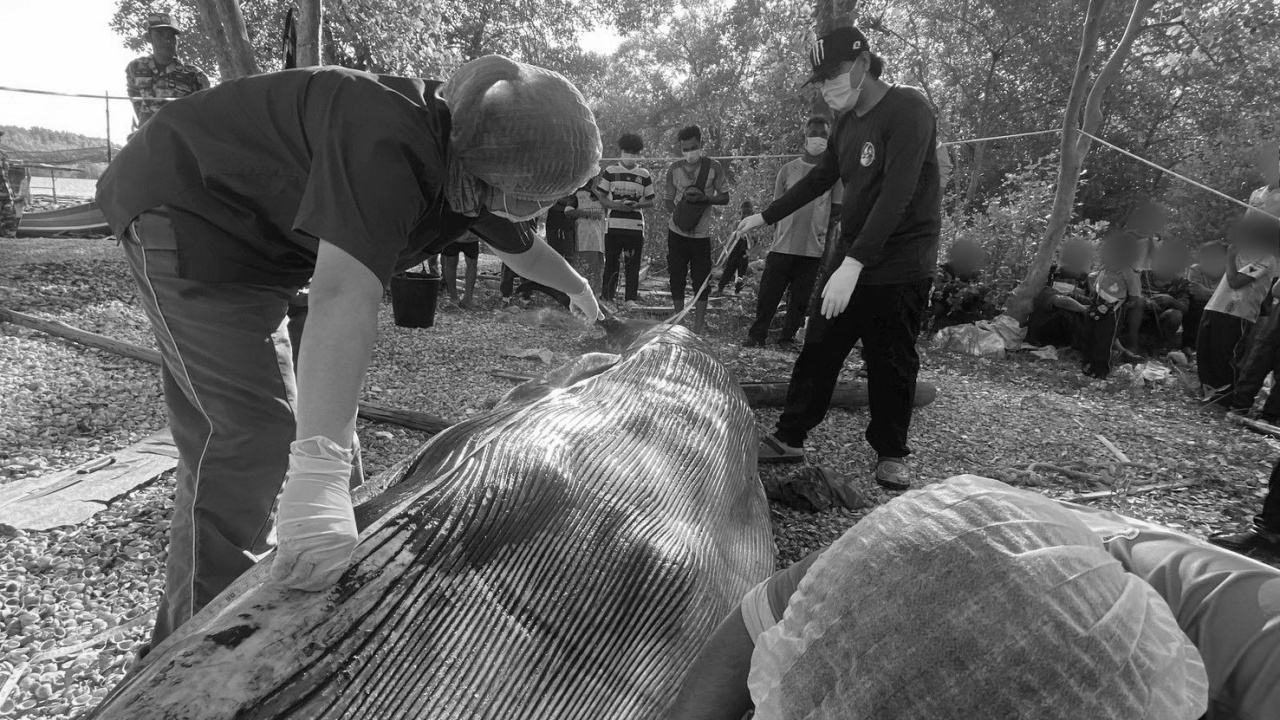
The Department of Marine and Coastal Resources disclosed the autopsy results of the carcass of an Omura’s whale. It was found stranded in Satun Province, showing heart congestion and mild edema, suspected to have been ill and separated from its mother before drowning.
In the case where local residents in Village 3, Pu Yu Subdistrict, Mueang District, Satun Province, found a dead stranded whale floating about 500 meters from the initial spot and alerted authorities to investigate,

on 28 January 2026, the Department of Marine and Coastal Resources stated that Dr. Pinsak Suraswadi, Director-General of the department, received reports from the Andaman Sea Lower Coastal Marine Resources Research Center (ALMRC) and the Satun Marine Conservation Center about the stranded whale carcass found in Khlong Pu Yu, Pu Yu Subdistrict, Mueang Satun District, Satun Province.
Officials from ALMRC, Satun Marine Conservation Center, Mueang Satun Fisheries, Mangrove Resources Conservation Center 24 in Tamalang, local leaders, and Pu Yu villagers jointly inspected and identified the whale as a female Omura’s whale (Balaenoptera omurai), measuring 4.99 meters in length, immature. The carcass was fresh, with a body condition score of 3 out of 5. External examination showed abrasions all over the body from stranding, with no signs of fishing gear injuries.
The internal autopsy revealed heart congestion and mild edema. The respiratory tract contained air bubbles and fluid accumulation in the trachea and lung tissue, with pulmonary edema. On the outer lung tissue, there were irregular black patches about 1-2 cm in size. The digestive tract was empty, with no food or foreign objects. The cause of death was drowning, likely caused by illness and separation from the mother.
Officials collected tissue samples for laboratory analysis, as well as skeletal samples from the lower jaw, pectoral fins, and pelvic bones. The carcass was managed and buried with the assistance of the Pu Yu Subdistrict Administrative Organization, which provided an excavator to bury the carcass on site.
Thanks to the Department of Marine and Coastal Resources’ Facebook page for the information.