

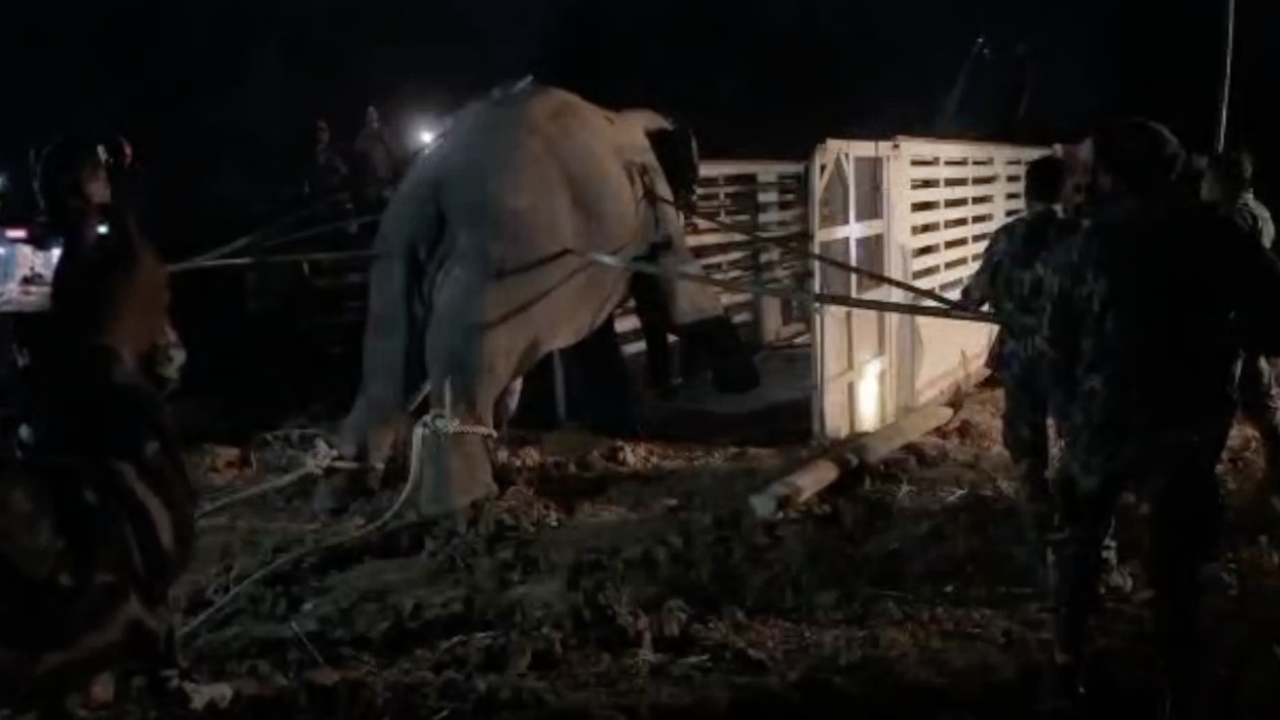
The Department of National Parks stated that the case of "Sidao Hoo Pub," a wild elephant from Doi Luang, dying during relocation is preliminarily suspected to be related to "food aspiration." A committee has been established to investigate for transparent and responsible action.
Regarding the sad news of "Sidao Hoo Pub," a wild elephant from Phu Luang, collapsing and dying while officials were relocating it for care and behavioral adjustment, as previously reported ("Sidao Hoo Pub," a wild elephant from Phu Luang, collapsed and died during relocation; officials to hold a briefing.)
On 4 Feb 2026 GMT+7, the Department of National Parks, Wildlife and Plant Conservation issued a statement clarifying the facts and expressing deep condolences over the loss of the wild elephant Sidao Hoo Pub, which died during relocation from Khon Kaen province to the Phu Luang wild elephant food restoration project area in Loei province.
The Department recognizes that this incident has caused grief and concern among the public. We sincerely express our condolences for the loss of this valuable wild elephant, as well as for the family affected by previous wild elephant attacks in Khon Kaen province.
Sidao Hoo Pub was a male wild elephant, approximately 15-20 years old, originally living in the Phu Luang Wildlife Sanctuary in Loei province. It later moved to forage in agricultural areas around Phu Wiang district, Khon Kaen province, frequently approaching communities, which led to incidents resulting in human fatalities.
This relocation was carried out under a temporary protection order from the Khon Kaen Administrative Court, with two main objectives:
1. To protect the safety of residents living in the risk area.
2. To conserve the wild elephant by returning it to a suitable natural food source.
The Department wishes to inform the public that this relocation was conducted in compliance with the legally binding temporary protection order of the Khon Kaen Administrative Court. Failure to comply would constitute contempt of court, punishable by law, and could lead to criminal liability for the responsible officials.
Moreover, not addressing the problem would leave local residents continuously at risk to life and property. Therefore, the Department is legally obliged to relocate the wild elephant, adhering to principles within the legal framework, social responsibility, and animal welfare.
The Department has carefully prepared and applied international standards in the operation as follows:
- Establishing a command center integrating multiple agencies.
- Employing a team of expert veterinarians and animal handlers.
- Calculating anesthetic dosages appropriately based on the elephant's weight and condition.
- Monitoring vital signs throughout the process, including respiration, pulse, and body temperature.
- Positioning the elephant to reduce pressure on the respiratory system.
Despite thorough preparation, the elephant experienced a sudden physiological crisis during transport. The veterinary team immediately halted the convoy and administered emergency medical care, including airway clearance, intravenous fluids, and temperature control, but unfortunately, the elephant could not be saved.
Preliminary assessment suggests the cause may be related to food aspiration; however, detailed autopsy results are awaited to confirm the exact cause.
The Department is committed to proceeding transparently and responsibly by:
1. Appointing an expert committee to systematically review all operational procedures.
2. Conducting a thorough autopsy, examining all bodily systems, including pathological and toxicological tests.
3. Reviewing and improving operational standards for capturing and relocating wildlife, especially regarding pre-relocation health assessments, fasting protocols, and emergency response plans.
4. Reporting the findings publicly with full transparency upon completion of the investigation.
The Department acknowledges that managing human-wildlife conflicts is a significant challenge requiring utmost caution. We will apply lessons learned from this incident to improve procedures, ensuring both public safety and animal welfare more effectively.
The Department thanks the public for their understanding and reaffirms its commitment to responsible, transparent work grounded in scientific principles and ethics in wildlife conservation.
Information courtesy of the Facebook page of the Department of National Parks, Wildlife and Plant Conservation.