

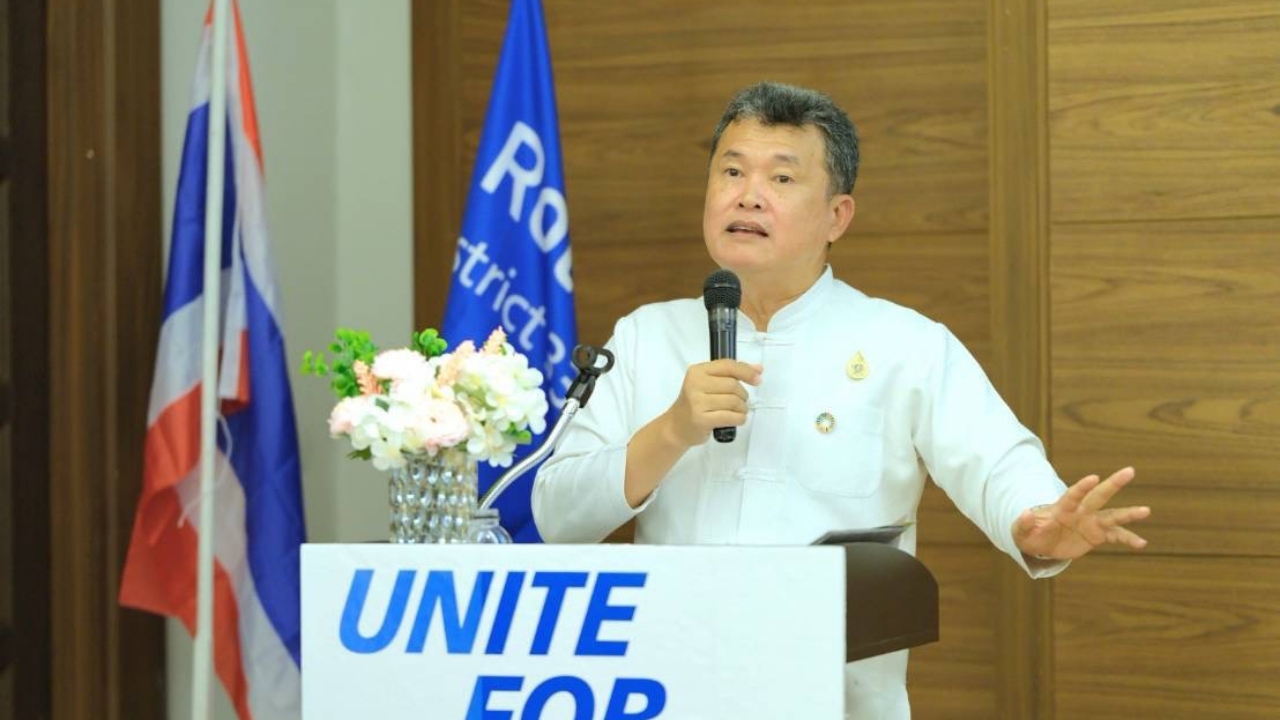
The former Ministry of Interior secretary supports Rotary in promoting sustainable community economic development, passing opportunities on to the next generation, and reveals a practical seven-step approach for implementation.
On 5 Mar 2026 GMT+7 at the Thammasat Association on Ngamduplee Alley, Rama IV Road, Thung Maha Mek, Sathon District, Bangkok, Mr. Sutthipong Juljarern, former Ministry of Interior secretary, gave a special lecture titled "Sustainable Community Economic Development." With extensive experience in land administration and a key role in driving grassroots economy projects, especially the "Khon Nong Na" initiative, the event was chaired by An. Jinda Techawanich Chaeng, chairwoman of the Subcommittee on Community Economic Development and honorary advisor of the Rotary Bangkok Harmony Club. Attendees included former district governors, assistant district governors, Rotary club presidents, committee members, and partner networks.
Mr. Sutthipong Juljarern stated in his special lecture that today was a special honor to speak about how to develop community economies sustainably. Sustainability is not marked by project launch days or attendance numbers, but by how, after seminars, ideas can be expanded and knowledge shared so communities can continue independently. From his experience, he posed three questions for reflection: First, if funding runs out, can the community still operate? Second, if key individuals leave or stop working, does the system continue? Finally, if crises occur—such as price drops, disasters, or shifts in consumer behavior—can the community adapt and recover? Answering these affirmatively greatly increases the chance of true, lasting sustainability.

"Sustainable community economies mean helping people support themselves through employment and income—this is the foundation. This aligns with Rotary's mission to foster local economic growth as a sustainable solution to poverty. Experience shows that projects starting from personal interest or top-down approaches, rather than community needs from the bottom up, often stop when funding ends or key people move on."
Mr. Sutthipong Juljarern further proposed that to succeed in Rotary's mission to assist community economies, a seven-step practical approach should be followed.
1. Community assessment: Listen comprehensively to understand community needs, estimate budgets and resources required, and identify constraints.
2. Find co-owners: Form teams and working groups, ensuring succession plans for future generations.
3. Choose focus areas: Start with one high-potential or community strength area rather than trying to do everything at once.
4. Design income models: Define costs, pricing, profits, and transparent, accountable sharing systems.
5. Improve quality to enable repeat sales, focusing on standards, production processes, and packaging.
6. Connect to markets and new opportunities, establishing continuous channels and access to financial tools and management, following Growing Local Economies standards and Rotary guidelines. Seventh and lastly, establish systems to measure results, learn, and adapt.
"I believe all this is achievable, especially with Rotary members taking action, since globally Rotary is known as a selfless volunteer organization. This aligns with the mission to serve others, promote integrity, and foster goodwill and peace through networks of business, professional, and community leaders."
"I invite Rotary volunteers to create a 90-day plan aimed at sustainable community economic development. Select a pilot community, collaborate on assessments and designs, focus on one community strength that can be driven forward. If successful, expand to other communities to build lasting stability for residents. Ultimately, sustainability isn’t the day we provide the most help, but the day communities stand independently and pass opportunities to future generations," Mr. Sutthipong Juljarern concluded.
Mr. Wichai Cheewaknith said in his opening remarks that today’s seminar aims to enhance club leaders' capacity in community economic development and provide a platform for exchanging ideas that can be applied and expanded. "The content opens perspectives on understanding community contexts, small entrepreneur mindsets, product value enhancement, market access, and securing funding and government support—all interconnected processes. I hope today's insights and experiences benefit all participants and help strengthen sustainable community economies."

Meanwhile, An. Jinda Techawanich Chaeng welcomed attendees and explained the event’s purpose: "On behalf of the event chair and chairwoman of Rotary District 3350's Subcommittee on Community Economic Development, I thank former district governor Wichai for opening the event and former Ministry of Interior secretary Sutthipong Juljarern for being today's keynote speaker. Our subcommittee focuses on promoting Rotary’s commitment to sustainable economic growth and community well-being through activities like supporting entrepreneurs, vocational training, and financial access to reduce poverty and foster sustainable economic development."
"Community economic development is one of seven key Rotary focus areas: 1. Empowering people 2. Skills development 3. Supporting entrepreneurs 4. Poverty alleviation 5. Supporting local organizations 6. Creating sustainable change, and 7. Stimulating local economies to reduce poverty and build self-reliance. I sincerely hope today’s leadership development program in community economic development will be a small but vital gear that moves Rotary forward in uniting for good, fostering hope globally, and creating meaningful, sustainable work."