

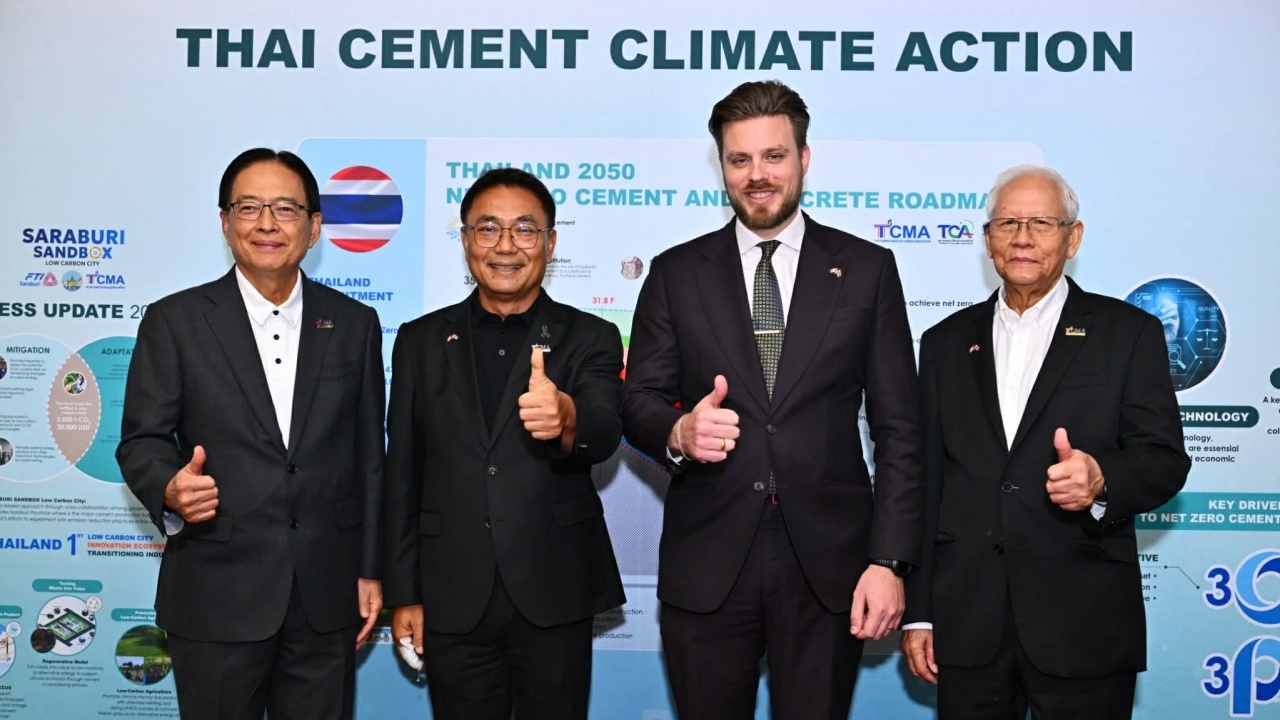
The Thai Cement Manufacturers Association (TCMA) is moving forward by connecting advanced knowledge, cutting-edge technology, and green innovations from abroad into the manufacturing sector in a concrete manner.
On 9 Mar 2024 GMT+7, Mr. Chana Phumi, Honorary President of the Thai Cement Manufacturers Association (TCMA), said that he led a TCMA executive delegation to meet with senior representatives from the Government of Saskatchewan, Canada, headed by His Excellency Ken Cheveldayoff, Minister of Advanced Education, Professor Jeff Keshen, President and Vice-Chancellor of the University of Regina. Both sides expressed satisfaction with the steady progress of their cooperation since signing a Memorandum of Understanding (MOU) in Sep 2024 GMT+7. This marks a crucial step in strategic collaboration between Thailand’s industry and international partners, aiming to elevate technology transfer into practical operations. According to the cement industry roadmap, over 45% of greenhouse gas emission reductions cannot be achieved by conventional measures alone, thus CCUS technology is essential.
This phase of cooperation will begin with developing and testing Carbon Capture technology to enhance the industry's technical readiness before expanding to CCU (Carbon Capture and Utilization) to convert captured carbon into economic value, such as developing raw materials or new products. Some applications may further develop into CCS (Carbon Capture and Storage) for safe long-term sequestration. This covers technological, infrastructural, and regulatory preparedness aspects. A key milestone is the pilot installation of a Mobile Carbon Capture Unit at a TCMA member cement plant in the Saraburi sandbox area by mid-2026. This effort is supported by Environment and Climate Change Canada (ECCC), UNIDO, GCCA, TCMA, the Government of Saskatchewan, and the University of Regina through the Clean Energy Technologies Research Institute (CETRI), which has extensive expertise in CCUS technology.
Mr. Chana added that Saraburi Province, as the country's cement production hub, has been developed into the Saraburi Sandbox to drive progress towards becoming a low-carbon city through an area-based implementation approach that integrates all relevant sectors. This represents the start of a structural transition, with the industry becoming genuinely part of the solution to climate change.
This collaboration reflects TCMA’s role as the core of the cement industry, acting as a bridge for transferring advanced knowledge, technology, and climate change innovations from Canada into practical use in Thailand. It is an action-oriented partnership involving government, academia, and industry, supported by global networks such as ECCC, GCCA, UNIDO, the Government of Saskatchewan, and the University of Regina. These partners provide robust support in knowledge, technology, and mechanisms for scaling up. Therefore, this partnership is a key driving force laying systemic foundations for Thailand’s industry to confidently and concretely achieve the Net Zero 2050 goal, while enhancing the Thai cement industry's role as a positive force and integral part of advancing the country towards a sustainable low-carbon future.
Mr. Ken stated that this collaboration demonstrates the strength of partnership between Thailand and Canada, especially the Government of Saskatchewan, which has concretely integrated the roles of government, education, and industry to drive innovation addressing climate change. He expressed pleasure in seeing the deployment of the mobile carbon capture unit in Thailand as a significant step in the bilateral cooperation, moving from knowledge exchange to practical implementation, laying the foundation for further collaborations.
Professor Jeff said that the University of Regina is proud to contribute to this innovative collaboration, aiming to transfer accumulated CCUS knowledge and experience through the Clean Energy Technologies Research Institute (CETRI), which combines academic excellence with industrial application. The partnership with TCMA covers not only research and pilot projects but also personnel development, knowledge exchange, and capacity building to support Thailand’s industrial transition towards a sustainable low-carbon future.