

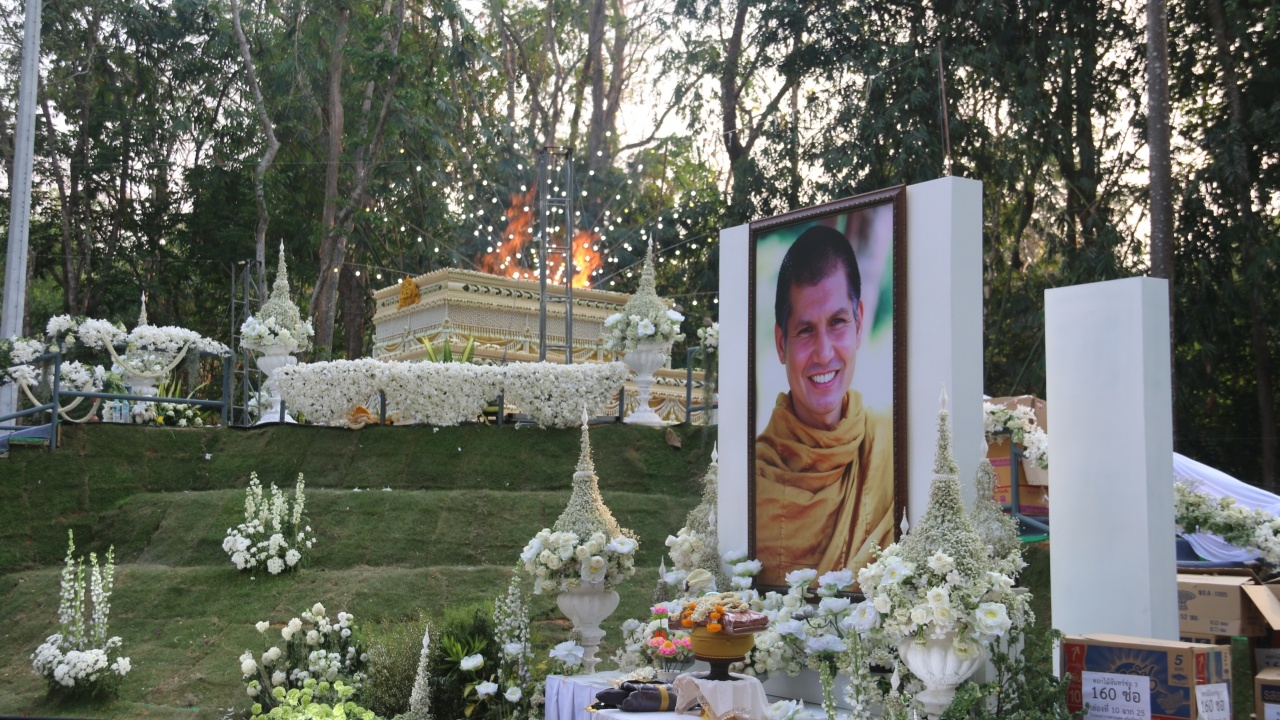
Kanchanaburi – Tears flowed during the cremation of former monk Yantahra at Suññatāram Forest Monastery. Thousands of Buddhists and disciples participated in the ceremony to dissolve the remains of former monk Yantahra Amorophikku at Suññatāram. The ceremony was presided over by Phra Phromwachiramonkol, abbot of Wat Ratchathiwat Ratchaworawihan.
On 10 March 2026, reporters stated that yesterday (9 March 2026) at Suññatāram Forest Monastery, Prangphel Subdistrict, Sangkhla Buri District, Kanchanaburi Province, Phra Phromwachiramonkol, abbot of Wat Ratchathiwat Ratchaworawihan (Bangkok), chaired the cremation ceremony. The ceremony was to dissolve the remains of former monk Yantahra Amorophikku (Winai Laongsuwan). Thousands of monks, novices, nuns, disciples—both Thai and foreign—and Buddhists who revered monk Yantahra Amorophikku attended the ceremony.

Teacher Yantahra, originally named Winai Laongsuwan, was born into a compassionate family under the influence of Buddhism on 14 October 1951 at Ban Tonhat, Pak Phanang District, Nakhon Si Thammarat Province. He was the youngest of eight children of parents Pho Roong and Mae Thanom Laongsuwan.

In his childhood, he was warmly cared for by his parents and siblings. Young Winai regularly accompanied his parents to the temple, fostering kindness and friendship. His family lived by Buddhist principles since the time of his grandparents.

He completed primary education at Municipal School 1 and lower secondary at Pak Phanang School in Nakhon Si Thammarat. He then moved to Bangkok to prepare for military academy exams but did not pass. He completed upper secondary and then studied hotel and tourism management at Bangkok Technical College. After graduation, he worked at Dusit Thani Hotel for a time.

Before ordination, while in Bangkok, he witnessed social injustices and worldly uncertainties, leading him to study philosophy and religion. Through meditation training, he found spiritual enlightenment and renounced lay life, embracing asceticism as a yogi wearing white robes (reflecting his Brahmin ancestry). He practiced celibacy, meditated intensively for 40 days, and traveled to peaceful places focusing on solitude. He sought teachings from masters like Luang Pu Suk of Wat Ram Pradit, Phra Kru Sutthamasamajan (Por Than Cheung), Buddhadasa Bhikkhu, Luang Pu Khao, Luang Pu Chob, Luang Pu Phang, and Luang Pu Dul. He lived as a yogi nearly four years (1971-1973).

On 6 May 1974, the 15th waxing moon of the 6th lunar month coinciding with Visakha Bucha Day, he was ordained at Wat Rattanaram (Bang Bo), Pak Phanang District, Nakhon Si Thammarat, with Phra Kru Satit Sirarajan as preceptor, Phra Kru Sutthamasamajan as sermon master, and Phra Kru Suthon as chanting companion. For 22 rainy seasons, he resided in caves, forests, mountains, and empty houses. After each retreat, he traveled to teach Dhamma to the public nationwide and internationally, including Europe.

In 1988, he visited his ailing sister in California, USA, who later passed away. In 1997, he became a political refugee in the United States and later obtained US citizenship. In 2023, he returned to Thailand to celebrate his 72nd birthday at Suññatāram in Keringkwae, Kanchanaburi, and in Pak Phanang, Nakhon Si Thammarat, visiting followers across southern, eastern, central, and northern Thailand before returning to the US.
In late 2024, he traveled to Mongolia and Vietnam upon invitation from Dr. Huong, a Vietnamese host, for a tribute event. From 12 to 24 February 2025, he journeyed to India and Nepal with a group to visit the four sacred pilgrimage sites. He returned to Thailand before heading back to the US on 5 March 2025. On 9 March 2025, he peacefully passed away at age 73 years, 4 months, and 8 days.