

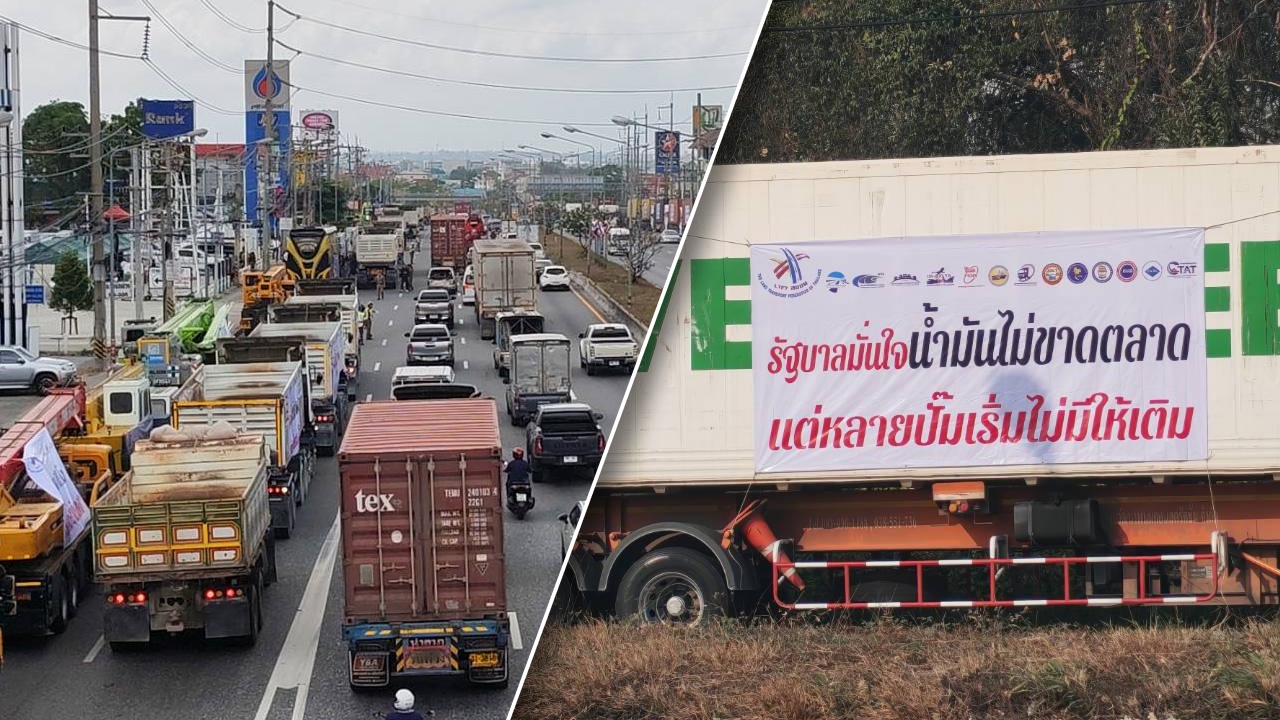
A group of transport operators gathered near Laem Chabang Port to highlight problems of high and scarce fuel supplies that affect logistics costs. They questioned the transparency of oil depot prices and the oil price structure, emphasizing that if the government fails to address the issues properly, they may escalate their protests.
On 18 March 2026, the Federation of Land Transport of Thailand called on affected truck operators to assemble in response to rising fuel prices and shortages. Over 1,000 trucks were parked along Sukhumvit Road, causing traffic slowdowns in both directions toward Chonburi and Pattaya at certain points.
Mr. Sirapop Pichairattanapong, Secretary-General of the Federation of Land Transport of Thailand, said the truck operators gathered at several points, divided into three main groups: over 200 trucks parked along Sukhumvit Road and around Laem Chabang Port, about 70 trucks at Nong Khwao to support local action, and over 600–700 trucks ready to join symbolic convoy movements.

The main cause of the protest stemmed from distrust in the government's management, especially regarding claims that oil reserves were sufficient for 60–90 days, while in practice fuel shortages were observed at service stations.
Additionally, they questioned the oil price increases, urging the government to fully utilize existing cost management mechanisms such as the oil fund, marketing margins, refining costs, and excise taxes before raising prices, to ensure fairness for consumers.

Another key issue raised was congestion at Laem Chabang Port, the main gateway for imports and exports, which causes delays and increases fuel consumption during a period of high prices and shortages.
The operators also questioned the rapid rise in "oil depot prices," which surged by 40–50 baht within 3–5 days without clear justification, directly impacting the transport and industrial sectors.
They also challenged the practice of referencing Singapore oil prices, stating that while acceptable for export refining, domestic sales should have a pricing structure fairer to local consumers.

However, representatives expressed confidence that the government intends to resolve the issues but urged faster, tangible actions, especially to address fuel shortages and reduce congestion in the transport system.
If the situation does not improve, the operators may consider escalating their protests but reiterated their willingness to accept price adjustments if they are reasonable, transparent, and clearly explained.