

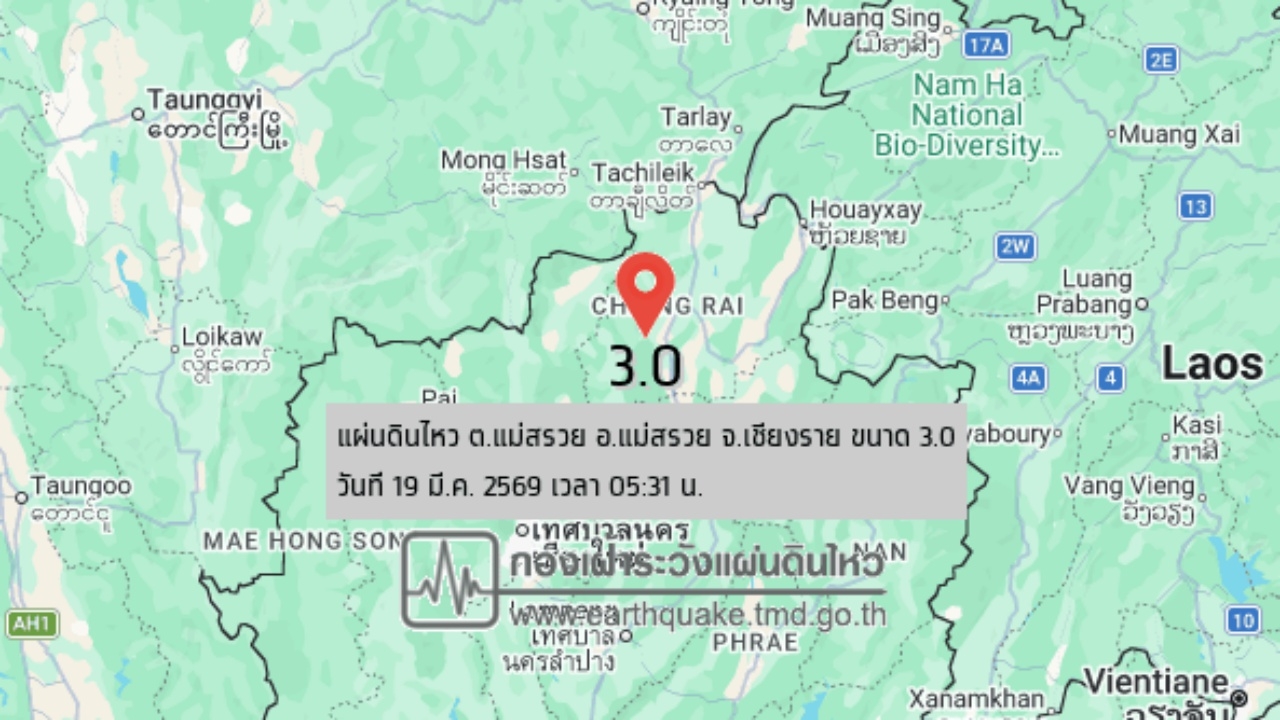
The Earthquake Surveillance Division reported a 3.0 magnitude earthquake near Mae Suai Subdistrict, Mae Suai District, Chiang Rai Province. Residents across several districts, including Chiang Mai Province, felt the tremors clearly. Geologists noted it occurred on the Mae Suai branch fault, which was thoroughly surveyed following the major 2014 Chiang Rai earthquake.
At 05:31 on 19 March 2026 GMT+7. The Earthquake Surveillance Division of the Meteorological Department reported detecting a 3.0 magnitude earthquake centered near Mae Suai Subdistrict, Mae Suai District, Chiang Rai Province. Coordinates were 19.713 degrees north, 99.618 degrees east, at a shallow depth of only 2 kilometers. This shallow quake caused clear tremors felt by residents in many parts of Chiang Rai Province, especially in Mueang Chiang Rai, Phan, and Mae Lao districts.
The Meteorological Department reported the quake occurred at 22:31:35 UTC, or 05:31:35 Thai time. Official information was released at 05:42. Following the event, many residents submitted reports of felt tremors to the monitoring system, reflecting the wide area affected around the epicenter.
In Mae Suai Subdistrict, close to the epicenter, residents in single-story homes reported clearly feeling the shaking. Near the Mae Suai Khlong Thom market, close to the PT gas station, occupants of a two-story house described experiencing shaking, rattling sounds, and continuous tremors lasting about 5–7 seconds.
In Chiang Rai city, specifically in Rob Wiang Subdistrict, people inside the Chiang Rai Fire Station felt about one second of shaking. In Pa O Don Chai Subdistrict, occupants of a two-story house reported "very strong bed shaking," while villagers in Doi Lan Subdistrict heard a thudding sound before experiencing a jolt followed by gentle swinging waves resembling seismic tremors that then stopped.
In Phan District, farther from the epicenter, residents still felt the tremors. In Sai Khao Subdistrict, occupants on the ground floor of a dormitory at Rajamangala University of Technology Lanna Chiang Rai reported feeling shaking that caused the building and floor to vibrate for about three seconds. In San Klang Subdistrict, locals said, "While lying down, the house shook strongly, like someone fell from the second floor bed." Another report from Sai Khao mentioned clear shaking of the second-floor floorboards.
Additionally, reports from San Sai Noi Subdistrict, San Sai District, Chiang Mai Province, some residents experienced slight dizziness, indicating that the tremors from this earthquake were felt beyond Chiang Rai Province's borders.
Geological data indicates the epicenter is located along the "Mae Suai branch fault" which is a subsidiary fault within the Mae Lao–Mae Suai fault system, oriented northeast–southwest. This branch fault has been extensively surveyed following the major 6.3 magnitude earthquake in Phan District, Chiang Rai Province in 2014, with detailed field studies completed around 2015 to delineate active fault lines in northern Thailand.
Geologists state that the Mae Suai branch fault is approximately 30 kilometers long, classified as a left-lateral strike-slip fault. It previously caused a 3.6 magnitude earthquake in Mae Suai on 5 August 2017. At that time, the Department of Mineral Resources confirmed it was due to movement along this subsidiary fault within the Mae Lao fault group, a geologically active structure capable of producing small to moderate earthquakes periodically.
The Mae Suai fault group is a significant geological structure in Chiang Rai Province, linked to Mae Suai, Mae Lao, and Mueang Chiang Rai districts. It lies close to the structural zone affected by the 2014 major earthquake. Geological disaster agencies continue close monitoring due to recurrent small earthquakes in this area.

So far, no damage to buildings, homes, or critical infrastructure has been reported. However, because this was a shallow earthquake, residents felt the tremors more distinctly than deeper quakes of similar magnitude. Monitoring agencies continue to track the situation closely and will inform the public of any aftershocks or additional information as it becomes available.