

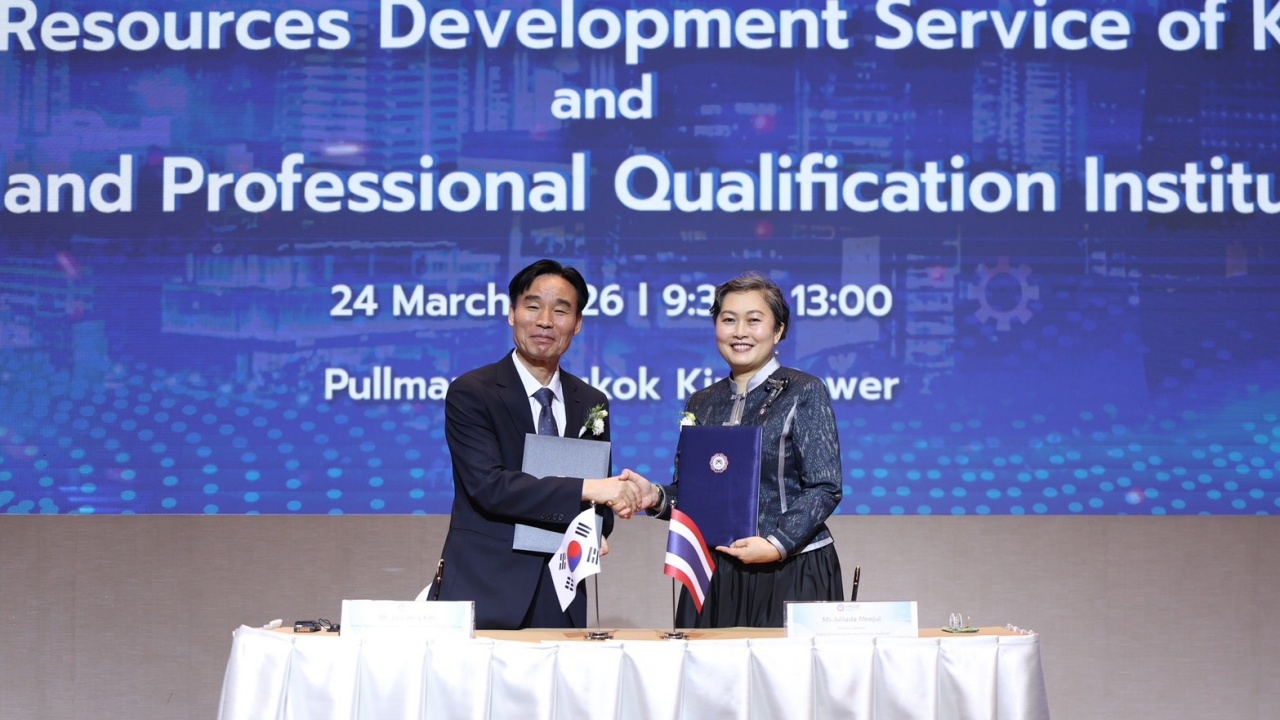
The ban has been lifted for "manual metal arc welders" to use Thai vocational qualifications to work in South Korea without paying brokerage fees and regardless of work experience.
On 24 Mar 2026 GMT+7, the Thailand Professional Qualification Institute (TPQI), led by Director Ms. Julaladda Meejul, advanced recognition of Thai welder skills by signing a Memorandum of Understanding (MOU) with the Human Resources Development Service of Korea (HRDKorea), under South Korea's Ministry of Employment and Labor, represented by Acting President Mr. Gyu Seog Kim. The signing took place at Pullman Bangkok King Power Hotel to mutually recognize TPQI's Level 4-5 Manual Metal Arc Welder vocational qualifications as equivalent to HRDKorea's Course-based Craftsman Shielded Metal Arc Welding qualifications. This paves a new path for working in South Korea under the new E-9 with Technical Abilities visa policy.
Ms. Julaladda revealed that this cooperation marks a historic milestone, offering tangible benefits to Thai workers seeking employment in South Korea. Those holding TPQI Level 4-5 manual metal arc welding vocational qualifications will be immediately recognized without retaking skill tests, as their qualifications are deemed equivalent to South Korean standards. This is based on mutual recognition of evaluation, training systems, and Thailand's vocational qualification framework.

This is the first time Thai manual metal arc welders can work abroad using their Thai vocational qualifications, focusing on skill-based employment. It addresses Thailand's skilled welder surplus lacking overseas job opportunities. Importantly, Thai workers are protected under the G2G system, avoiding brokerage fees and risks of exploitation, while receiving full, uncompromised salaries.
Simultaneously, this helps alleviate South Korea's urgent shortage of welders, allowing Korean employers to hire Thai workers more conveniently through government channels. Additionally, TPQI collaborates with certifying and training organizations to validate Gas Cutting competencies for welders, preparing them for actual work conditions in South Korea.
This cooperation resulted from close collaboration between TPQI and HRDKorea to align skills with the South Korean shipyard industry's high demand for welders. They added Gas Cutting skill testing to the manual metal arc welder vocational qualifications, ensuring Thai welders meet shipyard employers' requirements. Currently, TPQI's training unit equipped with certified tools and competency tests is at King Mongkut's University of Technology North Bangkok, Rayong Campus. Thus, applicants for the E-9 with Technical Abilities visa to South Korea must be certified by TPQI to access this opportunity.
Employment under this recognized manual metal arc welder vocational qualification operates via a transparent government-to-government (G2G) system under the Employment Permit System (EPS) and the Ministry of Labor's Department of Employment. TPQI certifies the vocational qualifications, and Thai welders receive the new E-9 with Technical Abilities visa issued by South Korea's Ministry of Employment and Labor, ensuring legal protection and safeguarding against exploitation.
Moreover, this achievement enhances Thailand's international reputation, as confidence in Thailand's vocational qualification system led South Korea to select Thailand as the "first country" to pilot the E-9 with Technical Abilities visa policy. This underscores mutual recognition of qualifications and truly elevates Thai skilled welders' status.