

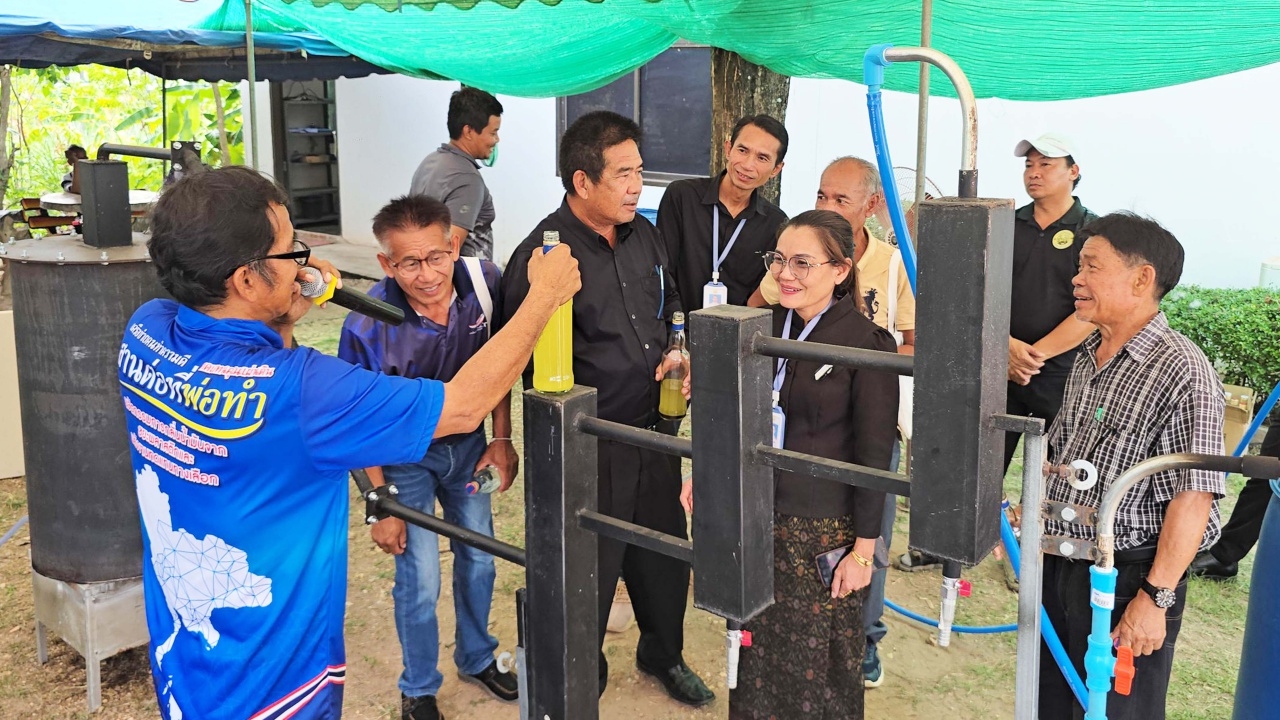
Phon Phek Subdistrict Administrative Organization in Khon Kaen is pioneering the conversion of plastic waste into fuel to reduce community waste and share knowledge with residents to produce their own fuel amid the oil crisis with rising prices and shortages.
At 9:00 a.m. on 27 March 2026, at the Phon Phek Subdistrict Administrative Organization meeting room in Khon Kaen, Mr. Auachai Puluan, the chief executive of Phon Phek SAO, chaired the launch of a waste sorting campaign project featuring practical activities to promote sorting plastic waste and converting it into fuel.Fuel
Residents from all 15 villages in Phon Phek, members of the waste bank, participated fully. Mr. Decha Jansri, chairman of the Network Center for Innovation in Oil Refining to Destroy Waste and a member of the Good Deeds Network continuing the legacy of the late King, acted as the instructor. He shared knowledge and demonstrated producing fuel from plastic waste, from sorting seven types of plastic to the pyrolysis production process—a heat-driven decomposition of plastic in an oxygen-free environment, not combustion, thus not causing pollution or harmful toxins to the environment.

Mr. Decha explained that the process involves heating or melting plastic to vaporize it, then condensing the vapor into fuel, including gasoline, diesel, and liquefied petroleum gas. If villagers have technical skills, they can build their own pressure tanks for use at a cost under 5,000 baht, and the knowledge is ready to be shared across the area.
The plastics used fall into seven categories: polyethylene terephthalate (PET), high-density polyethylene (HDPE), polyvinyl chloride (PVC), low-density polyethylene (LDPE), polypropylene (PP), polystyrene (PS), and other plastics such as water bottles, shampoo bottles, food containers, plastic bags, foam, and various daily-use plastic materials. In production, 10 kilograms of plastic waste can yield about 4–8 liters of fuel depending on the plastic type, within five hours—much faster than the natural degradation time of 40–50 years.

Producing diesel requires plastics types 2, 4, 5, and 6 in ratios of 60/20/10/15, with 5% polystyrene, resulting in a cetane rating of up to 65%, exceeding the Energy Business Department standard of 50%. Gasoline can be produced from all plastic types. Additionally, foam plastics can be refined into fuel with an octane rating as high as 100%. Initial tests show this fuel is premium quality and compatible with all engine types, facilitating easier engine starts.
After the theoretical training, a demonstration was held producing fuel from 10 kilograms of plastic waste heated in a stainless steel tank for five hours, producing gasoline and LPG. The produced fuel was tested in a Phon Phek SAO grass-cutting machine, which started immediately and operated normally, exciting and reassuring the villagers participating in the project.
Mr. Rawitsada Tesseeha, 38, a Phon Phek resident who attended the waste sorting and plastic-to-fuel promotion workshop, said,Fuelproduced through pyrolysis is a very good project because it’s close to daily life. If the waste we discard daily can be turned into fuel, I want to continue and encourage villagers to do it for additional income, which benefits the community.
To produce and refine fuel from waste during times of high and scarce oil prices, monitoring is necessary.Observewhether oil prices will continue to rise.Becauseif the price increase is long-term rather than short-term, I want to try this because the equipment for producing and refining fuel from waste is not expensive and uses readily available waste. However, not all types of waste can be used to produce fuel.
Ms. Pasuk Piasangka, chief administrator of Phon Phek SAO, told reporters that the project arose because of large amounts of plastic waste in the area. Previously, campaigns were conducted with Regional Environment Office 10 and a memorandum of understanding was established with local shops to systematically manage waste.

Waste collection is scheduled once a month, on the third Friday of each month. If this effort covers all 15 villages, the community can truly extract fuel from plastic waste,fuelwhich will generate extra income and provide fuel for the community, reducing costs during periods of rising oil prices. The SAO plans to establish a central extraction facility for the subdistrict as a pilot project.
The target group consists of waste bank members from all 15 villages to gain knowledge about plastic types and to transform waste that shops do not buy into added value, reducing residual waste in the community and maximizing resource use.

Initial discussions indicate an exchange rate of 10 kilograms of plastic waste for 4–8 liters of fuel. The type of fuel—diesel or gasoline—depends on the extraction machine's temperature settings and the plastic type. Foam plastics, commonly used disposable containers, can be refined into very clean fuel with an octane rating of 100%.
Initial tests found the fuel quality to be premium, usable in all engine types without harming engines, and it helps engines start more easily. The SAO will continue testing and development to confirm long-term efficiency.