

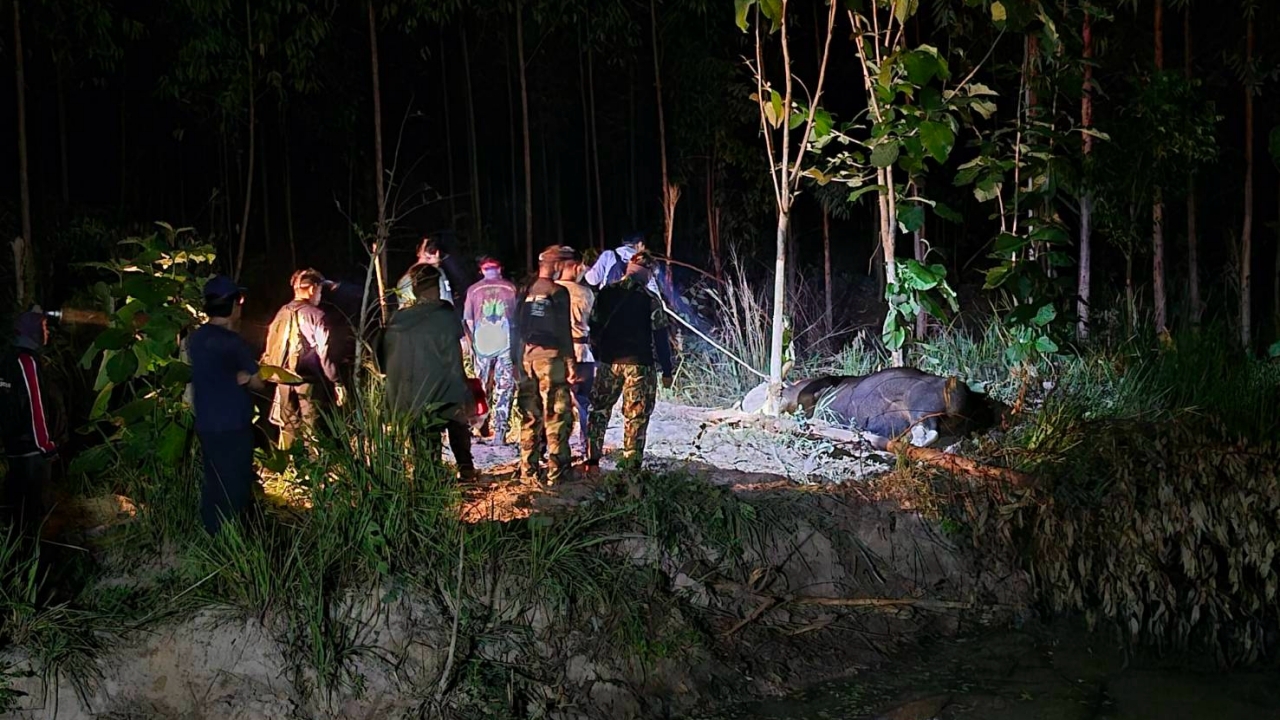
Rangers at Thap Lan National Park tried to save a female banteng caught in a poacher's snare but could not keep it alive. Heartbreaking footage shows a wild elephant attempting to help the banteng at the scene but unable to do anything.
On 1 April 2026, Mr. Atthaphon Charoenchansa, Director-General of the Department of National Parks, Wildlife and Plant Conservation, received a report of wildlife loss from Thap Lan National Park. A female banteng was found severely injured in a snare trap. Despite the veterinary team’s efforts to save her throughout the night, she could not be saved. The Director-General ordered a search of the adjoining forest areas to remove all traps and demanded a thorough investigation to bring the perpetrators to justice.
Mr. Yosawat Thiansawat, Director of Protected Areas Regional Office 1 (Prachinburi), said that Mr. Prawattisat Janthap, head of Thap Lan National Park, reported that at 22:38 on 31 March, a rapid response team monitoring and driving away wild elephants used drones to survey their area. They found a female banteng, weighing about 500 kilograms, lying abnormally in the forest area of Sa Takian subdistrict, Soeng Sang district, Nakhon Ratchasima province. They immediately contacted the park management patrol team in area 4 (Lam Plai Mat) to check. At the scene, the banteng was caught in a spring snare tightly around its left front leg and entangled with a tree, unable to move.

Mr. Katha Wut Kanyama, head of park management area 4, coordinated with veterinarians from Protected Areas Regional Office 7 (Nakhon Ratchasima) to provide emergency assistance. The veterinary team arrived at the scene at 02:30 on 1 April, administered a tranquilizer to release the snare, and gave painkillers and antibiotics to treat the wounds. Staff closely monitored the banteng’s condition. Although it began to regain consciousness at dawn, it remained severely weak and unable to stand. Finally, at 08:30, the banteng died.
Mr. Yosawat emphasized that animal snares are a “silent threat,” cruelly harming wildlife indiscriminately, and constitute a serious legal offense. He ordered officers to intensify investigations around the incident site and nearby areas, including those held under Section 64, to collect and destroy any remaining traps, and to investigate to bring offenders to justice decisively. The banteng’s carcass will be handled following scientific guidelines and the department’s regulations.

During the rescue, a drone operated by Thap Lan National Park staff captured heartbreaking thermal images showing a wild elephant circling around the banteng, seemingly wanting to help but unable to do so. Rangers had to drive the elephant away first to clear the way for the veterinary team to assist the banteng.
Mr. Prawattisat Janthap, head of Thap Lan National Park, explained that the area is home to herds of both wild elephants and bantengs that regularly feed together. The path where the banteng was caught is commonly used by both species for travel. When the banteng was trapped in the snare on the elephant trail, elephants passing by noticed something was wrong and tried to check but could not help. They only circled around it. Rangers spent nearly half an hour before they could drive the elephant away to allow the rescue team to reach and help the banteng.

