

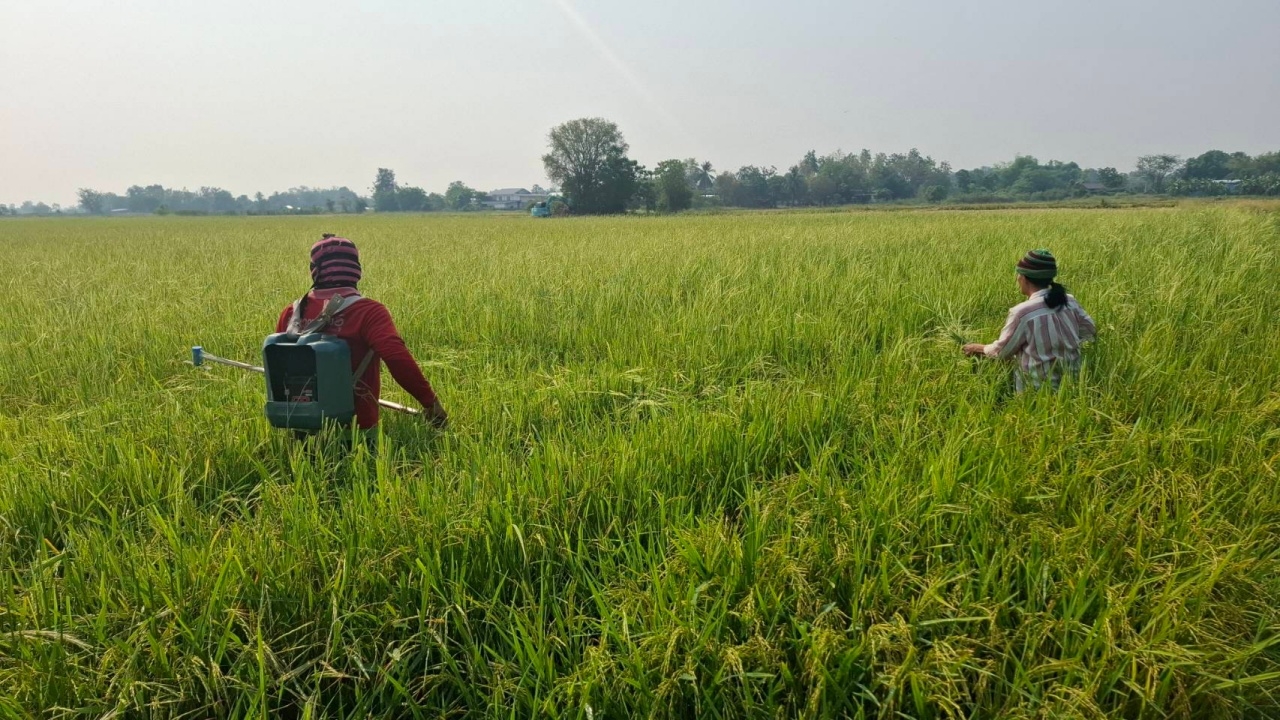
Opening up A 70-year-old farmer laments never having experienced oil priced over 50 baht per liter, too expensive to afford, possibly forced to stop farming until the situation improves.
At 07:30 on 6 April 2026, Ms. Jamroon Kengthanyakam, 70, who farms 20 rai near Ban Thung Ai Hu, Village No. 7, Nam Suem Subdistrict, Mueang District, Uthai Thani Province, shared that the rice she planted has grown and will be ready for harvest in 7-8 days. Since the initial fuel shortage, pumps have announced they would not sell to those bringing their own containers. Then fuel prices surged to over 50 baht per liter. Investing in fuel for water pumps no longer makes sense as it raises farming costs significantly. On top of this, fertilizer prices have also risen, with a sack now nearly 1,300 baht, up from just 800 baht.
Consequently, she only applied fertilizer once during early rice growth because the high fuel and fertilizer prices have persisted for over a month. This has caused the rice grains to be small and shriveled due to lack of water and fertilizer nourishment. Normally, 20 rai would yield about 25 cartloads of rice, but now it is expected to be less than 8 cartloads.
Typically, healthy rice has over 200 grains per ear, but now the rice ears are poor, with only about 20 grains each. The grains are so fragile they fall off easily when touched. This has drastically reduced the rice quantity. Furthermore, the current selling price is only 5,800 baht per cartload, which does not cover costs. At this point, the 20 rai of rice nearing harvest will be managed with minimal investment; whatever is earned at harvest will be accepted as is.
The usual hired rice harvester has raised the price to 600 baht per rai, up from 500 baht. Additionally, the harvester owner requires farmers to supply spare fuel. When the harvester arrives, the owner fills the tank, and after harvesting, the farmer must refill the harvester’s tank. This further increases costs beyond what is sustainable.
Ms. Jamroon, who inherited rice farming from her parents and has done it her whole life, says it is the only profession she has. Though farming is hard work, she has always been proud of it since childhood. But now, she admits she must give up. After harvesting these 20 rai, she plans to stop farming, although reluctantly. The high fuel and fertilizer prices, along with no visible solutions from the new government, have forced this decision. She may abandon farming until conditions improve, or if they don’t, let the fields go fallow or switch to other crops. Currently, everything is burdened by rising rice and input prices.