

Chiang Mai residents are struggling as this morning PM 2.5 levels surged back to rank the city as having the worst air quality in the world, causing 25 districts to be marked red and 17 hotspots to be detected.
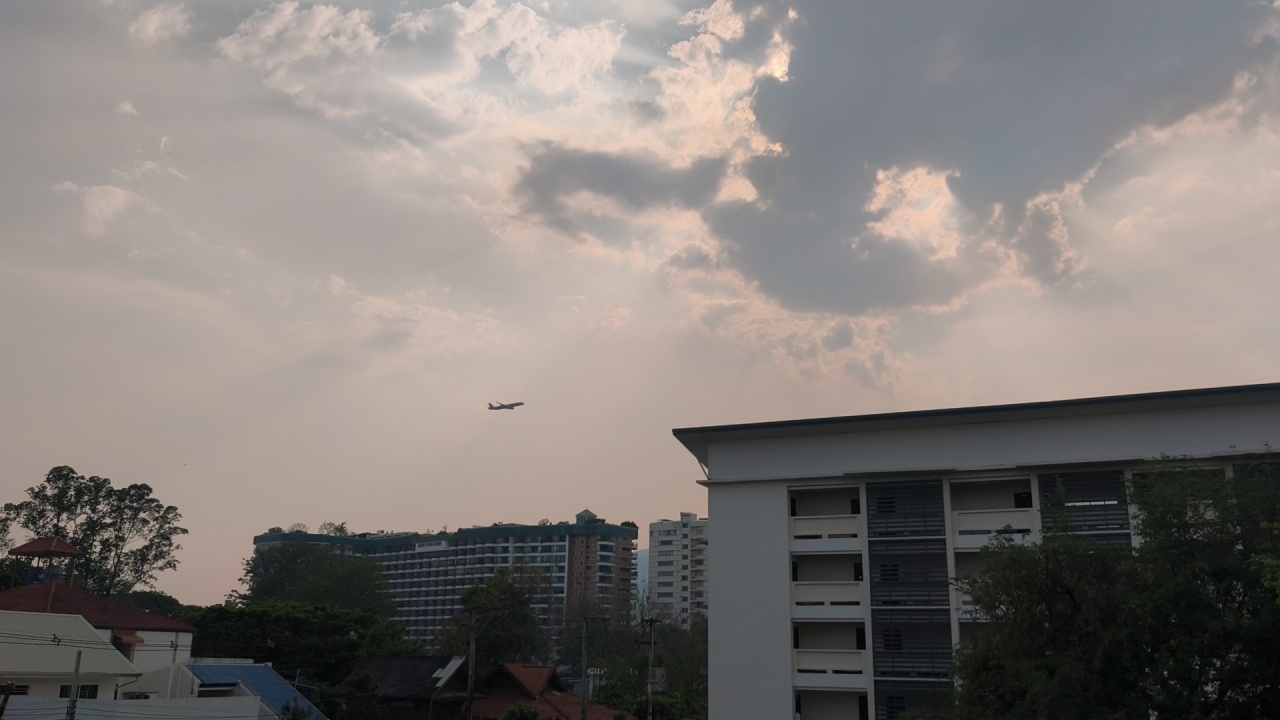
After rainfall occurred yesterday, 6 April 2026, in several areas—especially southern districts of Chiang Mai province—the city itself saw some reports of light rain in spots. This caused the sky, long covered by PM 2.5 haze, to clear, revealing clouds and making airplanes departing the airport clearly visible, indicating improved air quality.
Most recently, on 7 April 2026, reporters observed that although the morning sky was clear and bright, air quality soon worsened as PM 2.5 smog returned, placing Chiang Mai as the number one city with the worst air quality globally. Real-time air quality monitoring from 06:00-07:00 at Chiang Mai Municipality on IQAIR.COM showed a US.AQI of 209 and PM 2.5 at 137 micrograms per cubic meter, classified as purple.

While the number of hotspots decreased and PM 2.5 levels began to drop in many areas, they still exceeded standards. According to the Geo-Informatics and Space Technology Development Agency (GISTDA) through the hourly PM 2.5 tracking application 'Check Dust,' at 07:00, 25 districts in Chiang Mai had PM 2.5 levels exceeding the standard of 37.5 micrograms per cubic meter, all marked red, ranging from 88.3 to 148.6 micrograms per cubic meter. The highest was Mae Chaem District at 148.6 micrograms per cubic meter, while Chiang Mai city measured 102.3 micrograms per cubic meter.
Meanwhile, the Chiang Mai Provincial Command Center for Prevention and Resolution of Forest Fires, Haze, and PM 2.5 reported, based on GISTDA data for the morning of 7 April 2026, 17 hotspots across four districts, with the most in Chiang Dao District at nine points. Since 1 January to 6 April 2026, a total of 6,926 hotspots have accumulated. Similarly, the warroom.pro website and local warroom community reported 17 hotspots in Chiang Mai this morning.