

North Bangkok Poll reveals the oil price crisis is impacting the Songkran festival, leading to reduced travel among the public. The atmosphere is expected to be subdued, and people want the government to implement measures to control or lower fuel prices.
On 9 April 2026, Associate Professor Dr. Sanit Siriwisitkul, head of the North Bangkok Poll Center at North Bangkok University, disclosed that a survey conducted between 31 March and 5 April 2026 among 1,128 respondents nationwide addressed the topic "Songkran amid the oil price crisis."
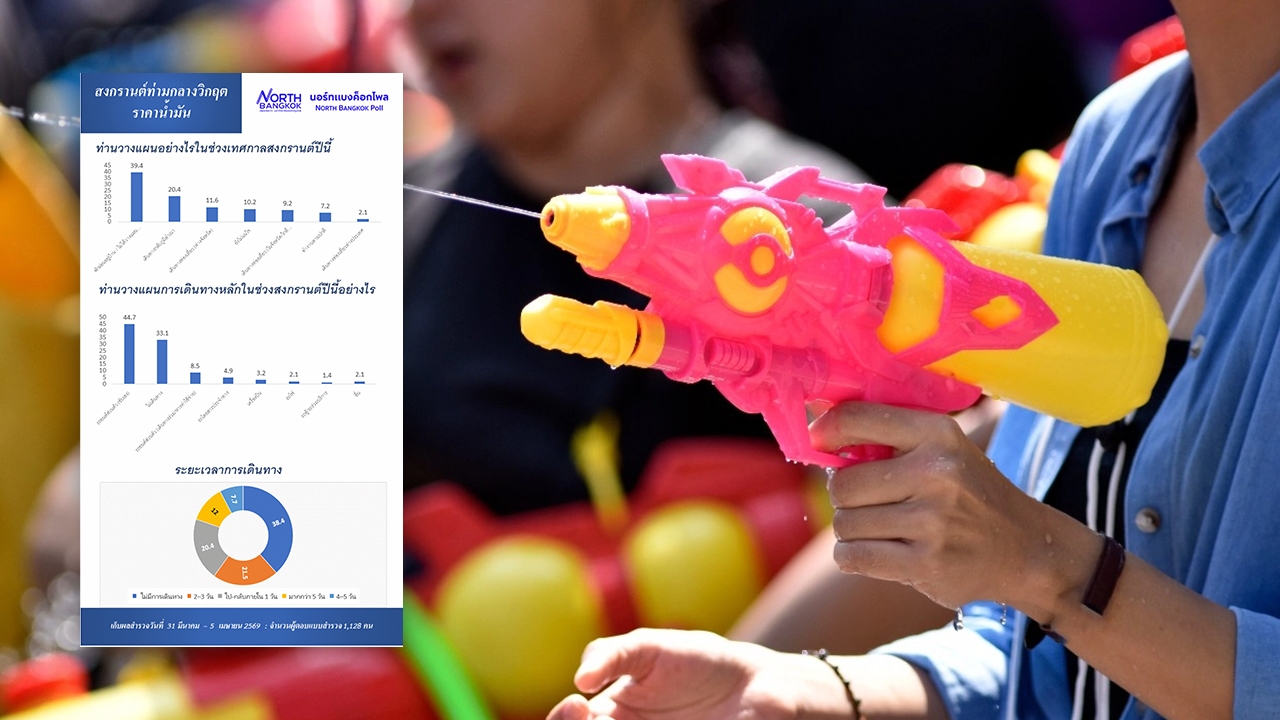
When asked about their plans for this year's Songkran festival, the majority of Thais chose to relax at home or had no travel plans, accounting for 39.4%. Traveling back to hometowns was 20.4%, traveling for tourism to other provinces 11.6%, unsure 10.2%, local or nearby tourism 9.2%, working as usual 7.2%, and international travel 2.1%.
Regarding main travel plans during Songkran, among those who planned to travel, 44.7% intended to drive private cars themselves, 33.1% planned no travel, 8.5% would carpool or share costs in private cars, 4.9% use buses, 3.2% planes, 2.1% trains, and 1.4% vans or shared services.
As for travel duration, most Thais preferred not to travel (38.4%). Trips lasting 2–3 days accounted for 21.5%, same-day round trips 20.4%, over 5 days 12.0%, and 4–5 days 7.7%.
When asked about the level of impact of the oil price crisis on Songkran travel, 39.1% said they were affected at the highest level, 22.2% at a high level, 17.3% moderate, 12.3% no impact, and 9.2% low impact.
Regarding changes in travel plans during Songkran, 44.4% reported no changes, 26.1% postponed or canceled trips, 19.7% traveled shorter distances, 16.2% reduced travel days, 15.8% switched from private cars to public transport, and 4.9% reduced the number of travelers.
On expectations for this year's Songkran atmosphere, 49.7% of Thais predicted it would be quieter, 35.2% moderately lively, 10.6% very quiet, and 6.3% very lively.
Regarding how oil prices affect the overall Songkran festival, 74.6% said there is a major impact, 19.7% moderate impact, 3.2% minor impact, and 2.5% no impact.
When asked which government measures are desired to help people during the high oil price crisis, the top five responses were: control or reduce fuel prices (78.2%), implement cost-of-living relief measures such as lowering water, electricity, and cooking gas bills (51.8% and 49.6%), stimulate the economy with programs like co-payment or voucher assistance (37.7%), and support work-from-home arrangements to reduce travel costs (36.6%).