

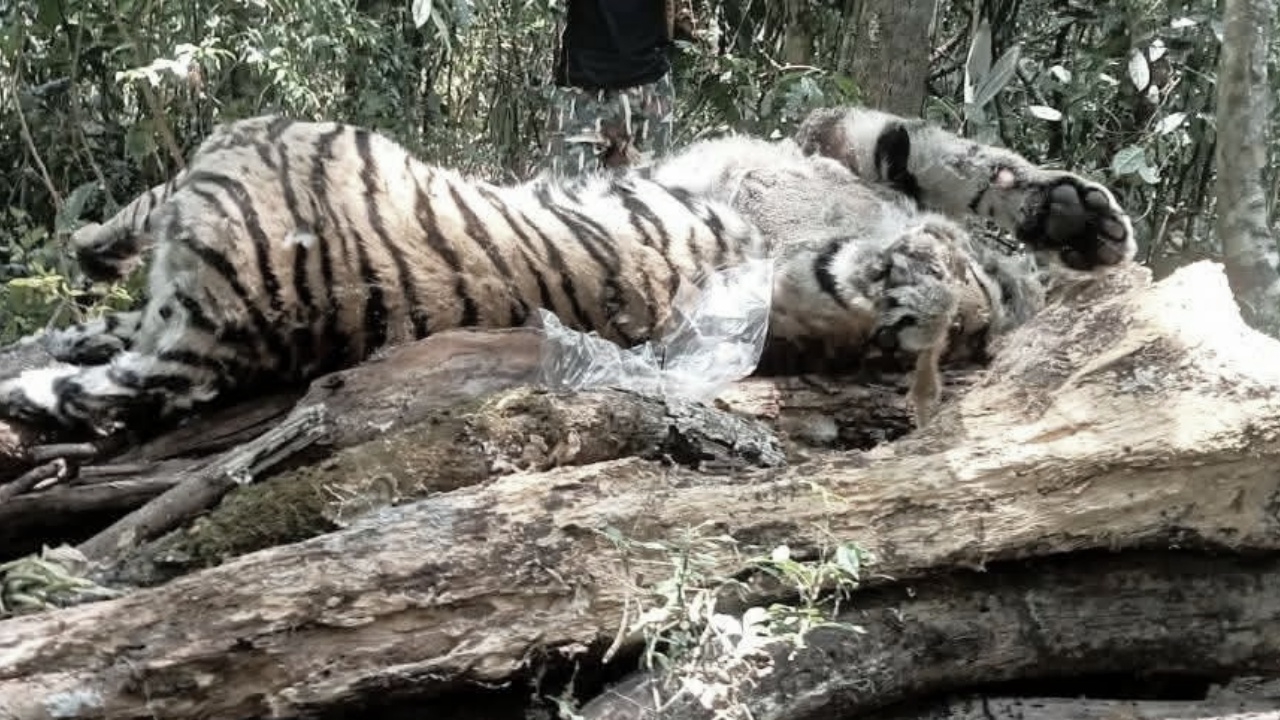
Carcass found "Juvenile tiger" Found dead in the Huai Laka Baeng Lek forest with bite wounds covering its body. It is believed to have died fighting a resident tiger over territory, driven by wild animal instincts, reflecting natural selection where the stronger survives.
On 21 Apr 2026 GMT+7, Mr. Panachakorn Photbandit, Director of Protected Area Regional Office 14 (Tak), revealed that officials of the Thung Yai Naresuan East Wildlife Sanctuary reported finding the carcass of a juvenile female tiger in the Huai Laka Baeng Lek forest. The body showed extensive bite wounds. It is believed the tiger died from fighting a resident tiger over territory, driven by wild instincts. The carcass was promptly burned according to the Department of National Parks regulations to prevent disease spread and poaching.
Mr. Piyapong Suebsane, head of the Thung Yai Naresuan East Wildlife Sanctuary, reported that on 19 Apr 2026 GMT+7, a team from Huai Nam Khiao Forest Protection Unit, together with the Khao Nang Ram Wildlife Research Station, conducted a mission to retrieve camera traps for research data collection in the sanctuary. During their journey through Huai Laka Baeng Lek forest, they came across a distressing scene of a dead tiger lying on a patrol path. They immediately contacted relevant parties to conduct a detailed site inspection.

Initial examination found the carcass to be a juvenile female tiger, not fully grown, with a front paw width of 8.5 cm, length 10.5 cm, and a paw span of 7 cm. The body showed severe bite wounds from a large carnivore, especially around the back of the neck, chest, and right hind leg base.
Officials and experts concluded that all wounds were likely inflicted by a stronger resident tiger attacking the juvenile in a territorial battle to claim forest area—typical behavior of wild cat species when reaching the age to separate and establish their own territory.

After recording data and collecting evidence, officials decided to burn the carcass on-site immediately to maintain ecosystem cleanliness and break the disease transmission cycle that could affect other wildlife. This also prevents illegal poaching of animal parts like skin or bones for unlawful use or wildlife trafficking.
Although the loss of this tiger saddened officials and those who discovered it, ecologically it represents a natural selection process where the stronger survives. Moreover, evidence of such territorial battles indicates a healthy and dense tiger population in the Thung Yai Naresuan East World Heritage forest, which remains an important habitat for globally rare wildlife.
Information courtesy of FacebookDepartment of National Parks, Wildlife and Plant Conservation