

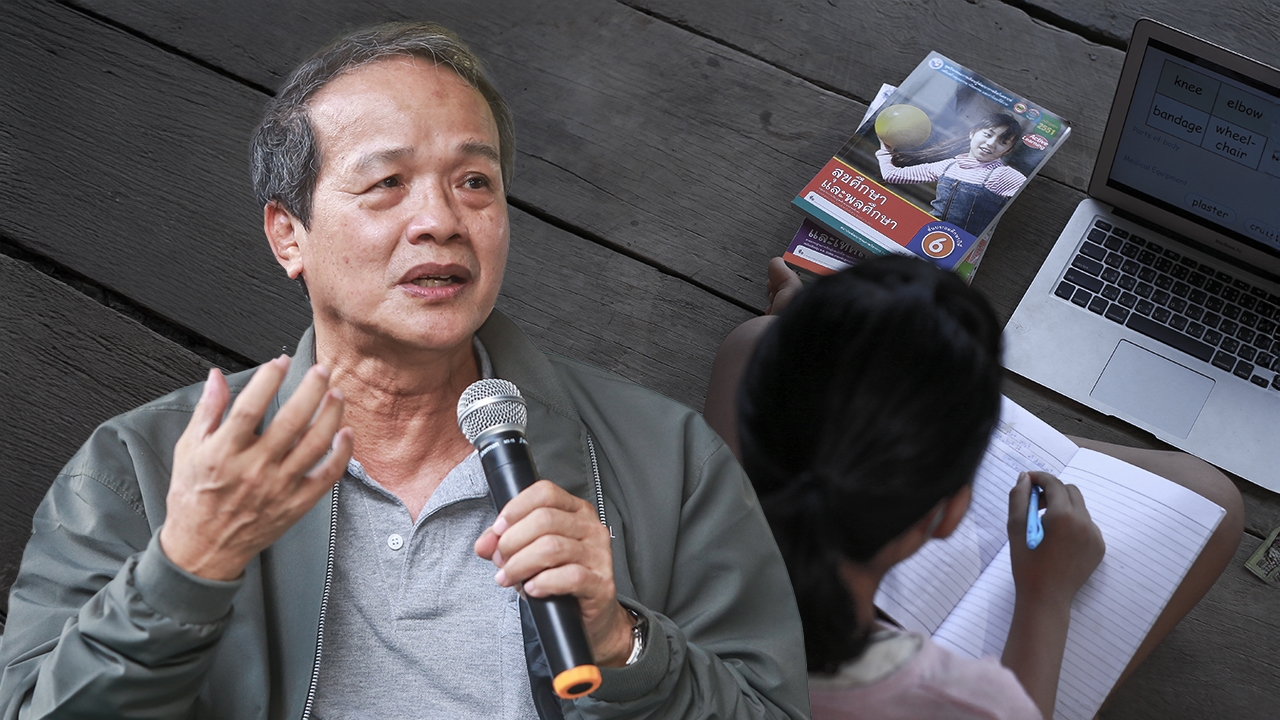
The Equitable Education Fund (EEF) is moving forward with five opportunity packages to assist children and youth individually, promptly, and precisely, integrating research and practice to build a sustainable child protection system under the Thailand Zero Dropout Plus policy.
At a meeting of the task force on innovative assistance for children and youth facing educational crises, the Equitable Education Fund (EEF), chaired by Professor Dr. Sompong Jitradab, approved the “Basic Welfare Package for Children and Youth in Educational Crisis” to address the upcoming 2026 school opening under the Thailand Zero Dropout Plus policy.
Professor Dr. Sompong said that the current global geopolitical conflicts have caused a chain reaction affecting energy prices, living costs, and Thailand’s macroeconomic stability. These impacts have particularly affected the most vulnerable poor households, aligning with educational economics knowledge which highlights that the school opening period is a financial crisis point for households. This is because many expenses arise simultaneously in a short period, including transportation, food, school supplies, uniforms, and other necessary educational costs.
“The financial pressure building up during the school opening period becomes a structural problem causing some children and youth to be at risk of dropping out or leaving the education system.”

Therefore, to strengthen the main agencies’ measures, the task force approved organizing the “Basic Welfare Package for Children in Educational Crisis.” This is a last-resort safety net designed to prevent children and youth from dropping out of the education system, addressing three levels of problems: 1. Immediate economic barriers, 2. Lack of access to flexible learning opportunities, and 3. Absence of long-term support mechanisms.
“These measures will be implemented through the EEF’s Education Crisis Assistance Center, focusing first on children and youth aged 3-18 nationwide who are in the “highest crisis” or “red group.” This group faces severe constraints that prevent them from continuing their education, forcing them to work to support their families or facing life conditions that abruptly disrupt their schooling. The EEF emphasizes that assistance must be individualized, immediate, and precise, because a short-term crisis in a single child's life, if not promptly addressed, could result in permanent dropout.” .Professor Dr. Sompong stated.

Professor Dr. Sompong said the basic welfare package for children and youth in educational crisis consists of “five opportunities,” namely:
Opportunity 1: Learning Plus Coupon Welfare support to access integrated education across three dimensions, including free online skill courses covering life skills, digital skills, and modern vocational skills, along with support for transportation and breakfast costs.
Opportunity 2: Free Learning Anytime, Anywhere via Mobile School A flexible online learning platform that connects learning from community, workplace, and daily life with learners, teachers, coaches, and learning spaces in a unified system. It aims to break down time and location barriers and provide free education without cost.

Opportunity 3: SIM Ready to Learn Provision of free internet access for learning, based on the principle that digital connectivity is a fundamental infrastructure for opportunity, similar to basic utilities. This reduces digital inequality that remains an obstacle to accessing education.
Opportunity 4: Learn to Earn A work-integrated learning mechanism through collaboration with the private sector, featuring a system that recognizes skills gained from work as educational credits. This allows learners to earn income while studying and obtain certified qualifications upon graduation, reducing the dilemma children face between earning a living and pursuing their future.
Opportunity 5: Opportunity Bank A centralized system allocating resources and welfare for educational equipment such as computers, phones, and learning materials, based on transparency and precise targeting to ensure limited resources reach children who truly need them. Even lacking a single essential item can cause a child to fall behind in learning.

Professor Dr. Sompong noted that what sets this measure apart from short-term aid is its design to integrate policy research with systematic practice under the framework of “participatory action research.” This approach gathers empirical evidence from real areas across all measures and builds towards creating a sustainable protection system for children and youth in educational crisis that can be scaled up to policy level in the future.
The EEF is ready to invite cooperation from provinces nationwide, local administrative organizations, and network partners interested in joining the project to help children in crisis. Contacts can be made through the EEF Education Crisis Assistance Center hotline at 092-596-6155 and 02-079-5475.