

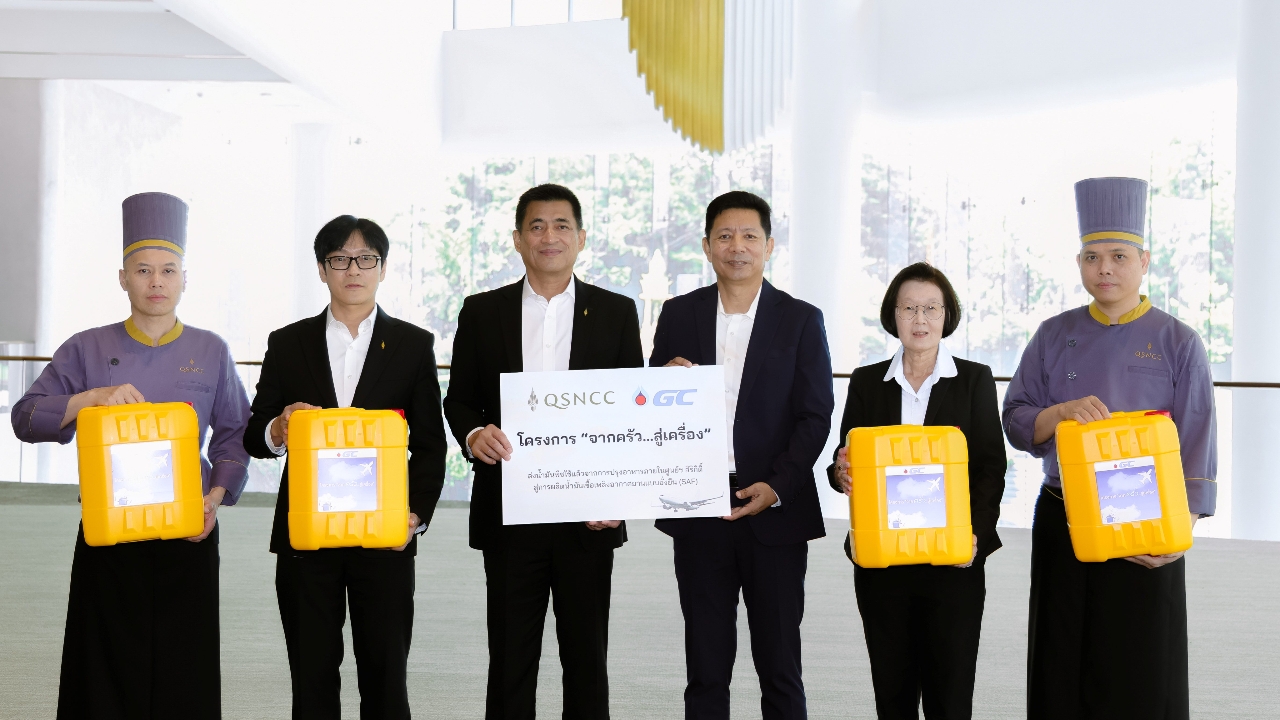
Bangkok – 28 Apr 2026 GMT+7 – PTT Global Chemical Public Company Limited (GC), a global leader in chemicals and Thailand’s first commercial producer of sustainable aviation fuel (SAF), announced a collaboration with NCC Management and Development Company Limited (NCC), operator of the Queen Sirikit National Convention Center (QSNCC), a world-class convention center. This partnership extends the “From Kitchen...to Engine” project by collecting used cooking oil (UCO) from restaurants within the center and processing it at GC’s bio-refinery to produce SAF and high-value bio-based products. This makes QSNCC the first global convention center in Thailand to participate in the project.
The expansion of the “From Kitchen...to Engine” project now includes a world-class convention center, representing another ecosystem with strong potential to collect used cooking oil for beneficial reuse. QSNCC not only hosts international events welcoming both Thai and foreign visitors but also houses numerous popular restaurants, enabling efficient used cooking oil management and systematic integration into GC’s bio-refinery production chain.
/ Ratchada Sawatdirak, Assistant Senior Executive Vice President of GC’s Refinery Business, said, “The partnership between GC and QSNCC marks another step in connecting the strengths of global industry and service sectors. It builds on GC’s success as Thailand’s pioneering commercial producer of sustainable aviation fuel (SAF) by using used cooking oil as feedstock. This process can reduce greenhouse gas emissions by more than 85% compared to traditional aviation fuel, while also enabling the production of high-value bio-based chemicals and bioplastics.”
/ Surapol Utintu, Chief Executive Officer of Queen Sirikit National Convention Center, stated, “QSNCC is committed to creating value for the economy, society, and environment by integrating sustainability into all business operations. The collaboration under the ‘From Kitchen...to Engine’ project reflects our approach to converting used cooking oil from the center into clean energy. At the same time, we manage food waste and other resources appropriately to maximize benefits for the environment and the wider community.”
“We also strive to build cooperation with partners across various sectors to minimize food waste, while encouraging employees, customers, suppliers, and visitors to participate properly in waste segregation. This supports appropriate waste management processes and reduces landfill waste to the lowest possible levels,” Surapol added.
This approach highlights that advancing a circular economy cannot be achieved alone but requires collaboration among partners in all sectors to jointly create an ecosystem that transforms consumption leftovers into tangible new value.