

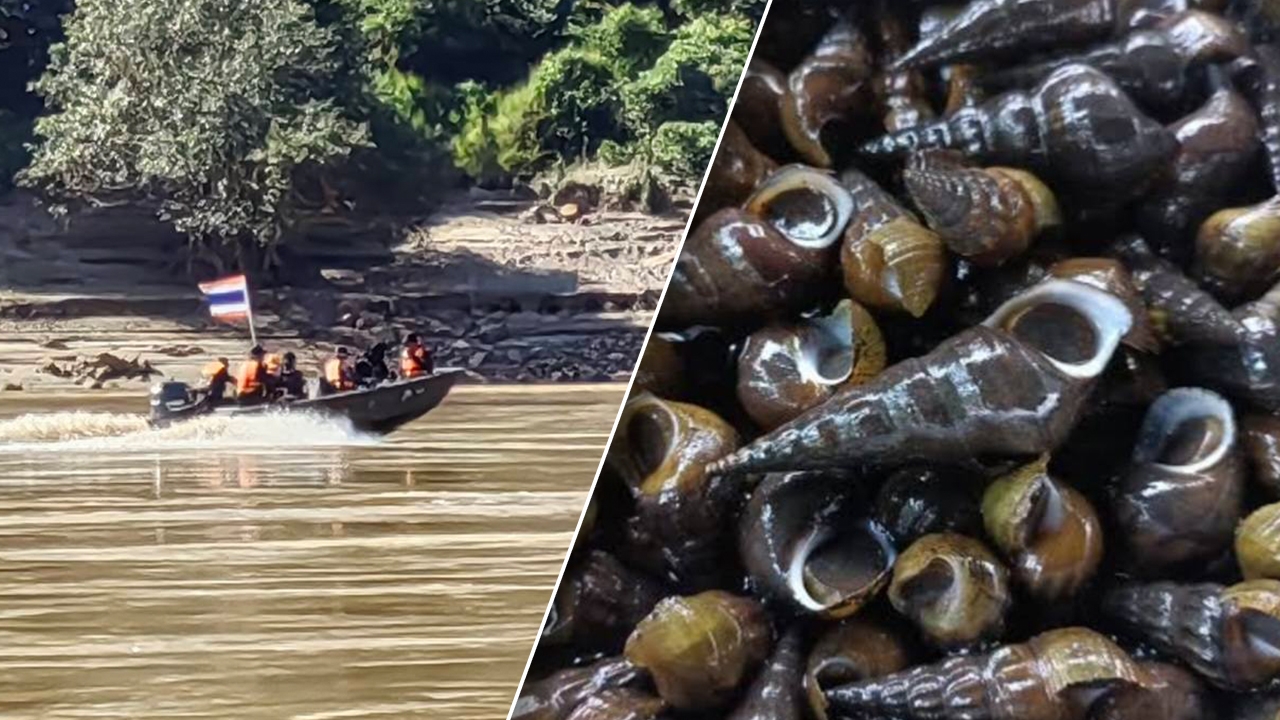
Mae Hong Son — The president of the Mae Sam Laep Subdistrict Administrative Organization has warned local residents to strictly avoid collecting shellfish from the Salawin River for consumption after detecting lead and arsenic levels exceeding safety standards at a level hazardous to health.
On 4 May 2026, Mr. Pongpipat Meebenjamas, president of the Mae Sam Laep Subdistrict Administrative Organization in Sob Moei District, Mae Hong Son Province, revealed that monitoring and sample analysis by the Environmental Science Research Center, Faculty of Science, Chiang Mai University, supported by the Health Systems Research Institute, found heavy metal contamination in long-shelled clams collected from the Salawin River basin at "health-hazardous" levels. Total arsenic (As) was detected at 11.06 mg/kg in fresh shellfish, a level for which Thailand has no standard, while lead (Pb) was found at 3.83 mg/kg, exceeding the standard by more than 2.5 times (standard limit 1.5 mg/kg).

Following monitoring of water, sediment, and data from the Pollution Control Department via SCPC 1, all results consistently showed values exceeding standards by several times. Thus, the detection of heavy metals in shellfish is likely due to high accumulation. The Department of Fisheries has been asked to retest for confirmation to assure local residents. Meanwhile, citizens have been advised to temporarily avoid consuming Salawin River shellfish. Volunteer monitoring teams recently submitted shellfish samples from the Salawin River for analysis and have preliminarily reported high arsenic contamination levels to local authorities.

Therefore, the research team has outlined the following action plan:
1. Advise residents to temporarily avoid consuming shellfish from the Salawin River, especially children, pregnant women, the elderly, and those with underlying health conditions such as kidney disease or cancer.
2. Request the monitoring team to collect additional shellfish samples for analysis at the Department of Medical Sciences laboratory, focusing on inorganic arsenic, the more toxic form.

3. Collaborate with local monitoring teams to conduct health risk screenings. Currently, Ms. Yupaporn, a pediatric nursing instructor, is developing a risk screening tool, which will be implemented locally once completed.
4. Results from the risk screening will identify high-risk individuals. The research team will coordinate with local health centers and Sob Moei Hospital to collect samples for testing at Ramathibodi Hospital laboratories, analyzing arsenic in urine and lead in blood. If contamination is found in community members, appropriate medical services will be coordinated.