

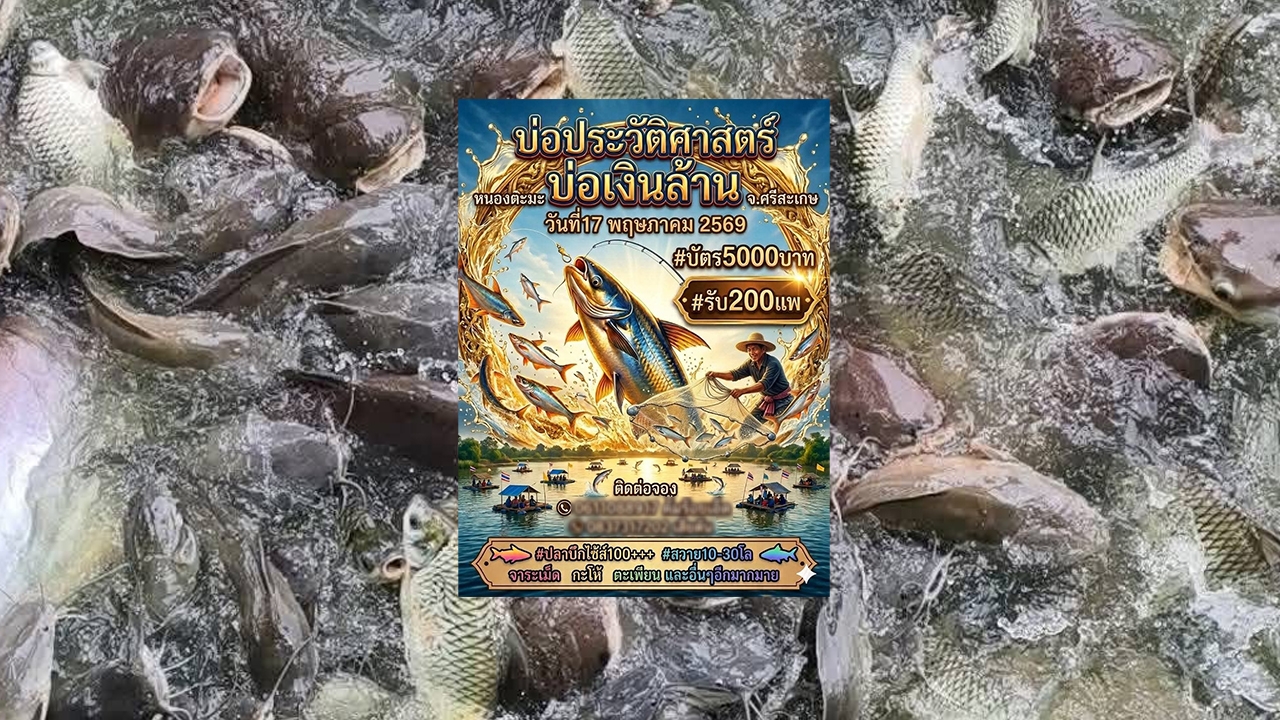
A heated controversy has arisen in Sisaket over a private investor leasing “Nong Tama,” a wetland designated as a sanctuary area, and selling 5,000 baht tickets allowing participants to cast nets for fishing. This has deeply shaken public trust, as the wetland is closely connected to the local community’s way of life. The Sisaket City District Chief has urgently called a meeting and initially plans to delay the fishing activities.
This issue has become a hot topic, sparking intense public debate and criticism. “Nong Tama” is a large body of water located behind Nong Tama Temple in the Sisaket City Municipality, Sisaket Province. Recently, the community proposed auctioning the wetland to a private party to organize activities. “Selling tickets for fishing” to raise funds for constructing and repairing the temple pavilion. However, this idea has stirred strong emotional reactions among the public, especially from those who had released fish and fed them here, believing the area to be a sanctuary area.

On 6 May 2026, reporters visited the site to verify facts and found Nong Tama is a large wetland resembling a natural pond located clearly behind Nong Tama Temple. It hosts various fish species such as Nile tilapia, cyprinids, catfish, and others visible from the surface, as many people regularly feed them, especially on weekends and birthdays. Visitors often come to make merit, release fish, and feed them consistently for decades. This has led many to associate the wetland with the temple and consider it a “sanctuary area” where harming aquatic animals is prohibited, reinforced by past signage. Consequently, the fish are accustomed to humans, unafraid, and have multiplied rapidly.
However, later findings revealed that Nong Tama is not on temple-owned land and lacks official public land title or government land title deeds. It is currently under municipal survey and boundary verification by the Sisaket City Municipality.
Community consultations in Ban Nong Tama discussed problems such as overpopulation of fish causing water quality issues and occasional fish die-offs with foul odors during dry or rainy seasons, causing local disturbances. To address this, a public meeting resolved to implement a project to reduce fish numbers by “leasing” the fishing rights to a private party to organize fishing activities, selling tickets to the public at 5,000 baht each on 17 May 2026.
The proceeds will fund public benefits, especially the construction and repair of the Nong Tama Temple pavilion, fulfilling community goals. Although well-intentioned to solve environmental problems and develop the community, once publicized, the plan faced strong backlash, particularly online, viewed as “killing fish that people once released” and violating moral and sanctuary principles. Local opinions are divided, with some supporting and others strongly opposing.

Mrs. Payom, a 71-year-old fish food vendor in the area for over a decade, said that Nong Tama has long been a place for many people to make merit. Previously, many came to feed fish on weekends, but since news of the fishing plans surfaced, it has quieted down. People likely feel upset because the fish they released will be caught and sold.
She personally opposes selling fishing tickets, feeling sorry for the fish, though she understands some see it as a solution to the fish overpopulation problem.
Regarding fish die-offs and foul smells, she noted there have been no incidents this year, but in a past year many fish died after a herbicide was sprayed near the wetland’s head, and runoff entered the water. Generally, fish deaths have not been frequent.
Since the fishing controversy began, those who used to release and feed fish have stopped coming, likely feeling saddened that the fish they cared for will be caught and sold to fund the temple pavilion.
Mr. Charan, 65, a member of the village committee, said he was unaware of the project details and that few villagers attended the public meeting. He only recently learned of it and does not know its origins. He personally disagrees with the plan because it affects people emotionally, especially those who released fish. Fish die-offs are common in certain seasons, especially March to April, but this year the situation has not been severe due to sufficient water levels.
Phra Kru Sutthamthat Piyatammo, abbot of Nong Tama Temple, clarified that the wetland is not temple property. However, most locals believe it belongs to the temple because of its location behind it and its role in their lifestyle. This misunderstanding has raised questions about why the temple would allow fishing, damaging its reputation, though it is not temple land. The abbot personally hopes the project can be halted or delayed, as it is emotionally inappropriate.

“Most fish were released by villagers for merit and are considered part of the sanctuary area. Any fishing should be carefully considered.”
On 7 May 2026 at around 18:00, Mr. Kanwalin Muangkaew, Sisaket City District Chief, will urgently convene a meeting of all relevant agencies to find a solution to the issue.
Preliminary indications suggest “delaying the fishing activities” to open a forum to inform and hear opinions from all sides thoroughly before deciding on next steps.