

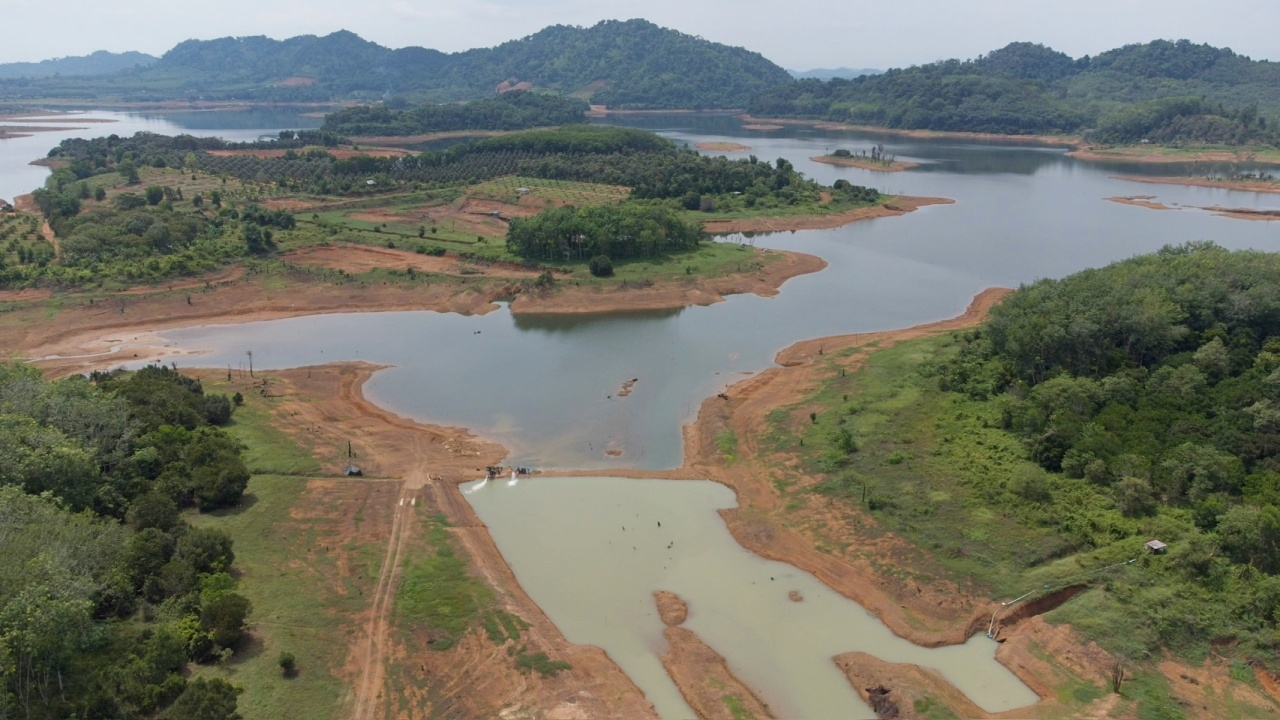
The worst drought in 11 years has brought the Khao Rakham Reservoir into a critical state, with the canal drying up. The Royal Irrigation Department has set up large water pumps to provide assistance. farmers and local residents who have begun to suffer severe impacts.
On 12 May 2026, reporters reported that the drought situation in Trat province has worsened significantly. The Khao Rakham Reservoir has only 30% of its water remaining, or 14.384 million cubic meters from its total capacity of 47.690 million cubic meters. This has caused the Nam Chiao Canal, which directly receives water from the reservoir, to dry up, severely affecting the Nam Chiao subdistrict in Laem Ngop district and the Nong Sano subdistrict in the city district in an unprecedented manner.
Recently, the Royal Irrigation Department installed large water pumps to help sustain farmers and residents who are starting to suffer greatly from shortages of both drinking and usage water.

Mr. Chaiyagorn Lunta, head of the engineering division of the Trat Irrigation Project, together with Mr. Peeraphong Phiphatlertsakul, chairman of the Nam Chiao water users group, along with the chairman of the Nong Sano water users group and several villagers, visited the Wang Kraten Canal bridge in Nong Sano subdistrict to monitor water diversion from the Khao Rakham Reservoir, which currently holds its lowest level in 11 years. This water is diverted into the Nam Chiao Canal because the canal has dried up and lacks water for consumption and use.
Mr. Chaiyagorn revealed that this year marks the lowest water levels in 11 years. The main cause was a shortfall of 5 to 6 million cubic meters from the reservoir’s capacity at the end of the last season, combined with a prolonged drought causing water to drop rapidly beyond expectations. The agency is urgently addressing the issue by deploying large pumps to divert water back into the Nam Chiao Canal. This water diversion will continue until the end of the dry season and the official start of the rainy season, expected by the end of this month or early next month, as recent rainfall is only due to seasonal storms.
Regarding the water diversion, the water has now traveled about 4 kilometers, halfway through the total 8-kilometer distance. It is expected to reach the final section within 3 to 5 days, providing relief to residents in Nam Chiao and Nong Sano subdistricts.
Meanwhile, Mr. Sanchai Namtham, 65, a representative of affected farmers, described the hardship, saying their gardens have lacked water for months. The extreme heat causes water to evaporate quickly. Many farmers bear the burden of buying water at a high cost of up to 10,000 baht per trip, which only sustains their gardens for a single day.
Previously, he tried to help by sharing water from a small pond managed by the Department of Provincial Administration to nearby villagers and farmers for survival. But once that water ran out, they were almost hopeless. If the situation continued for another week, all the trees would die. Fortunately, the irrigation department’s timely water diversion has saved farmers from total ruin.
Mr. Peeraphong Phiphatlertsakul stated that this year’s El Niño phenomenon has severely impacted the area, causing the Nam Chiao Canal, which had never dried before, to run dry. As a result, farmers in Nam Chiao subdistrict must purchase water for agriculture. Nong Sano subdistrict faces even greater hardship, lacking not only agricultural water but also raw water for village water supply. Initially, the Nong Sano Subdistrict Administrative Organization addressed the immediate issue by pumping water from the Nong Samed area to replenish the system and provide water to residents.
For long-term solutions, Mr. Chaiyagorn said this water diversion is the first time such a measure has been taken here, and plans are being developed to handle this issue annually to prevent future water shortages.
Additionally, a representative from the water management group said they have proposed and coordinated with the Trat Irrigation Department, which is currently preparing a project to install permanent water pumps for diversion. The project is expected to be completed within 2-3 years, after which the water management group, in cooperation with government agencies, will oversee its operation.