

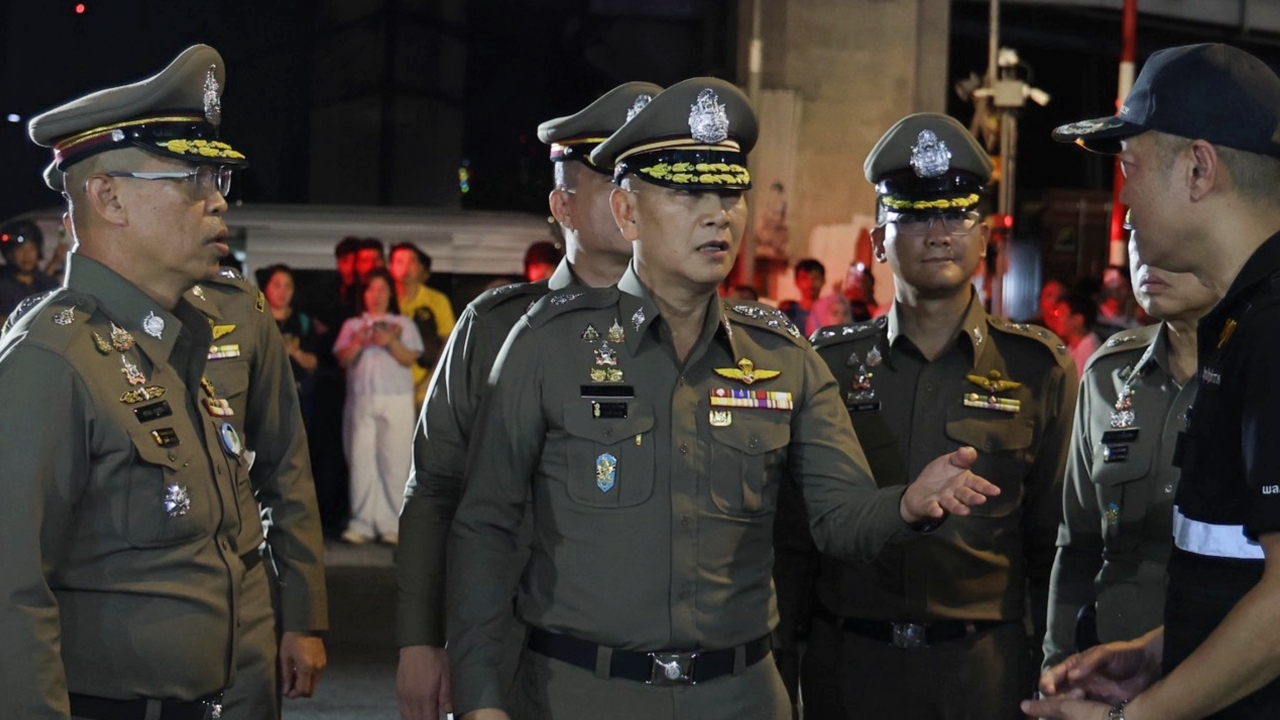
The police chief has ordered an investigation into the train and bus drivers on charges of negligence causing death. He revealed that the crossing gate operator has been detained and questioned, emphasizing the need to tighten traffic discipline among Bangkok drivers.
Following an accident involving freight train number 2126 traveling from Laem Chabang to Bang Sue Junction, operated by the State Railway of Thailand (SRT), which collided with bus route 206 stopped on the railway tracks due to a red traffic signal at the Asoke-Phetchaburi intersection near the Asoke-Din Daeng level crossing (between Khlong Tan and Makkasan stations), resulting in 8 deaths and approximately 30 injuries at around 15:40 on 16 May 2026, as previously reported.
Most recently, at 21:00, Police General Kittirat Phanphet, the police chief, visited the scene to follow up on the train collision with the bus that caused a fire. He said he had instructed the Metropolitan Police Commissioner, the commander of Metropolitan Police Division 1, and Makkasan Police Station to urgently manage traffic to ensure smooth road use for the public. Coordination with the Department of Disaster Prevention and Mitigation and relevant agencies is ongoing to move the bus off the train. The bus has already been shifted, with only some concrete slabs remaining to be moved.

The police chief stated that traffic announcements are being continuously broadcast to inform the public. He has ordered the investigation team to proceed legally against both the train and bus drivers for negligence causing death, while expediting the collection of evidence including CCTV footage and other proofs. The case is progressing significantly.
When asked about the condition of the drivers, with reports suggesting the bus driver died while the train driver survived, as well as whether the crossing gate operator was detained, Police General Kittirat said he had been informed that the bus driver is alive and the train driver was injured. He emphasized that this incident caused significant damage, so it is necessary to proceed according to laws and regulations regarding the detention of those involved.
Regarding legal issues under the Land Traffic Act, which prohibits vehicles from approaching within 5 meters of railway tracks, and questions about the train's speed, the police chief said he has instructed a review of all relevant regulations and laws. He expressed condolences to the families of the deceased and described the incident as an important lesson, particularly for public transport drivers who must be responsible for others' lives and property.
The police chief noted that CCTV footage clearly shows the bus stopped spanning the railway tracks. Regardless of whether a train was approaching or the crossing gate was down, drivers should maintain the legally required distance from the tracks. He pointed out that this incident highlights the need to strengthen traffic discipline.
When pressed on whether the bus stopping on the tracks constitutes a legal violation, the police chief responded that it may be more than just a borderline issue. Driving onto railway tracks is inherently improper because the potential harm is foreseeable.
There are also questions about coordination between the crossing gate operator and traffic police in clearing the way. The police chief said he has ordered an investigation into whether the gate operator notified the police, and whether railway officials aware of the train's approach warned the traffic police or drivers to move vehicles and evacuate passengers. He believes timely warnings could have reduced casualties.
Regarding doubts about whether the train driver should have seen the bus blocking the tracks from about 500 meters away and whether this constitutes negligence, the police chief said the investigation will focus on three main aspects: distance, speed, and timing. They will also examine whether warnings were given to move vehicles off the tracks and how coordination occurred as the train approached the crossing.

When asked if the bus driver is at fault, the police chief said preliminary views suggest negligence because stopping on the railway tracks is a risky behavior. While further factual and legal investigation is needed, CCTV clearly shows the bus stopped on the tracks while the train was running on its normal route.
Regarding public questions about why the train did not stop if the bus was negligent, the police chief said the investigation results will be key. They will consider whether the train driver exercised sufficient caution, including slowing down, responding to warning signals, and awareness of traffic conditions at the crossing.
Finally, the police chief urged the public to take this incident as a warning, especially to avoid parking near railway tracks even during traffic jams. He stressed that everyone must observe traffic discipline and work together to prevent such tragedies. Though accidents like this happen frequently, he believes they can be addressed by instilling discipline and safety awareness among road users.
At 21:40, the railway authorities brought a new locomotive to move the freight containers after previously relocating vehicles from the accident site.