

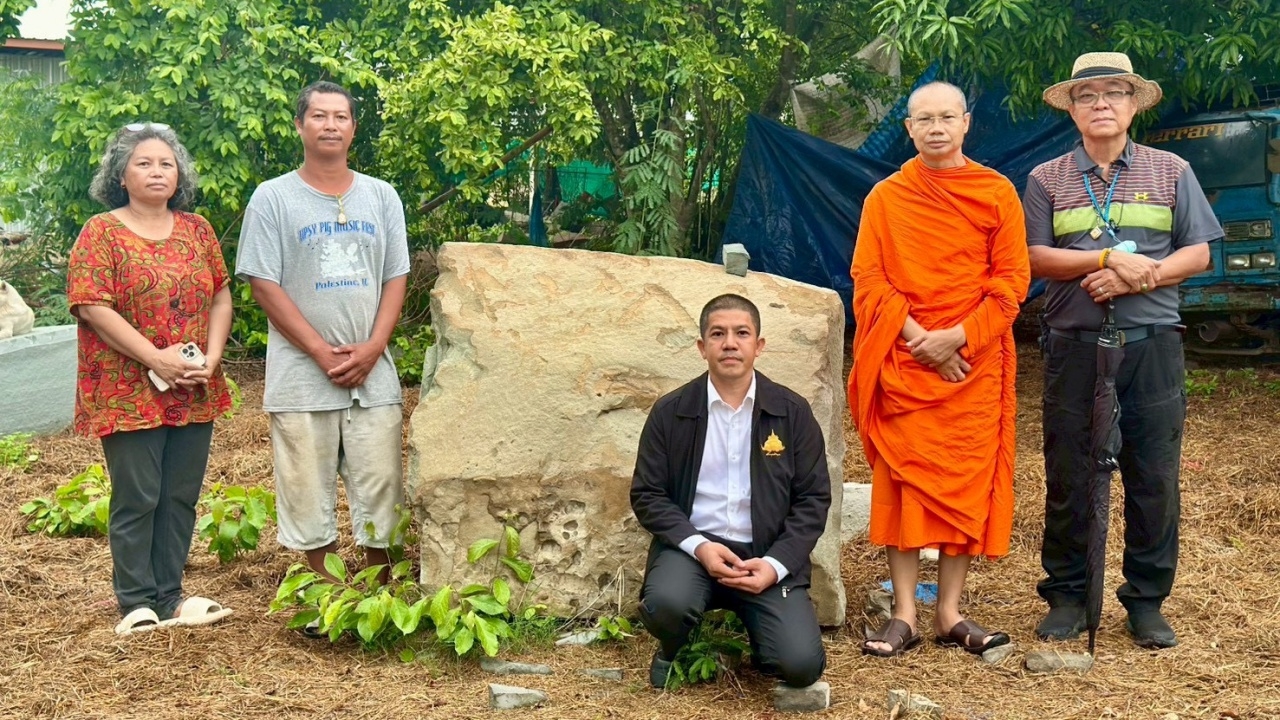
"Discovery of an ancient stone carver, a precious gem who creates Khmer-era stone carving art, quietly residing in Aranyaprathet, Sa Kaeo Province."','tags':['ancient art','stone carving','Khmer art','Aranyaprathet','Sa Kaeo']
After the ceremonial transfer of the 700-year-old Luang Pho Ngern Buddha statue from Wat Pak Nam Bung Saraphang in Ubon Ratchathani Province to be enshrined at Muang Suk Siam, Icon Siam, Bangkok, allowing tourists to perform water pouring during the recent Songkran festival,
Before the statue was brought to Bangkok, Mr. Bancha Chantadilok, advisor to the Suk Siam Icon Siam project,
led a group from Muang Suk Siam several times to the excavation site of Luang Pho Ngern to gather background information about the Buddha image to be enshrined. They learned that the area of Dong Phra Ganesh at Wat Pa Phra Phikanet in Ubon Ratchathani Province,
not only yielded the Luang Pho Ngern statue but also the discovery of an ancient Khmer sandstone Ganesh, Kohn Nonti, and a temple spire estimated to be about 1,000 years old. Currently, the sandstone Ganesh is preserved at Wat Supattanaram in Ubon Ratchathani city. This inspired the idea to replicate the ancient Khmer sandstone Ganesh sculpture back to Wat Pa Phra Phikanet, its discovery site, to accompany Luang Pho Ngern as originally paired. Previously, in 2024, the temple had already created a replica of Luang Pho Ngern as the principal Buddha image for the natural ordination hall at Wat Pa Phra Phikanet.
Mr. Bancha Chantadilok will oversee the replication of the Ganesh statue and has already informed the abbot in advance.

The mission to find an ancient Khmer stone carver began, leading to the discovery of a quietly residing ancient stone carver in Aranyaprathet, Sa Kaeo Province.
Orasiri Ongsoontorn, who inherited ancient stone carving from his father, described the origins of the high-skilled ancient stone carving craft:

"Orasiri was born into a family of ancient stone carvers, passing down the master craftsmen’s spirit from generation to generation, starting with ancestors who traveled with the royal army of Somdej Phaya Maha Kasat Suek, eventually settling in the Khmer civilization area known as ‘Rajamarka’ of the Khmer civilization at Muang Pae (Buriram)."
"On the paternal side, Orasiri’s great-grandparents originally lived in Phimai, Nakhon Ratchasima, and came with the army of Somdej Chao Phraya Maha Kasat Suek, who camped near Muang Pae, now Buriram, when returning to the capital. The great-grandparents chose not to follow back to the capital and settled near Muang Talung, present-day Prakhon Chai District, Buriram Province, close to Prasat Muang Tam and Prasat Phanom Rung."

"Later, the ancestors expanded their settlement to Ta Phraya District, Prachinburi Province, and Aranyaprathet District, Sa Kaeo Province, as it is today."
Orasiri’s father was born in Ta Phraya District, Prachinburi Province, and was a farmer by profession. However, he had special artistic abilities, especially in ancient stone carving, which he self-taught by observing stone carvings on ancient temples and memorizing the images, then experimenting with carving.
Orasiri said, "My father loved art and often visited ancient temple carvings at various sites, memorizing them to replicate. The stone carving chisel he used to carve the first reliefs looked exactly like the original, as if taken from a mold. From then on, my father pursued a career in ancient stone carving."
Orasiri described his own special craftsmanship skills as similar to his father’s: "In my childhood, I recall people from other places coming to hire my parents to carve stone at home constantly. As the eldest daughter, I developed a strong bond with stone temples and craftsmanship. During my youth, I often dreamed of ancient people and stone temples, or four-faced Brahma temples, even though I had never seen them in real life."
"As a child, I was able to draw the four-faced Brahma without a model or having seen the real thing. It was an image from my dreams. Later, when I grew up, I learned that the four-faced Brahma I drew from imagination was actually Avalokitesvara Bodhisattva according to Bayon art."

"The Ganesh statue found at Wat Pa Phra Phikanet is believed to be early Baphuon period Khmer art, with influences from 1,600-year-old Koh Ker Khmer art, predating the Bayon period. It is a classical era where artisans attempted to depict humans most realistically, with elegance—even the shins have ridges like those of a human," Orasiri emphasized.
Orasiri recounted, "Around age 13, I dreamed again of an ancient man with his hair tied up, wearing a white Brahmin loincloth. He pointed and said, ‘Here, here,’ near a mound on the land of my grandparents close to Ta Muean temple. I had these repeated dreams several times and told my grandfather to take me there. I pointed to the spot from my dream and asked him to dig."
"My parents and relatives helped dig, and they found ancient tools—ancient iron chisels with handles still attached. The spot resembled an ancient kiln; digging revealed a bronze kiln and many old celadon bowls. After discovering these ancient stone carving iron tools, I never dreamed again of the ancient man with tied-up hair wearing white loincloths."
"Finding iron chisels and a bronze kiln at the old city temple site suggests that the area might once have been a royal craftsman’s residence along the Rajamarka route in the past," Orasiri speculated.
"Although we moved from Ta Phraya to Aranyaprathet District, Sa Kaeo Province over 30 years ago, stone carving remains the main profession sustaining the family."
"Our family’s stone carving is not about learning a new skill from scratch but about ‘awakening old skills’ passed down. From my father’s generation, who exported works abroad, the art was rarely seen locally. Now, my siblings and I began handling tools from age 16, all skilled artisans. We also pass this knowledge to our nieces and nephews, showing this skill is transmitted not only by hand but through bloodline."
Orasiri emphasized, "Every mark carved into each stone block becomes the signature of the carver. Each region has its own distinct ‘identity’ or signature. For example, northern regions feature delicate Lanna or Chiang Saen styles, the northeast reflects Lao art influences, and Korat style is a blend."
"Our family’s carving style is clearly distinct from other contemporary stone carving sites, which mainly produce modern-style works. Our family is deeply connected and immersed in ‘ancient Khmer art,’ which gives our work a unique charm and spirit—this is the signature of our family’s artisan lineage."
"The uniqueness of our family line is its direct ‘roots’ linked to ancient stone temple art. This craft requires great precision and passion because it is not just about replicating external shapes but about carving with ‘life’ and ‘solemnity’ true to ancient originals."

The story of Orasiri and his family, the precious gems crafting ancient Khmer stone carving art hidden in Aranyaprathet, is not just about ordinary artisans. It is a ‘lineage of artists’ deeply rooted in the history of artistic creation passed down for thousands of years, keeping ancient art alive and becoming a heritage for the land in today’s world."','tags':['ancient stone carving','Khmer art','heritage','Aranyaprathet','craftsmanship','family tradition','cultural preservation']}]}]}