

Schools under Mahasarakham Provincial Administrative Organization (PAO) visited Darunaratchaburi School in Ratchaburi Province to study the GPAS 5 Steps systematic learning approach, covering information searching, analysis, knowledge creation, hands-on practice, communication, and reflection.
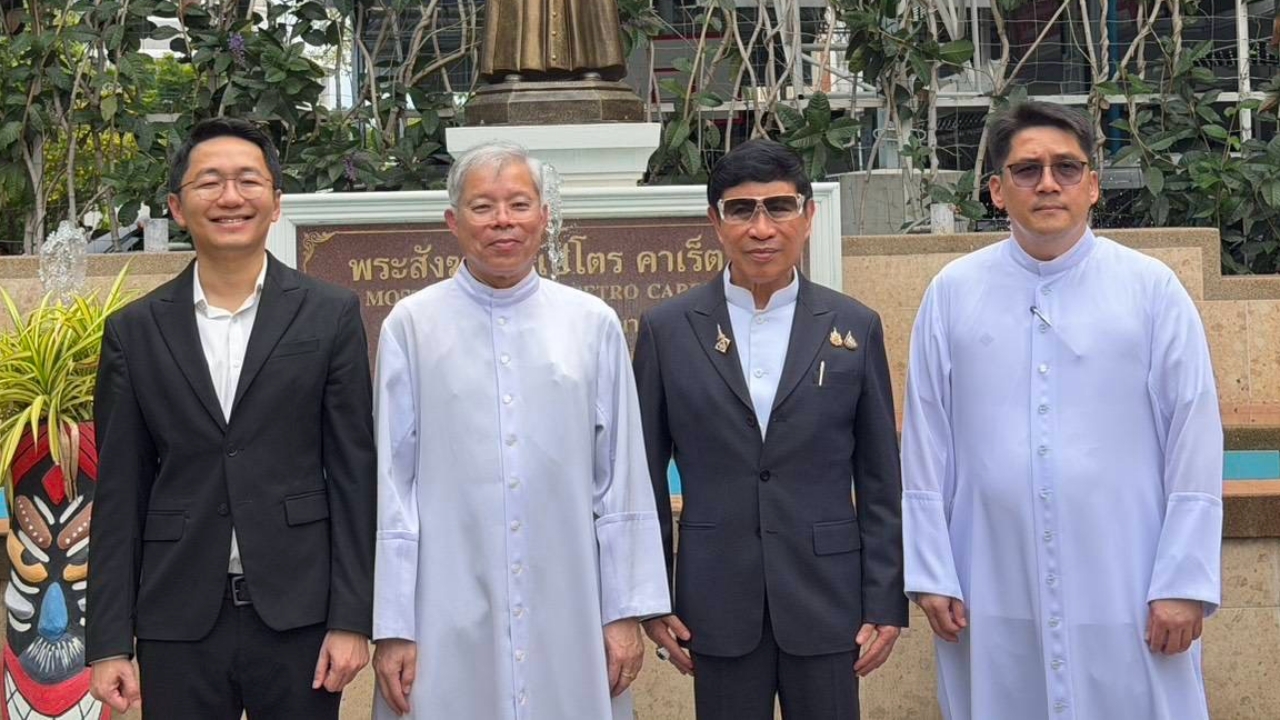
On 19 May, reporters reported that Mr. Phonphat Jarassthein, President of the Mahasarakham Provincial Administrative Organization (PAO), led over 104 administrators, teachers, and educational staff from PAO schools in Mahasarakham to visit Darunaratchaburi School in Ratchaburi Province. The purpose was to bring back ideas to develop their schools. Father Assistant Professor Apisit Kritcharoen, Director of Darunaratchaburi School, welcomed the group. Also present were Mr. Yutthapong Jarassthein, Advisor to the Minister of Education, and Mr. Saksin Rojaranyrom, Chairman of the Academic Quality Development Institute (AQDI), who shared insights on the GPAS 5 Steps learning approach.
Mr. Saksin explained that in the AI era, machines think millions of times faster than humans, making traditional rote memorization obsolete since such memory quickly expires. Students must be nurtured to develop advanced systematic thinking patterns that form deep, long-term memory. This fosters analytical, creative thinking and critical judgment in applying knowledge. AI ensures that knowledge never expires. Therefore, schools can no longer teach children by rote memorization for exams because what matters is not who remembers more, but who can apply knowledge to create value and innovation. The core of GPAS 5 Steps is to develop students to learn systematically—from information searching, analysis, knowledge construction, practical application, communication, to reflection—so that students become owners of their knowledge.
Father Assistant Professor Apisit said the school's goal is not just to conduct enjoyable activities but to build a system that cultivates wisdom by transforming teachers from instructors into learning designers. This approach allows students to think, experiment, and discover answers independently. Teachers reported that active learning classrooms may not be as quiet as before, but the sounds of discussion, debate, and brainstorming among students reflect genuine thinking happening in the classroom.
Mr. Phonphat stated that currently, Mahasarakham PAO oversees 21 schools with over 4,500 students, mostly from impoverished and underprivileged families. Although there are about 400 teachers, there is a shortage of English teachers and no capacity to hire more due to staffing limits. Mahasarakham PAO has begun integrating technology by establishing Smart Classrooms to address educational inequality. The goal is to elevate students to think, plan, and live meaningfully beyond merely studying for exams. This study visit is not just about observing a model school but preparing to implement the Ratchaburi model to create a network of model schools in the Northeast. The plan is to develop innovative teachers, foster student innovation, and promote Mahasarakham as the intellectual center of the Northeast within three years.