

Ministry of Higher Education, Equitable Education Fund, and University Presidents' Council set direction for TCAS70.“Ensuring Opportunity Guarantees.”Developing human capital by linking data on financially disadvantaged students to scholarships and welfare to break the cycle of inequality in university admissions.
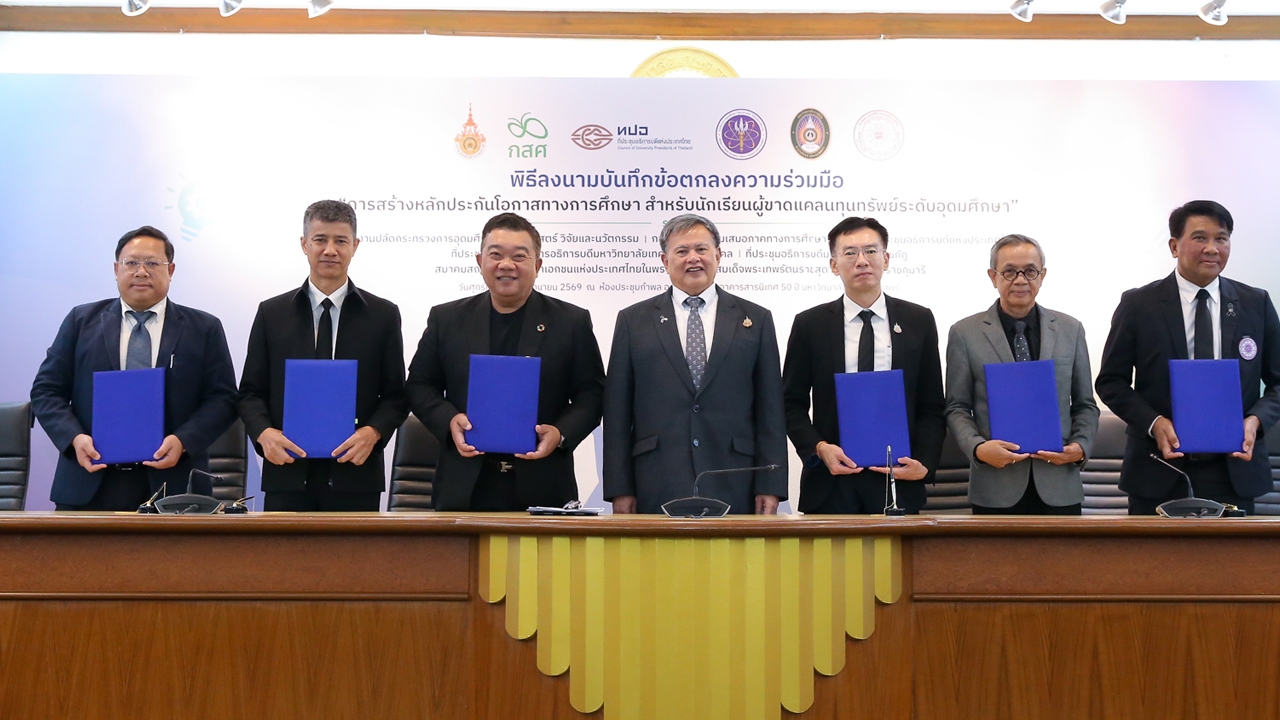
On 12 June at the Kamphon Adulwit Meeting Room, 2nd Floor, 50th Anniversary Information Building, Kasetsart University, the Equitable Education Fund signed a memorandum of understanding (MOU) to create educational opportunity guarantees for financially disadvantaged university students. The agreement was made among the Office of the Permanent Secretary of the Ministry of Higher Education, Science, Research and Innovation; the Association of University Presidents of Thailand; the Council of Presidents of Rajamangala University of Technology; the Council of Presidents of Rajabhat Universities; and the Association of Private Higher Education Institutions of Thailand.

Professor Dr. Yossanan Wongwattana, Deputy Prime Minister and Minister of Higher Education, Science, Research and Innovation, said that over the years, Thailand has had a sufficient amount of scholarships at a certain level, but lacked a “management system” to help organizations or donors connect with capable students who need financial support. Today, cooperation between the Ministry of Education, the Ministry of Higher Education, and the Equitable Education Fund has enabled linking data of students proven to be from poor or extremely poor households and who have received equitable scholarships throughout 12 years of education.
“When these students apply to universities, we do not recognize them, so they have to pay application fees and prove their status again, causing some to drop out during this transition. This long-standing issue, known as The Lost Einstein phenomenon in Thailand, can be resolved through data management and integration of government agencies’ work. Today, we are systematically and sustainably addressing this problem,” said Professor Dr. Yossanan.

Professor Dr. Yossanan added that this year, the Ministry of Higher Education has prepared TCAS70 measures to reduce expenses by up to 3,150 baht per person, including waiving fees for TGAT/TPAT 1-5 and A-Level exams (up to 7 subjects), waiving application fees for round 3 (Admission) for up to 7 choices, and reducing Portfolio round application fees by 25% for students under the Equitable Education Fund system. This will assist more than 28,000 students. They also plan to launch the TCAS Verified system in July 2026 to quickly and accurately verify disadvantaged students’ identities.
“I urge all universities to use Equitable Education Fund data to allocate scholarships to equitable scholarship students so that financially disadvantaged students do not have to reprove their status. Universities should also disclose scholarship allocation data, specifying the number and proportion of equitable scholarship students supported by all funding sources within their institutions. Currently, four pilot universities—Kasetsart University, University of Phayao, Nakhon Ratchasima Rajabhat University, and King Mongkut's Institute of Technology Ladkrabang—will collaborate with the Equitable Education Fund in 2026 to analyze data and allocate scholarships for implementation in 2027. This model should be expanded to all universities, and the ministry will promote all institutions to follow suit,” Professor Dr. Yossanan said.

“Every year, many exceptionally talented students decide not to continue their studies simply becauseof “transition period expenses.”and lack of comprehensive welfare information. The Ministry of Higher Education will work with the Ministry of Education and the Equitable Education Fund to proactively communicate welfare rights directly to students in all schools before exam applications, preventing students from dropping out. The goal is to double the continuation rate for financially disadvantaged students according to the Equitable Education Fund’s data and feedback from students today. I will use their proposals to develop policies that best address youth needs,” the Deputy Prime Minister stated.

Dr. Krisanapong Keeratikorn, Advisor to the Equitable Education Fund Executive Committee, said statistical data from the TCAS system between 2022 and 2025 shows that 85,363 equitable scholarship students overcame economic obstacles and confirmed university admission without significant changes.. (This part is a continuation from previous and has no additional text.)A regional analysis reveals that the Northeast has the highest number of equitable scholarship students confirming university admission: 34,531 in the Northeast, 23,103 in the Central region, 13,175 in the North, 11,407 in the South, 2,513 in the East, and 634 in the West.
Among higher education institutions with the highest number of equitable scholarship students confirming admission, Mahasarakham University ranks first nationally. In 2025, it had 3,040 students (21.64% of all new students) and in 2024, 3,193 students (26% of new students). Next was Phraboromarajchanok Institute with 1,467 students, representing 60% of new students, followed by Ubon Ratchathani Rajabhat University with 1,181 students, and Kasetsart University with 1,089 students in 2025.Kasetsart University1,089 students in 2025.

Dr. Krisanapong said that although the enrollment numbers appear large, many students still cannot reach their dreams due to high financial barriers, including“transition period expenses.”University entry transition costs can be up to 12 times higher than the average income of extremely poor households. These accumulated transition expenses range from about 13,200 to 29,000 baht, including exam fees of 100–140 baht per subject, Portfolio round application fees of 300–500 baht per program, initial fees and dormitory costs of 2,500–7,000 baht, and first tuition installment of 10,000–20,000 baht, which must be paid immediately to secure admission with no deferrals allowed.
“Additionally, these students face challenges accessing scholarship sources, lack of guidance suited to their potential, and“relocation costs.”In 2025, 4,139 students had to relocate across regions, and 10,934 moved between provinces within the same region, leading to significant hidden expenses causing some students to drop out,” Dr. Krisanapong said.

Professor Dr. Supachai Pathumnakul, Permanent Secretary of the Ministry of Higher Education, Science, Research and Innovation, said the six partner agencies—the Office of the Permanent Secretary of the Ministry, the Equitable Education Fund, the Association of University Presidents of Thailand, the Council of Presidents of Rajamangala University of Technology, the Council of Presidents of Rajabhat Universities, and the Association of Private Higher Education Institutions of Thailand—have jointly signed a five-year memorandum of understanding to build“an educational opportunity guarantee system”and to promote“seamless education”in a genuine way, eliminating all transitional barriers through innovation and data.

“The Equitable Education Fund will initiate the use of a screening and referral system with large-scale data (Big Data) on financially disadvantaged students. The University Presidents' Council will take over to connect this data to the centralized selection system (TCAS), enabling us to identify students and allocate rights to universities accurately, ensuring no one is lost along the way. Meanwhile, the Ministry’s Office will serve as the policy mechanism to transmit data, supervise, and drive support measures with higher education institutions, pushing policy innovations such as reducing exam application fees and mobilizing scholarship sources. Crucially, the Councils of Rajamangala Universities, Rajabhat Universities, and the Association of Private Institutions, as on-the-ground operators, will open network institutions as research sites to develop support systems and sustain all scholarship students,” the Permanent Secretary said.

Professor Dr. Supachai added that this initiative creates an innovation ecosystem linking universities, government, private sectors, and funding sources into an integrated system. The immediate expected result is that in the 2026 academic year, the Equitable Education Fund’s target group entering TCAS70, estimated at 34,000 to 41,000 students, will receive continuous care and support from their first day at university.