

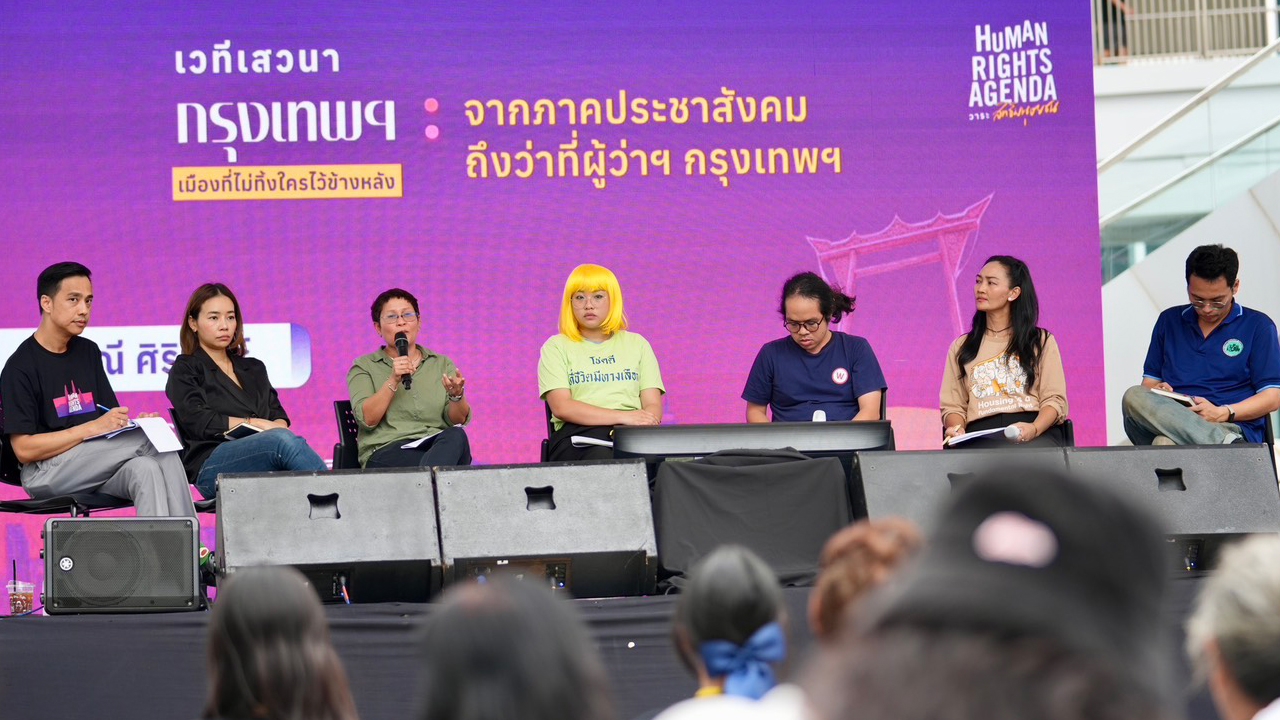
Amnesty International Thailand and civil society have voiced to the incoming Bangkok governor the need to promote Bangkok as a “Human Rights City” that leaves no one behind.
Bangkok, 20 June 2026 GMT+7 – Amnesty International Thailand, together with civil society networks, academic institutions, and media, held a public forum titled “Leaders’ Discourse, Human Rights Agenda: Bangkok, a City That Leaves No One Behind” at the Bangkok Art and Culture Centre. This event took place ahead of the Bangkok gubernatorial and city council elections on 28 June 2026 GMT+7, providing a platform to discuss everyday human rights issues and inviting society to question what kind of city Bangkok, home to diverse residents and workers, should be.
The event featured discussions on human rights education, youth and activist forums, leaders’ discourse on human rights, and booths from civil society organizations. It offered candidates for Bangkok governor a chance to present their visions on human rights issues. Amnesty Thailand emphasized that human rights are not distant concepts but relate directly to homes, schools, streets, sidewalks, air quality, public spaces, health, livelihoods, peaceful protests, and the dignity of people’s daily lives.
Amnesty Thailand believes local elections, whether in Bangkok, Pattaya, or other cities, should not be reduced to mere personality contests. Instead, they should provide the public with opportunities to see candidates’ visions, scrutinize policies, question urban development directions, and participate in shaping the future of their communities—where they live, work, learn, and live daily. Human rights issues are closely tied to quality of life, including public services, urban spaces, housing, environment, health, education, safety, livelihoods, and human dignity.
Thus, local elections are not only about choosing city administrators but also a crucial chance for citizens to jointly decide how their city should develop inclusively without leaving anyone behind. A good city should not be judged solely by modernity or orderliness but by how it ensures everyone can live safely with dignity, access services, and have a voice in decisions affecting their lives.
Human rights should not depend on any single governor.
Over recent years, although Bangkok has emphasized urban development through various policies and tools covering transportation, safety, transparency, environment, health, education, economy, society, and city management, Amnesty Thailand opines that regardless of the policy frameworks, the next key step is to institutionalize human rights-based urban development. This includes having action plans, budgets, indicators, participatory mechanisms, human rights impact assessments, and accessible remedies for the public.
/** No translatable content; name only **/ Petchrat Saksiriwetkul, Campaign Manager of Amnesty International Thailand, said that making Bangkok a truly human rights-respecting city cannot stem solely from national policies or the promises or declarations of any single leader. It must come from the practical application of human rights in people’s daily lives. /** Fragment: continuation from previous, so translation limited to fragment **/ It must be made real in people’s everyday experiences. This happens through the work of local authorities, urban policies, and public services that people access daily, because human rights are meaningful only when citizens can tangibly experience them in life.
“Whether national or local elections, citizens should have space to listen, compare, question, and express their needs about public policies. The Bangkok gubernatorial election should not be about individuals alone but an important opportunity to push forward policy agendas—especially human rights policies that determine people’s quality of life every day in the city.”
Petchrat added that human rights are obligations that the Thai state must respect and protect nationally. However, in reality, whether these rights are realized or violated is evident in the work of local administrative organizations that are present in citizens’ daily lives. Bangkok has a crucial role as the agency directly responsible for services and infrastructure used daily, including public services, public spaces, schools, health centers, sidewalks, environment, and mechanisms for listening and responding to the public’s voice. These services and policies are the intersection between human rights principles and people’s real lives. They are where human rights must be transformed from paper principles into accessible, equitable, and tangible services, care, and protection in daily life.
Lessons from human rights cities worldwide—such as Gwangju, York, Vienna, Lund, and Ulaanbaatar—show that a human rights city does not emerge from any single leader alone. It requires embedding human rights into urban governance structures through participation of citizens, civil society, and directly affected groups; measurable indicators; human rights education for officials and the public; impact assessments of urban policies; and effective remedies when rights are violated.
“Bangkok must not let the human rights agenda depend solely on any one governor but must institutionalize human rights as an urban system that continuously and fairly protects people, even as leadership changes.”
Amnesty Thailand proposes that Bangkok governor candidates, city council members, and city agencies collaborate to push forward a “Bangkok Human Rights City Action Plan” within the first year of the administration. This plan should be linked to Bangkok’s authority, urban development plans, budget, and policies. Regardless of who governs, the plan must set goals, indicators, budgets, responsible agencies, timelines, and monitoring mechanisms accessible to the public.
Civil society reiterates that Bangkok must listen to its citizens and leave no one behind.

/** Name only **/ Achara Sarawalee, Isara Foundation She revealed that homelessness and people living in public spaces are not issues affecting only certain groups but the entire society, as they relate directly to welfare and human dignity. Solutions should go beyond immediate aid or reactive management to systemic approaches that help people rebuild their lives, including housing, employment, physical and mental health, and respectful treatment. The key to solving homelessness is preventing anyone from losing their home and family in the first place, because once people fall outside protection systems, starting over becomes much harder and more painful. Thus, addressing homelessness is not the responsibility of a single agency but requires cooperation among government, civil society, and citizens to create a city that leaves no one behind. A livable Bangkok is not a city that tries to make homeless people disappear from public view but one where no one is abandoned in times of crisis.
“Homelessness and living in public spaces are not problems of a single group but concern the welfare and dignity of all. Solutions in Bangkok must enable these people to rebuild their lives with housing, jobs, and health, while preventing anyone from losing their homes or families initially. This requires cooperation among the state, civil society, and citizens to build a Bangkok that leaves no one behind.”
Jarunee Siriphan, from the Network to Eliminate Discrimination (MOFDI), stated that “Bangkok is not lacking diversity but still lacks equality.” Bangkok is home to one of the most diverse populations in the country and the world, yet many face prejudice, stigma, and discrimination accessing services, education, employment, healthcare, and social participation. The key question is not how we coexist with diversity, but how to transform existing diversity into the city’s strength and how to make Bangkok a learning space that respects differences, designs services, policies, and public spaces accessible equally, moving toward an Inclusive City that not only accepts but embraces and supports everyone to fully participate.
“MOFDI invites Bangkok governor candidates to promote Bangkok as a model city for equality and non-discrimination by developing urban policies and mechanisms, supporting multicultural learning, creating organizational cultures that respect diversity, and establishing concrete complaint and protection mechanisms for those facing discrimination from diverse differences. This will prepare Bangkok to pilot anti-discrimination laws in the future. The most livable city is not one where everyone is the same but one where all can live safely, equally, and with human dignity.”

/** Name only **/ Chanthita Kraisrikul, Tam Tang Foundation She stated that Bangkok must advance comprehensive and equitable health policies, especially regarding bodily rights, by ensuring access to safe abortion services. As the capital with the highest population density and greatest demand for abortion services in the country, Tam Tang Foundation calls on Bangkok under the #BangkokSafeAbortionNewOpportunities campaign to expand safe abortion services in all 13 medical offices under the Bangkok Medical Department and 69 public health centers under the Health Department. This will make services accessible, close to home, safe, free of charge, and stigma-free for women and those with unintended pregnancies.
The proposal emphasizes the necessity of accessible, understandable, and practical services and an effective referral system, including reducing unnecessary costs like ultrasound scans. Tam Tang Foundation urges Bangkok to declare that “safe abortion is a basic health service for Bangkok residents” and calls for medical personnel training to reduce stigma and bias in healthcare facilities, stressing that the new governor must make safe abortion services truly accessible to all.
“A good and balanced life in Bangkok can only be achieved when the governor makes safe abortion services accessible to everyone, enabling those who need abortions to regain bright and healthy lives.”

/** Name only **/ Theerath Panichudompach, Welfare State Network for Equality and Justice (We Fair) He said that one fundamental right citizens should have protected by the state is “the right to a good quality of life,” including access to education, housing, public health systems, safety of life and property, and fair protection in employment. Achieving these rights requires policies through a welfare state system that cares for all inclusively and equitably. This is not solely the government’s duty but also a critical role of local agencies. Bangkok, with over 10 million residents and workers, plays a significant role in developing policies and public services to make the right to a good quality of life a reality in daily life.
“Therefore, Bangkok should not be just a city focused on infrastructure development for economic growth but a city prioritizing welfare policies and infrastructure that support caring for everyone. It should be a city that helps you grow with quality, provides guarantees for care when facing risks, and supports your loved ones while you live life as yourself.”

/** Name only **/ Nuengnit Chidnok, Network of Four Regions Slum He said that urban poor people are city builders, not excess population to be evicted or relocated anywhere. Bangkok cannot be a human rights city as long as skyscrapers grow atop the displacement of small residents. Housing security is not charity but a fundamental right and human dignity everyone must have. The new Bangkok governor must halt urban development policies that worsen inequality and instead establish mechanisms to fairly protect land and housing rights and recognize community rights in land management, so the city truly belongs to all.
“If Bangkok is to become a human rights city, it must start by assuring the urban poor that they have secure housing and can return safely each night without fear of eviction or forced displacement from their own communities.”

/** Name only **/ Jitsak Saetang, Vice President of the Federation of Street Vendors of Bangkok He revealed that the past 10 years have been the most difficult period for street vendors in Bangkok. It is estimated that over half, about 250,000 street vendors, have disappeared from the capital. Many had to move out to find “cities that still provide space and acceptance for their livelihoods.” Though Bangkok was once the “City of Opportunity,” it is now in a coma as it loses labor and small entrepreneurs, leading to fewer workers and a declining birth rate, raising long-term concerns.
He gave his own example: his parents supported four children solely by selling chicken rice. He believes street vendors are not only a vital link connecting farmers, producers, and urban consumers but also an essential mechanism creating economic opportunity and security for Thai families.
“If cities like Bangkok provide no space for small people, the city may have no future for coming generations. Street vendors are not just food sellers but provide affordable food access to all groups, reduce living costs, create economic opportunities, and enliven every alley. A city without space for street vendors might be more orderly but is not necessarily more accessible to opportunities.”

Amnesty Thailand highlights five proposals to build “Bangkok as a Human Rights City” that leaves no one behind.
For this Bangkok gubernatorial election, Amnesty Thailand presents five human rights policy proposals, emphasizing that sustainable urban development must go hand in hand with protecting the rights of all groups—especially workers, urban poor, homeless, migrant workers, persons with disabilities, elderly, children and youth, women, LGBTQ+ individuals, and all vulnerable groups.
A city where everyone can speak safely.
Bangkok should be a city where people can express opinions, question, critique policies, and participate in shaping the city’s future without fear. Public spaces should be safe and equal areas for meeting, learning, and expression.
A city facilitating peaceful assembly.
Although Bangkok does not directly legislate or control police operations, it plays a key role in managing public spaces, sidewalks, streets, cleanliness, restrooms, lighting, emergency medical services, and safety to ensure citizens’ freedoms are exercised safely and effectively.
A city that listens to everyone before deciding.
Public participation should not be mere formality but begin at the policy formulation stage, especially on issues affecting communities, vulnerable groups, and those directly impacted by urban development projects.
A city with non-discriminatory services.
Everyone must have equal access to Bangkok’s services, not only those with complete documents, in official systems, or easy information access. Bangkok should develop mechanisms to protect against discrimination in city services and train officials to respect human dignity when serving.
A city developing fairly and not displacing anyone.
Bangkok’s development must be based on human rights principles, especially the rights to adequate housing, housing security, and protection from unjust eviction. Urban projects, zoning, public space regulations, or environmental measures must not cause urban poor, low-income communities, homeless, migrant and informal workers, street vendors, children, elderly, disabled, or vulnerable groups to lose homes, jobs, community networks, or access to basic urban services.
Amnesty Thailand stresses that these five proposals should not be seen as charity or mere social welfare but as obligations that the Bangkok governor must realize through human rights commitments within the scope of local authorities' powers over public services, urban management, education, health, environment, welfare, public participation, and city budgeting. Amnesty calls on gubernatorial candidates to publicly commit to making “Bangkok a Human Rights City” with at least six key components.
Amnesty International Thailand emphasizes that this Bangkok gubernatorial election is a crucial opportunity to elevate urban development from ad hoc problem-solving to building a city system that respects, protects, and realizes human rights in everyday life for all. A good Bangkok is not only modern or orderly but one where everyone has a home, voice, space, services, opportunities, and dignity equally.