

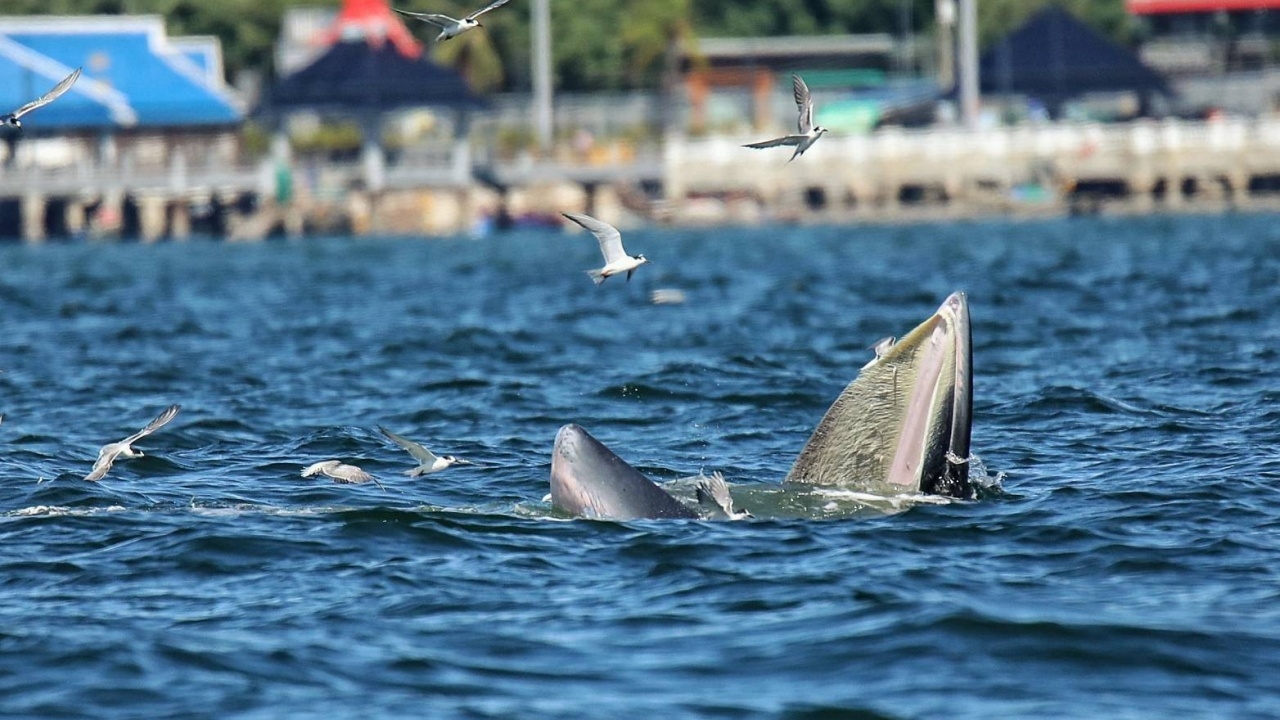
"Bryde's whale pod" found feeding near Bang Saen Beach, with up to 13 seen this year. The largest whale is about the size of a city bus and weighs over one ton.
On 26 June 2026, tourists and boaters near Bang Saen Beach expressed excitement after spotting several Bryde's whales, including calves, swimming and feeding about 2 kilometers offshore in Saen Suk Subdistrict, Mueang District, Chonburi Province, impressing those who witnessed the scene.
Photos showed the Bryde's whales swimming in natural feeding patterns while tourist boats slowed and turned off engines, allowing vessels to drift with the current about 100–150 meters away, following responsible whale-watching guidelines to avoid disturbing the animals.
Mr. Eksak Soemsri (Tai Kao), 50, a shark sea rescue official and owner of the Ploy Pailin Navi 2 boat, reported that this year’s survey found about 13 Bryde's whales in Bang Saen, divided into two groups around Koh Sampanyue north of Koh Si Chang Island, and near Khao Sam Muk, Bang Saen Beach, as well as Ang Sila area.
In the past week, more calves have been spotted, along with whales migrating from other regions, identifiable by distinctive features such as scars on the right tail fin, spotted patterns on the back, and some with barnacles near the tail base. The largest whale this year is about the size of a city bus and weighs over one ton.
Key whale-watching practices include maintaining at least a 100-meter distance and turning off engines when whales approach to prevent engine noise disturbance, as whales rely on Earth's magnetic fields and sonar sound waves for navigation, similar to dolphins.
Currently, local fishing has minimal impact on the whales, but there is concern over nighttime vessel traffic, especially from pair trawlers and commercial fishing boats, since whales rest with half of their brain asleep, increasing the risk of disturbance or accidents from navigation.
Photo credit: Eaksak Soemsri (Tai Kao), Ploy Pailin Navi 2